Suomi
 Svenska
 Polski
 Čeština
 Slovenčina
 Norsk
 Dansk
Yellow-legged Gull
Larus michahellis
Identify the Yellow-legged Gull by sound or photo and log your sightings with Birdpass.


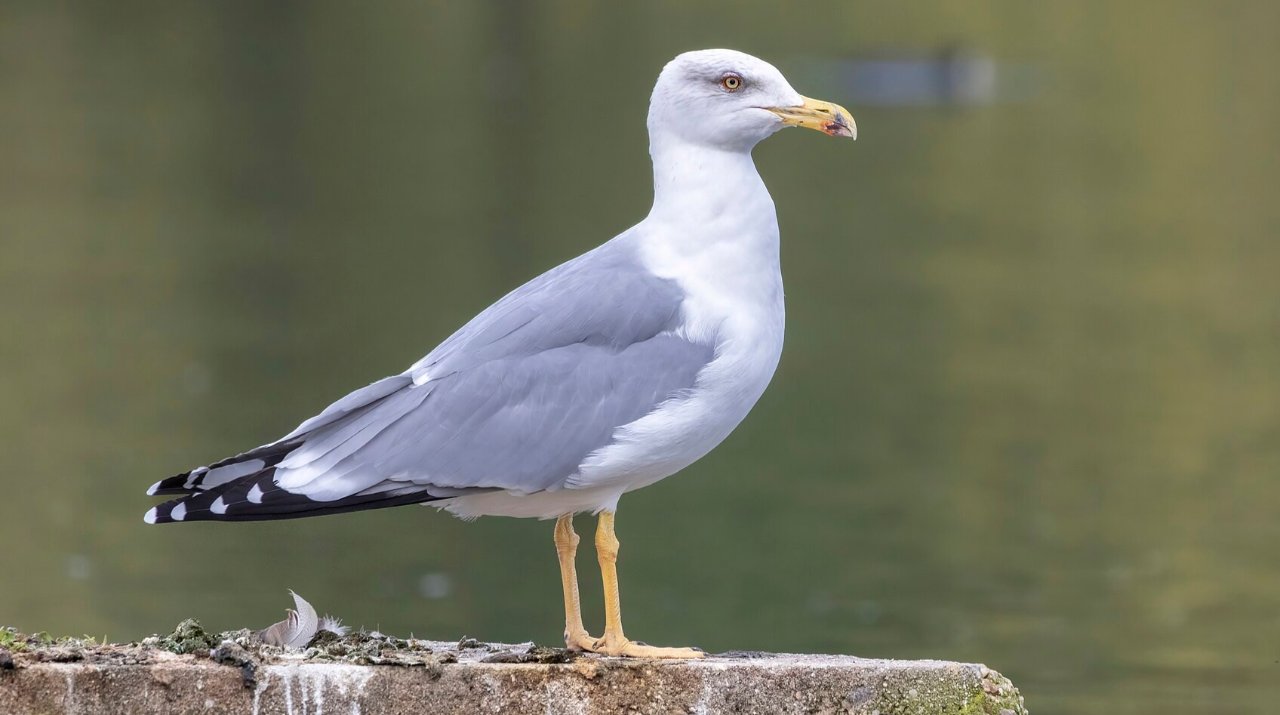
The Yellow-legged Gull is a large gull centred on the Mediterranean, only recently widely accepted as a species separate from the Herring and Caspian Gulls. Adults look like Herring Gulls but have bright yellow legs, a slightly darker grey back and more black in the wingtips. Many birds are resident, while others disperse north after breeding, and in recent decades it has spread into central and western Europe.
Did you know?
- During the 2020 lockdown in Rome, Yellow-legged Gulls switched from scavenging to hunting rats and pigeons.
- Some have been seen plucking olives from trees in flight.
Voice
About the species
Identification
The easiest mark of the adult is its bright yellow legs (greyish-pink in Herring Gull). It is sturdier and heavier-billed than Herring Gull, with a slightly darker grey back and wings and a different pattern of black in the wingtips; in winter the head stays almost white. Young birds are very like young Herring Gulls and require experience to identify.
Family
Laridae
Size
Large (crow)
Colours
white, grey, black, yellow, red
About the habitat
Sea cliffs, rocky coasts, islands, harbours and increasingly towns and cities; breeds around the Mediterranean, on Atlantic coasts and islands and on the western Black Sea, and occurs more widely outside the breeding season.
Diet
Omnivorous and opportunistic: fish, invertebrates, birds and their eggs, rodents, fruit such as olives, and refuse at landfills and harbours; it steals catches from other seabirds.
Behaviour
Usually breeds in colonies, laying about three eggs on the ground, cliff ledges or city roofs, and defends the nest vigorously. Its laughing call is deeper and more nasal than a Herring Gull's. After breeding many birds disperse northwards along Europe's coasts and rivers.
Sources
Photo: Alexis Lours, CC BY 4.0 https://commons.wikimedia.org/wiki/File:Yellow-legged Gull 2023-10-10.jpg
Sound: Cedric MROCZKO, CC BY-SA 4.0 https://commons.wikimedia.org/wiki/File:Yellow-legged_Gull_-_Larus_michahellis_michahellis.ogg
Text: Wikipedia (English), CC BY-SA 4.0 https://en.wikipedia.org/wiki/Yellow-legged_gull