Suomi
 Svenska
 Polski
 Čeština
 Slovenčina
 Norsk
 Dansk
Slaty-backed Gull
Larus schistisagus
Identify the Slaty-backed Gull by sound or photo and log your sightings with Birdpass.


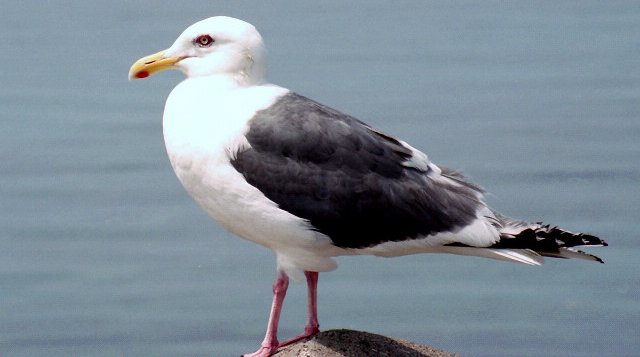
The Slaty-backed Gull is a large, dark-backed gull of the north-western Pacific, breeding mainly in the Russian Far East and northern Japan. It is mostly coastal and wanders widely outside the breeding season, regularly reaching western Alaska and rarely North America further east and Europe. It resembles the Western Gull but has a slate-grey back and a distinctive “string of pearls” pattern on the wingtips.
Did you know?
- On the spread wing, white crescents form a striking “string of pearls” pattern.
- It is one of the few gulls whose range centres on the Sea of Okhotsk.
About the species
Identification
A large, heavy gull with a dark slate-grey back, a white head and underparts, pale eyes, a strong yellow bill with a red spot and pink legs. The wingtips show a row of white spots (“string of pearls”) and a broad white trailing edge. Told from Lesser Black-backed Gull especially by leg colour (yellow in Lesser Black-backed) and from Great Black-backed Gull by its slightly paler back and bold white wing pattern.
Family
Laridae
Size
Very large (swan)
Colours
white, grey, black, yellow, red
About the habitat
Breeds on rocky coasts and offshore islands of the north-western Pacific; outside the breeding season marine coasts, harbours, estuaries and offshore waters.
Diet
Omnivorous: fish and marine invertebrates, carrion, offal and refuse, eggs and chicks; it also steals prey from other birds.
Behaviour
Often follows fishing vessels and forages along coasts and around harbours, loafing on docks, beaches and ice. It breeds in colonies on coastal cliffs and islands. Like many gulls, chicks peck the red spot on the parent's bill to trigger feeding.
Sources
Photo: E-190, CC BY-SA 3.0 https://commons.wikimedia.org/wiki/File:Ooseguro-kamome.jpg
Text: Wikipedia (English) + GBIF regional observations + Wikipedia (Finnish), CC BY-SA 4.0; GBIF occurrence data; Wikipedia: CC BY-SA 4.0 https://en.wikipedia.org/wiki/Slaty-backed_gull