Suomi
 Svenska
 Polski
 Čeština
 Slovenčina
 Norsk
 Dansk
Great Black-backed Gull
Larus marinus
Identify the Great Black-backed Gull by sound or photo and log your sightings with Birdpass.


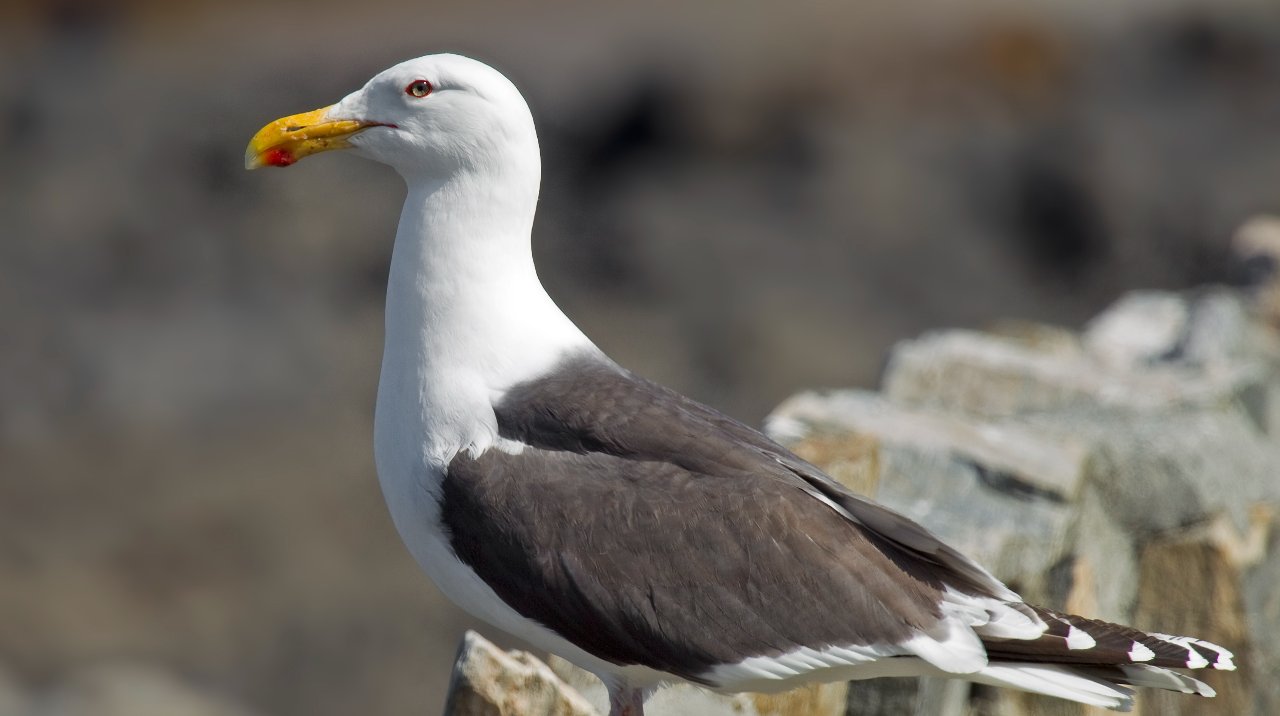
The Great Black-backed Gull is the largest gull in the world, an imposing, heavy-billed seabird of the North Atlantic. A powerful predator, pirate and scavenger, it breeds on coasts and islands of northern Europe and north-eastern North America and in places on large lakes. Adults have a white head and underparts, a blackish back and wings, pink legs and a yellow bill with a red spot. Southern populations are resident, while northern birds move south in winter.
Did you know?
- It is the largest gull species in the world.
- Its call is a deep, laughing “kow-kow-kow” that can start with a low, cow-like note.
Voice
About the species
Identification
The largest gull: the adult has a white head and body, a black back and wings with large white wingtip spots, a heavy yellow bill with a red spot and fleshy pink legs. It is bulkier than Lesser Black-backed and Herring Gulls; Lesser Black-backed has yellow legs and a slimmer build, Herring Gull a grey back. Young birds are chequered brown for their first years and reach adult plumage at about four years; the calls are deeper and more powerful than a Herring Gull's.
Family
Laridae
Size
Very large (swan)
Colours
white, black, yellow, red
About the habitat
Rocky and sandy coasts, outer archipelago skerries and islands, estuaries and large lakes; also harbours and landfills.
Diet
Omnivorous: mainly fish, often stolen from other birds, as well as seabirds and their eggs and chicks, rodents, insects, berries, carrion and refuse.
Behaviour
Bold and dominant, it hunts, scavenges and robs other seabirds of their catch, and raids nests. It breeds from about 4–5 years of age, singly on small, treeless skerries or in small colonies; both adults incubate and fiercely defend the nest. Its deep, laughing call is lower than that of other gulls. It often follows boats and visits harbours and landfills.
Sources
Photo: Andreas Trepte, CC BY-SA 2.5 https://commons.wikimedia.org/wiki/File:Great Black-backed Gull Larus marinus.jpg
Sound: Sonothèque ADVL, XC730806, CC0 1.0 https://xeno-canto.org/730806
Text: Wikipedia (English) + FinBIF species descriptions + Wikipedia (Finnish), CC BY-SA 4.0; FinBIF: CC BY 4.0; Wikipedia: CC BY-SA 4.0 https://en.wikipedia.org/wiki/Great_black-backed_gull