Suomi
 Svenska
 Polski
 Čeština
 Slovenčina
 Norsk
 Dansk
Ruff
Calidris pugnax
Identify the Ruff by sound or photo and log your sightings with Birdpass.


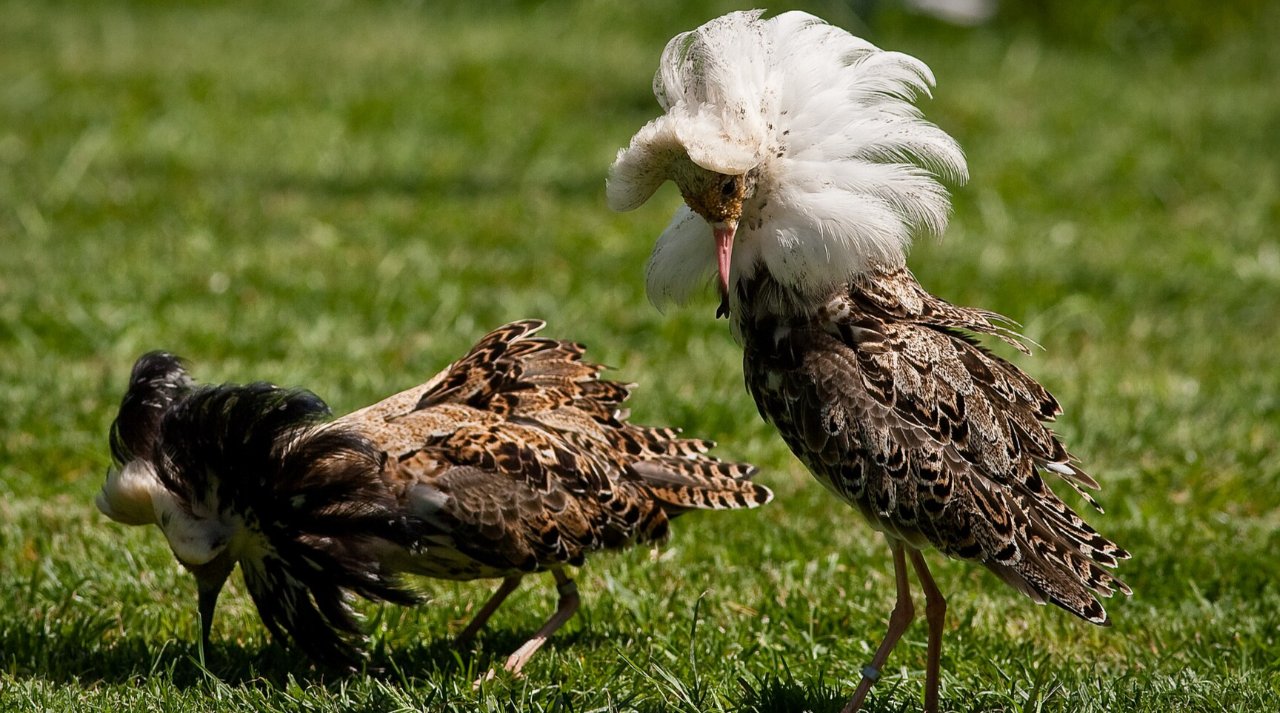
The Ruff is a medium-sized, long-legged wader of northern Eurasian wet meadows and marshes, famous for the male's extravagant breeding plumage and communal courtship. Males are much larger than females (reeves) and grow flamboyant neck ruffs and head tufts in varied colours for displays at leks. Highly migratory, it winters in huge flocks in Africa, and also in southern Europe, southern Asia and Australia. It has declined in parts of Europe due to loss of wet meadows.
Did you know?
- Male Ruffs come in three genetically determined types that use different mating tactics.
- The English name comes from the male's extravagant collar of feathers.
About the species
Identification
A strongly dimorphic wader: in the breeding season males are spectacular, with a thick ruff around the neck in individually varying colours and patterns; females and young are smaller and brownish. The bill is straight, the back and neck have dark patterning, and the wing shows a faint pale bar. White ovals on each side of the base of the tail are characteristic in flight; in winter plumage the overall look is greyer.
Family
Scolopacidae
Size
Medium (thrush)
Colours
brown, white, black, orange
About the habitat
Breeds on wet meadows, sedge fens, marshes, floodplains and boggy tundra; on migration and in winter muddy margins, flooded fields, coastal flats and other shallow wetlands.
Diet
Mainly insects and their larvae, worms, small crustaceans and molluscs, picked and probed from wet grass and soft mud; on migration and in winter also seeds, rice and other plant material.
Behaviour
Strongly migratory and gregarious outside the breeding season. Males gather on leks to display, erecting their ruffs and head tufts; there are three male types – territorial “independents”, pale “satellites” and rare female-mimicking “faeders”. Females visit the leks to mate, then lay about four eggs in a hidden ground nest and raise the chicks alone.
Sources
Photo: Arjan Haverkamp, CC BY 2.0 https://commons.wikimedia.org/wiki/File:Philomachus pugnax -Diergaarde Blijdorp-8c.jpg
Text: Wikipedia (English) + FinBIF species descriptions + GBIF regional observations + Wikipedia (Norwegian), CC BY-SA 4.0; FinBIF: CC BY 4.0; GBIF occurrence data; Wikipedia: CC BY-SA 4.0 https://en.wikipedia.org/wiki/Ruff_(bird)