Suomi
 Svenska
 Polski
 Čeština
 Slovenčina
 Norsk
 Dansk
Least Sandpiper
Calidris minutilla
Identify the Least Sandpiper by sound or photo and log your sightings with Birdpass.


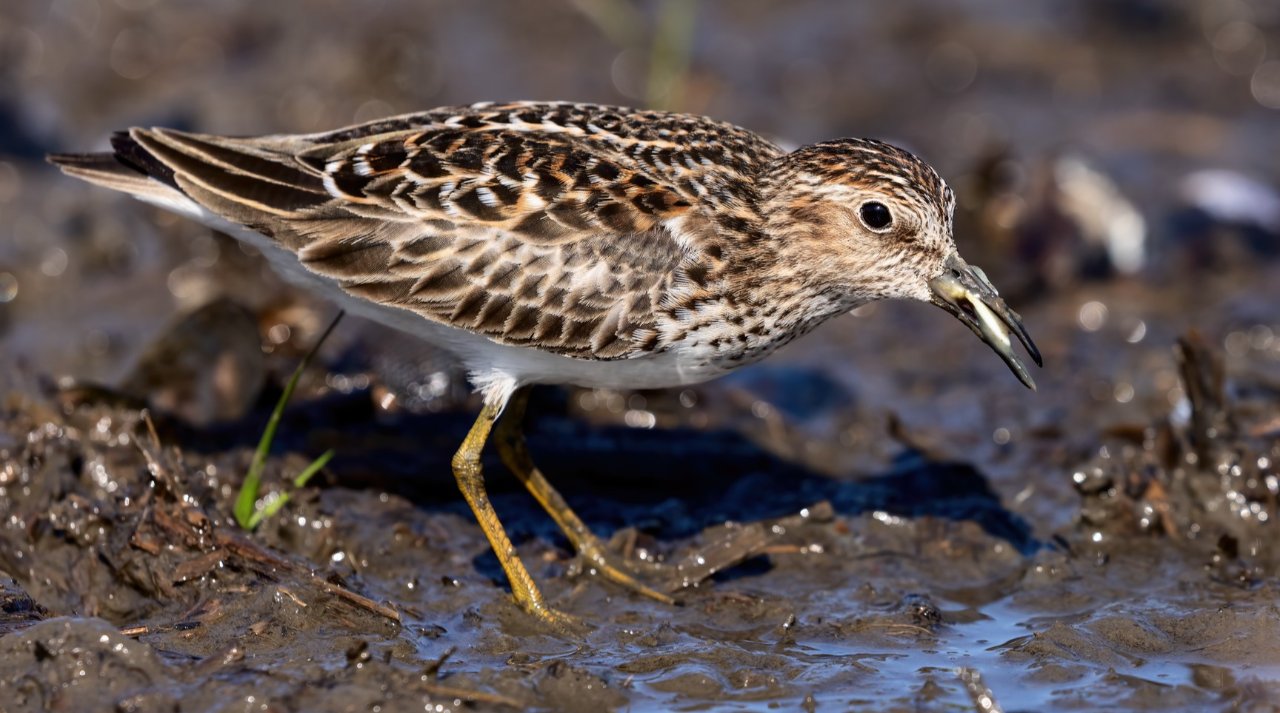
The Least Sandpiper is the world's smallest shorebird, a tiny “peep” with yellow-green legs and a fine, slightly drooping dark bill. It breeds on tundra and bogs of northern North America and migrates in flocks to the southern United States, Central America, the Caribbean and northern South America. It is an extreme rarity in Europe.
Did you know?
- It is the smallest shorebird in the world.
- The chicks feed themselves and can fly within about two weeks of hatching.
About the species
Identification
A very small wader with yellowish legs and a short, thin dark bill. The upperparts are brown-mottled, the breast brownish and the belly pale; the sexes are alike. Its yellowish legs and tiny size help separate it from similar black-legged stints.
Family
Scolopacidae
Size
Small (sparrow)
Colours
brown, white, yellow, grey
About the habitat
Breeds on tundra and bogs; outside the breeding season muddy shorelines, marsh edges and mudflats.
Diet
Small invertebrates such as tiny crustaceans, insects and snails; on migration also worms and horseshoe-crab eggs.
Behaviour
Forages on mudflats and vegetated margins by picking from the surface and sometimes probing, often crouched. Migrates in flocks. Nests on the ground near water; both parents incubate, but the female often leaves before the young fledge. The chicks feed themselves and can fly within about two weeks.
Sources
Photo: Charles Homler d/b/a FocusOnWildlife, CC BY-SA 4.0 https://commons.wikimedia.org/wiki/File:Least Sandpiper Foraging.png
Text: Wikipedia (English), CC BY-SA 4.0 https://en.wikipedia.org/wiki/Least_sandpiper