Suomi
 Svenska
 Polski
 Čeština
 Slovenčina
 Norsk
 Dansk
Red-necked Stint
Calidris ruficollis
Identify the Red-necked Stint by sound or photo and log your sightings with Birdpass.


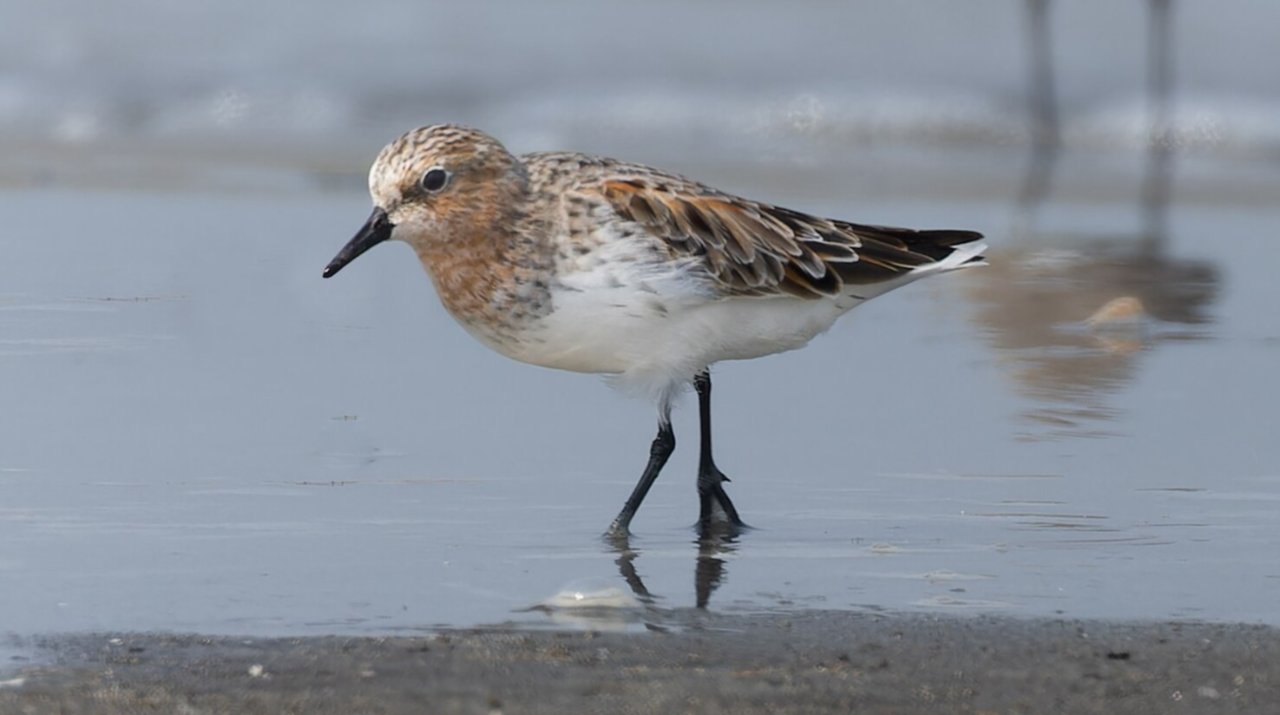
The Red-necked Stint is a tiny wader that breeds on low Arctic tundra in north-eastern Siberia and winters on coasts of South-East Asia and Australasia, south to Tasmania and New Zealand. In breeding plumage it has a warm orange-red neck and a neat white V on the back; in other plumages it closely resembles the Little Stint. Highly gregarious, it often gathers in mixed flocks on mudflats. It is an extreme rarity in Europe.
Did you know?
- Its call is a hoarse “stit”.
- Its closest relative within Calidris is the Spoon-billed Sandpiper.
About the species
Identification
A very small stint (12–14 cm) with dark legs and an elongated body. The bill tip is fine, and there is no webbing between the toes. In breeding plumage the neck, nape and upper breast are rusty-red, and its movements are restless. Winter birds are very like Little Stint, but have a shorter bill and longer wings.
Family
Scolopacidae
Size
Small (sparrow)
Colours
brown, grey, white, orange
About the habitat
Breeds on low Arctic tundra, usually on dry, raised ground; outside the breeding season coastal mudflats and muddy lake edges.
Diet
Mainly insects and other small invertebrates, picked by sight from wet grass and soft mud; in winter from intertidal mudflats and lake margins.
Behaviour
Strongly migratory and very social, often in flocks with other small sandpipers. It moves restlessly while feeding. It nests in a shallow scrape on the tundra; both parents incubate, but after hatching the female leaves and the male cares for the chicks. The call is a hoarse “stit”.
Sources
Photo: Tisha Mukherjee, CC BY-SA 4.0 https://commons.wikimedia.org/wiki/File:Red-necked Stint in Bakkhali April 2026 by Tisha Mukherjee 01.jpg
Text: Wikipedia (English), CC BY-SA 4.0 https://en.wikipedia.org/wiki/Red-necked_stint