
 Suomi
 Svenska
 Polski
 Čeština
 Slovenčina
 Norsk
 Dansk
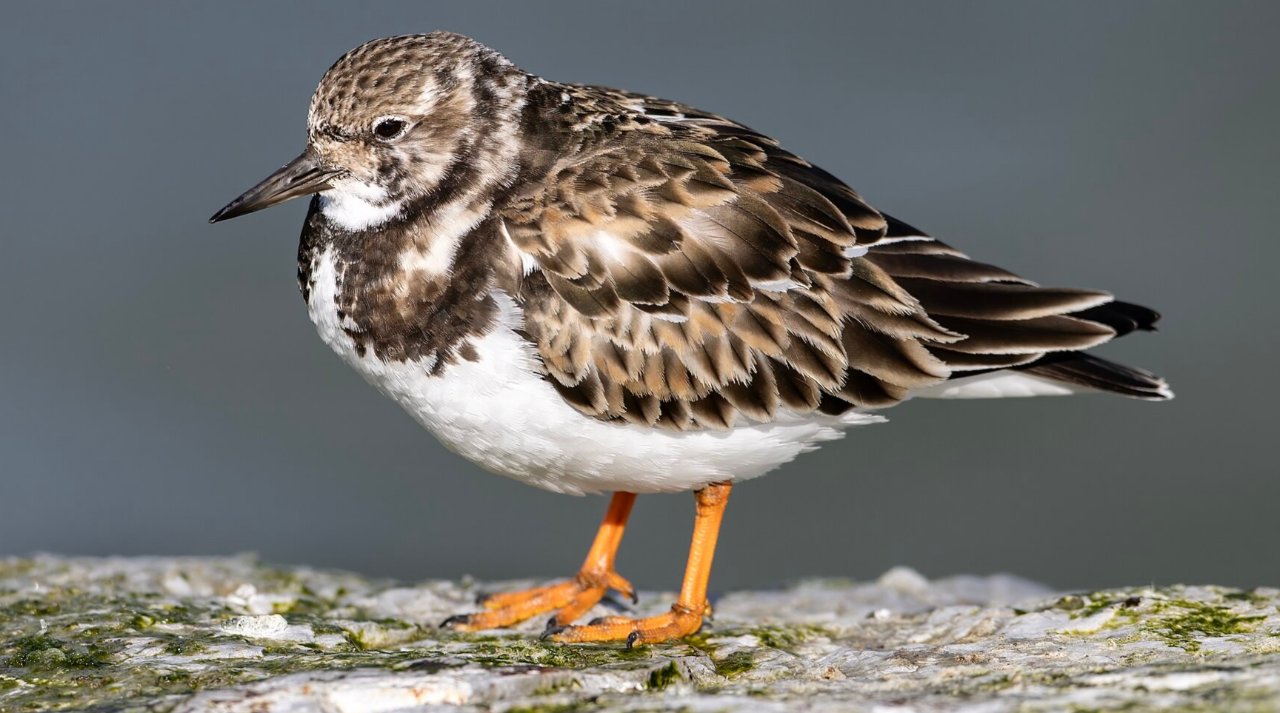
Ruddy Turnstone
Arenaria interpres
Identify the Ruddy Turnstone by sound or photo and log your sightings with Birdpass.


The Ruddy Turnstone is a small, stocky, boldly patterned shorebird with bright orange legs. It breeds on high-latitude coasts, islets and tundra of Eurasia and North America and migrates to winter on shorelines across much of the world. It is a familiar sight on beaches and rocky shores, busily flipping stones and seaweed as it feeds, and is known for its loud, chattering calls.
Did you know?
- It gets its name from its habit of flipping stones, shells and seaweed to uncover hidden prey.
- Ruddy Turnstones recognise individual neighbours by their unique plumage patterns.
Voice
About the species
Identification
A stocky wader with a striking black, white and orange-rufous pattern in breeding plumage; the legs are bright orange and the bill shortish and slightly upturned. The black-and-white head pattern is sharper in breeding males, but the sexes look alike. The call is a sharp, chattering series. In flight it shows a bold black-and-white pattern on wings, back and tail. Its patchwork plumage and orange legs separate it from other waders.
Family
Scolopacidae
Size
Medium (thrush)
Colours
orange, black, white, brown
About the habitat
Breeds on treeless coastal plains, islets and Arctic tundra, often near tern and gull colonies. Outside the breeding season it is mostly coastal – rocky shores, beaches, tidal flats and harbours – with migrants sometimes on inland lakes.
Diet
Mainly invertebrates: insects and their larvae on the breeding grounds, and crustaceans, molluscs, worms and spiders elsewhere; it also scavenges carrion and scraps and takes the eggs of other birds, especially terns.
Behaviour
Forages actively along shorelines, turning over stones, shells and seaweed, probing and even hammering to reach prey; social dominance influences which tactics individuals use. Migrates and winters in social flocks. When breeding it is monogamous and territorial, scolding loudly near the nest, and it often nests among tern or gull colonies.
Sources
Photo: Chuck Homler d/b/a Focus On Wildlife, CC BY-SA 4.0 https://commons.wikimedia.org/wiki/File:Ruddy Turnstone (Arenaria interpres), winter plumage, Barnegat Inlet, Ocean County, New Jersey, USA.jpg
Sound: Sonothèque ADVL, XC730512, CC0 1.0 https://xeno-canto.org/730512
Text: Wikipedia (English) + FinBIF species descriptions + Wikipedia (Finnish), CC BY-SA 4.0; FinBIF: CC BY 4.0; Wikipedia: CC BY-SA 4.0 https://en.wikipedia.org/wiki/Ruddy_turnstone
, winter plumage, Barnegat Inlet, Ocean County, New Jersey, USA.jpg)