Suomi
 Svenska
 Polski
 Čeština
 Slovenčina
 Norsk
 Dansk
Spotted Sandpiper
Actitis macularius
Identify the Spotted Sandpiper by sound or photo and log your sightings with Birdpass.


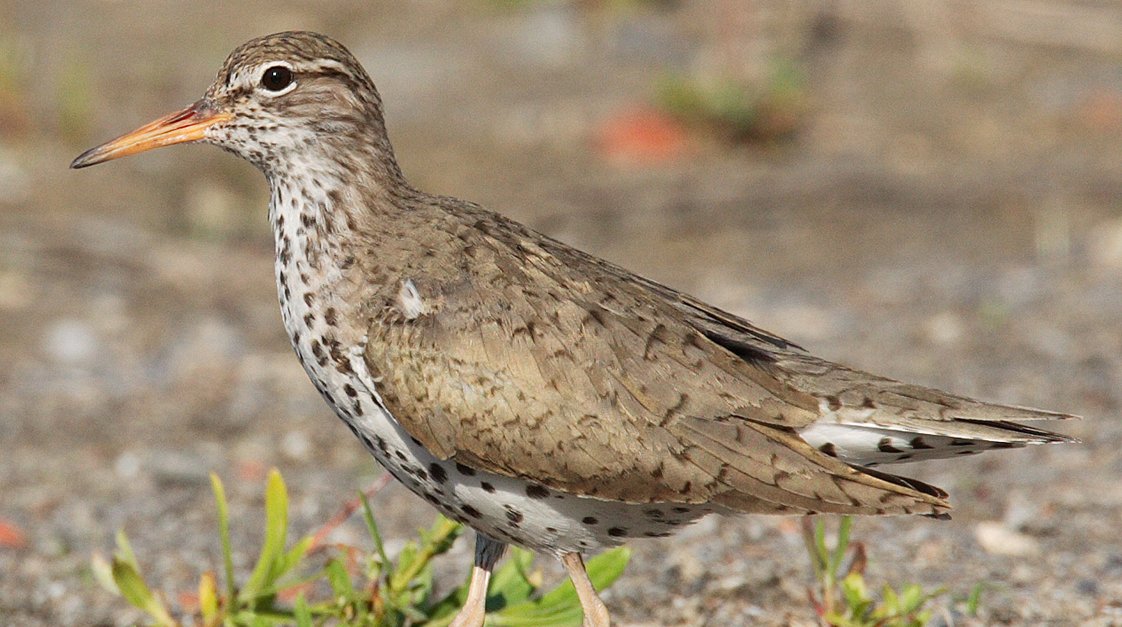
The Spotted Sandpiper is a small North American shorebird, brown above and white below, with bold dark spots on the underparts in breeding plumage. It is famed for its constant tail-bobbing walk and stiff-winged, low flight over water. It breeds near fresh water across much of Canada and the United States and winters from the southern United States to South America, occasionally straying to Europe. Unusually, females often compete for mates while males take the lead in incubation and chick-rearing.
Did you know?
- In a striking role reversal, females may mate with several males in a season while the males do most of the incubation and chick care.
- It is the New World sister species of the Common Sandpiper, and the two can hybridise where vagrants meet local breeders.
Voice
About the species
Identification
Head and back plain brown; breast and belly white with scattered brown spots in breeding plumage. The eye is dark, the bill orange with a dark tip and the legs fairly long and yellowish. Non-breeding birds lack the spots and are very similar to Common Sandpiper. Easy to recognise by its bobbing, wagtail-like movements along the shore.
Family
Scolopacidae
Size
Small (sparrow)
Colours
brown, white, black, orange
About the habitat
Breeds near fresh water – riverbanks and lake and pond edges – often where some vegetation offers cover. In winter it uses shores and wetlands from the southern United States through the Caribbean to South America.
Diet
Forages by sight along shores and in shallow water, picking prey from the surface or snapping insects from the air: flies, beetles, mayflies, midges, caterpillars, spiders, snails, worms, small crustaceans and small fish.
Behaviour
Usually seen singly, walking with a teetering motion and constantly bobbing its rear end. Flies low over water with stiff, shallow wingbeats. In the breeding season females arrive first and defend territories, and may mate with several males, which do most of the incubation and chick care.
Sources
Photo: Factumquintus, CC BY-SA 3.0 https://commons.wikimedia.org/wiki/File:Actitis-macularia-005.jpg
Sound: Unknown authorUnknown author, Public domain https://commons.wikimedia.org/wiki/File:Spotted_Sandpiper.ogg
Text: Wikipedia (English) + GBIF regional observations + Wikipedia (Norwegian), CC BY-SA 4.0; GBIF occurrence data; Wikipedia: CC BY-SA 4.0 https://en.wikipedia.org/wiki/Spotted_sandpiper