Suomi
 Svenska
 Polski
 Čeština
 Slovenčina
 Norsk
 Dansk
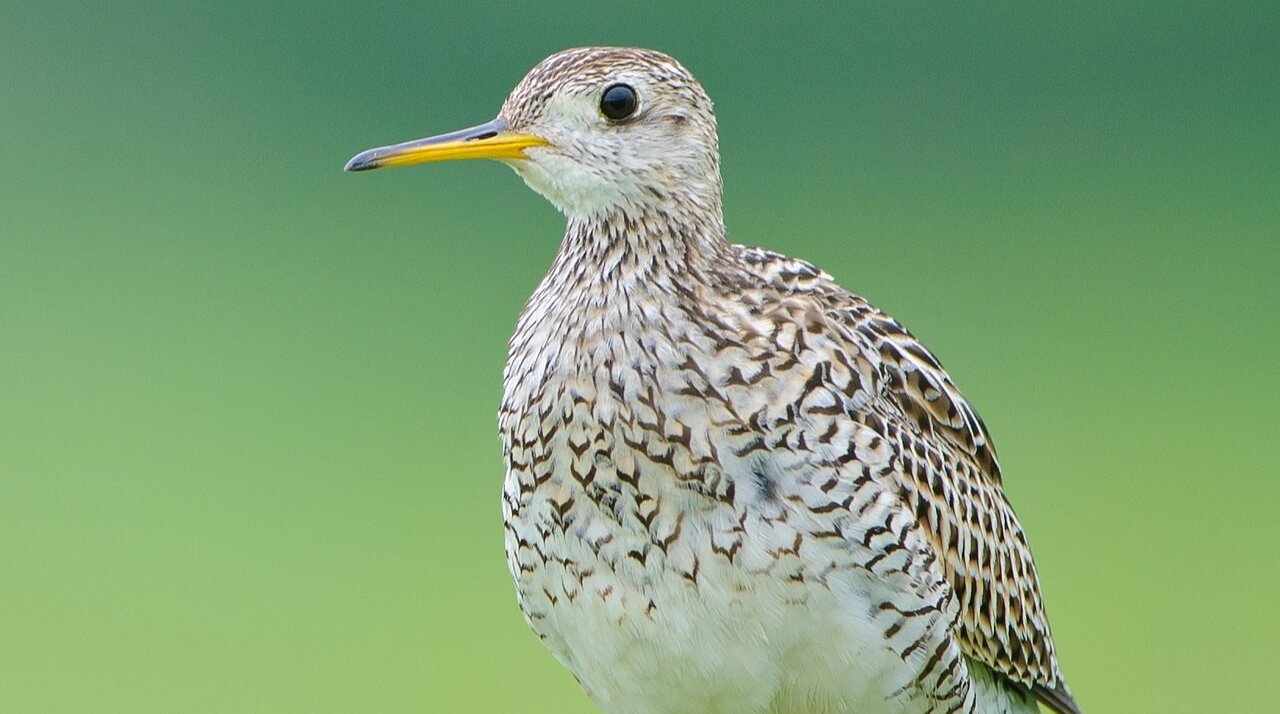
Upland Sandpiper
Bartramia longicauda
Identify the Upland Sandpiper by sound or photo and log your sightings with Birdpass.


The Upland Sandpiper is a slender, long-tailed shorebird of dry grasslands rather than shores. It breeds across the prairies and fields of interior North America and migrates to southern South America for the winter. It has a small, dove-like head on a thin neck and often perches on fence posts, giving a far-carrying, whistled call. It is an exceptional vagrant to Europe.
Did you know?
- Its genus name honours the naturalist William Bartram.
- Its whistled call, like a “wolf whistle”, often rings out from high in the air.
Voice
About the species
Identification
A medium-sized wader (26–28 cm) with long yellow legs, a relatively long tail and a fairly short bill on a small, dove-like head with a large dark eye. The upperparts are intricately mottled brown and the underparts pale. The sexes are alike. It is often seen perched conspicuously on posts.
Family
Scolopacidae
Size
Medium (thrush)
Colours
brown, white, grey, black
About the habitat
Open grassland – native prairie, pastures, hayfields and airfields; unusually for a sandpiper, it largely avoids coasts.
Diet
Mainly insects and other invertebrates taken by sight in fields – grasshoppers, crickets, beetles, ants, spiders, snails and earthworms – supplemented by some seeds and grain.
Behaviour
Forages by walking through grass and picking prey from the ground or low vegetation. Often stands very upright and perches on posts, poles or even treetops to watch over its territory; on landing it briefly holds its wings raised. It nests on the ground, both parents tend the young and use distraction displays against predators.
Sources
Photo: Johnath, CC BY-SA 3.0 https://commons.wikimedia.org/wiki/File:UplandSandpiperOntarioCropped.jpg
Sound: Jonathon Jongsma, XC104531, CC BY-SA 3.0 https://xeno-canto.org/104531
Text: Wikipedia (English) + GBIF regional observations + Wikipedia (Finnish), CC BY-SA 4.0; GBIF occurrence data; Wikipedia: CC BY-SA 4.0 https://en.wikipedia.org/wiki/Upland_sandpiper