
 Suomi
 Svenska
 Polski
 Čeština
 Slovenčina
 Norsk
 Dansk
Sharp-tailed Sandpiper
Calidris acuminata
Identify the Sharp-tailed Sandpiper by sound or photo and log your sightings with Birdpass.


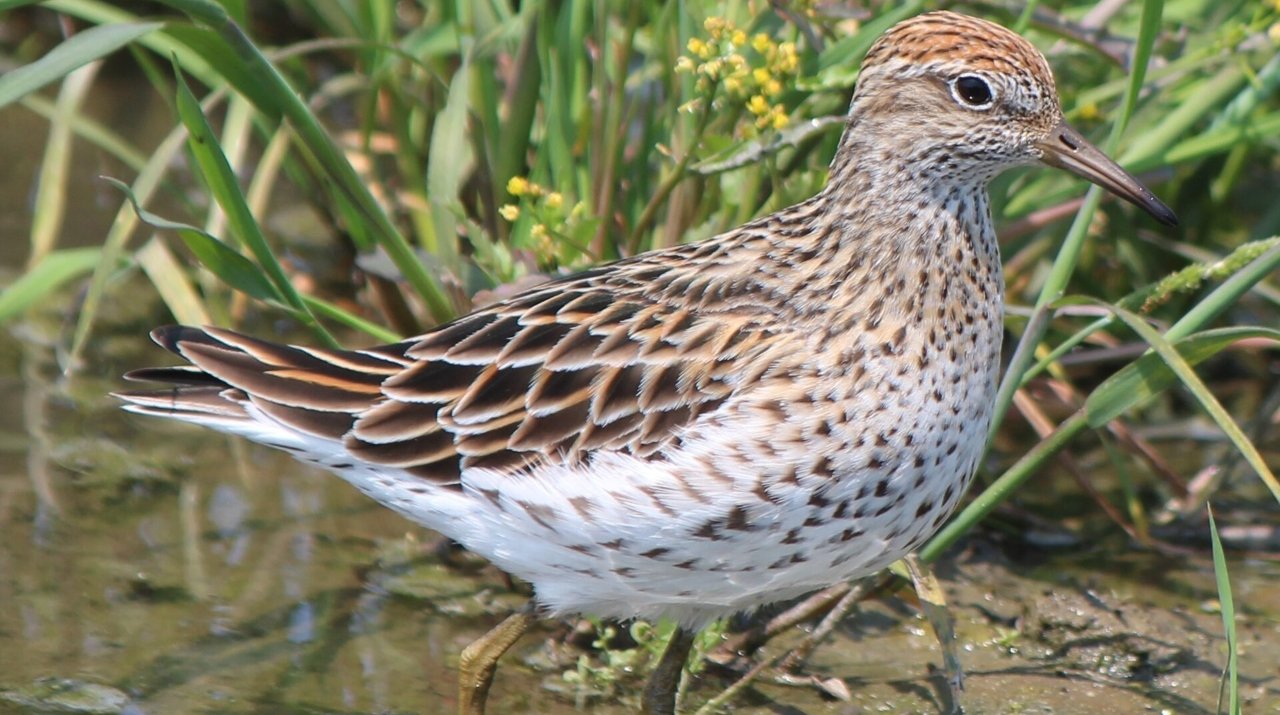
The Sharp-tailed Sandpiper is a small to medium wader that breeds on the tundra of north-eastern Siberia and winters mainly in Australia and elsewhere in Australasia. It has a chestnut cap, a strong pale eyebrow and a warm, finely marked breast; juveniles in autumn are especially bright. It resembles Pectoral Sandpiper but lacks a sharply defined breast band. It is declining and listed as Vulnerable due to wetland loss along its flyway.
Did you know?
- Some juveniles are believed to fly non-stop over 10,000 km across the Pacific from Alaska to Australasia.
- In autumn juveniles are brighter than adults, with a richer chestnut cap.
About the species
Identification
A smallish sandpiper with a fairly short, slightly drooping bill and yellowish-green legs. Juveniles show a rusty cap, a clear pale supercilium and a warm brown, finely streaked breast, with dark-centred, pale-fringed feathers on the back. The tail looks pointed. It is easily confused with Pectoral Sandpiper, but in Sharp-tailed the border between breast and belly is soft, the cap distinctly rufous and the overall tone warmer.
Family
Scolopacidae
Size
Medium (thrush)
Colours
brown, white, grey
About the habitat
Breeds on hummocky and lichen tundra; on migration and in winter muddy margins of shallow fresh or brackish wetlands with grass and sedges, lagoons, flooded fields and coastal mudflats.
Diet
Mainly aquatic insects and their larvae, molluscs, crustaceans and worms, picked by sight and sometimes probed from soft mud; occasionally seeds.
Behaviour
A long-distance migrant; many juveniles travel via Alaska, and adults leave earlier than juveniles. It forages on wet margins and mudflats, often moving between tidal flats and freshwater wetlands. On the breeding grounds it nests in a shallow, lined scrape; the female incubates the usual four eggs and raises the chicks alone.
Sources
Photo: Alpsdake, CC BY-SA 4.0 https://commons.wikimedia.org/wiki/File:Calidris acuminata (s4).JPG
Text: Wikipedia (English) + GBIF regional observations + Wikipedia (Finnish), CC BY-SA 4.0; GBIF occurrence data; Wikipedia: CC BY-SA 4.0 https://en.wikipedia.org/wiki/Sharp-tailed_sandpiper
.JPG)