Suomi
 Svenska
 Polski
 Čeština
 Slovenčina
 Norsk
 Dansk
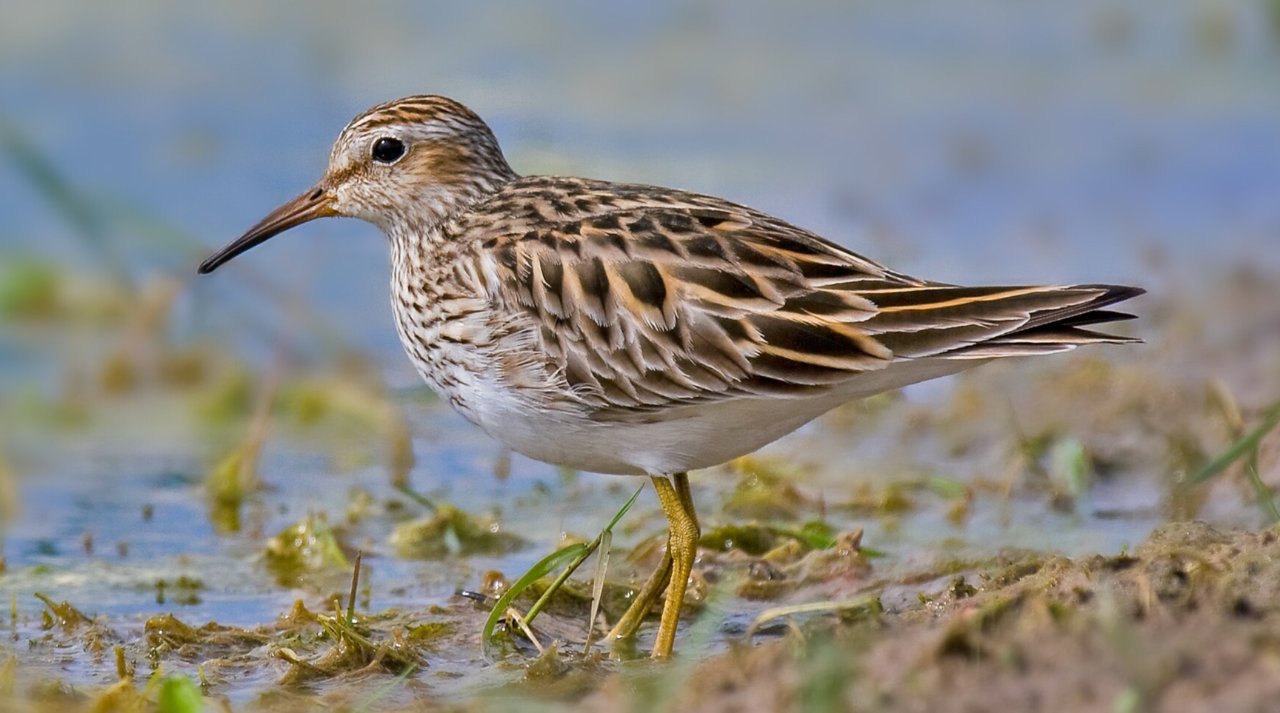
Pectoral Sandpiper
Calidris melanotos
Identify the Pectoral Sandpiper by sound or photo and log your sightings with Birdpass.


The Pectoral Sandpiper is a medium-small sandpiper that breeds on the Arctic tundra of North America and Siberia and migrates astonishing distances to winter mainly in South America, but also in Australia and New Zealand. It is named for its dark-streaked breast that ends abruptly against a clean white belly. It is a regular vagrant to western and northern Europe, mainly in autumn. Its population has declined by about half since the 1970s.
Did you know?
- During courtship, males inflate their breasts using a temporary fat sac.
- “Cox's Sandpiper”, once described as a separate species, is a hybrid between Pectoral and Curlew Sandpipers.
Voice
About the species
Identification
A smallish, brown-mottled wader (19–24 cm). The streaked breast is sharply cut off from the white belly; the rest of the plumage is scaly brown and the legs yellowish. The combination of yellowish legs and a crisp breast band separates it from similar-sized sandpipers; it lacks the white rump of White-rumped Sandpiper.
Family
Scolopacidae
Size
Medium (thrush)
Colours
brown, white, black, yellow
About the habitat
Breeds on wet tundra, sedge meadows and polygon mires. On migration and in winter wet meadows, marshes, flooded fields and muddy shorelines.
Diet
Mainly insects and their larvae, spiders and small crustaceans, picked and probed from wet soil, shallow water and damp grass; also seeds.
Behaviour
Feeds by steady walking and pecking or probing along muddy margins and in wet grass, alone or in small groups. On the breeding grounds males display by inflating their chests with a special fat-filled sac and giving low, hooting calls. The female lays four eggs in a deep, well-lined scrape and raises the young alone.
Sources
Photo: Andreas Trepte, CC BY-SA 2.5 https://commons.wikimedia.org/wiki/File:Pectoral Sandpiper3.jpg
Sound: Niels Krabbe, CC BY-SA 4.0 https://commons.wikimedia.org/wiki/File:Calidris_melanotos_-_Pectoral_Sandpiper_XC250563.mp3
Text: Wikipedia (English) + GBIF regional observations + Wikipedia (Finnish) + GBIF regional observations + Wikipedia (Norwegian), CC BY-SA 4.0; GBIF occurrence data; Wikipedia: CC BY-SA 4.0 https://en.wikipedia.org/wiki/Pectoral_sandpiper