
 Suomi
 Svenska
 Polski
 Čeština
 Slovenčina
 Norsk
 Dansk
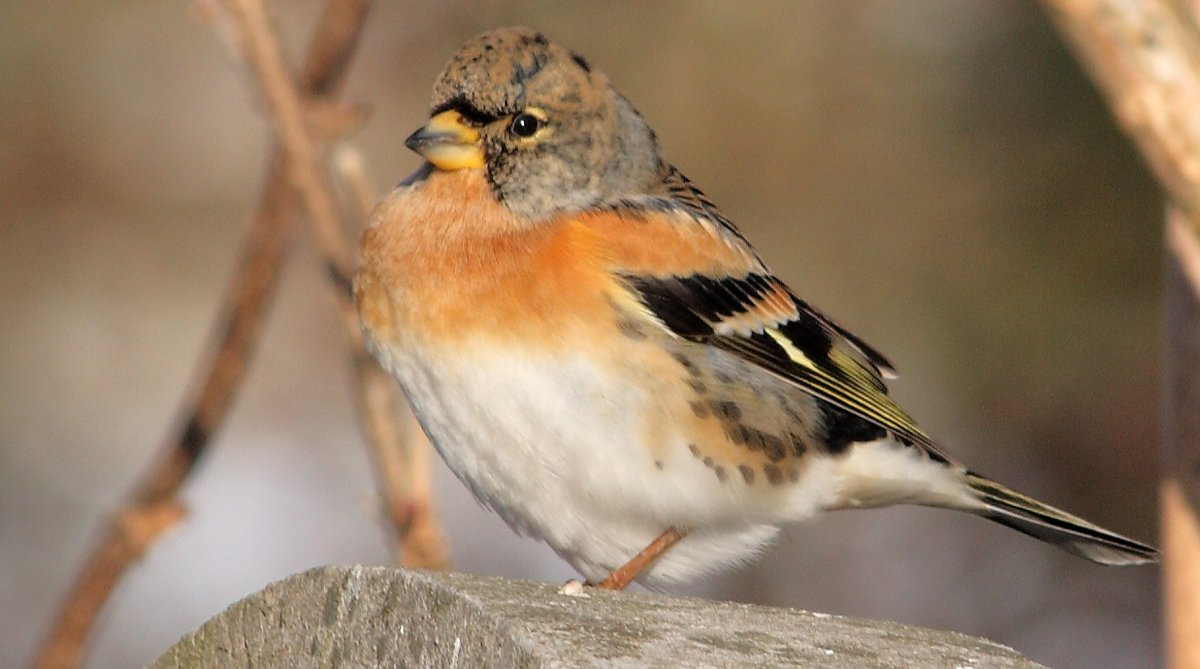
Brambling
Fringilla montifringilla
Identify the Brambling by sound or photo and log your sightings with Birdpass.


The Brambling is a migratory finch that breeds in the forests of northern Europe and across the Palearctic and winters further south in Europe, North Africa and Asia. Breeding males have a black head, bright orange breast and shoulders and a white belly, while females are more muted. In all plumages its white rump separates it from the similar Chaffinch. In winter it can gather in immense wandering flocks where seeds are plentiful.
Did you know?
- In good beech mast years winter flocks can number in the millions.
- Despite the name, “brambling” has nothing to do with brambles; the word's origin is uncertain.
Voice
About the species
Identification
A clear white rump, visible in flight, separates it from Chaffinch. In summer the male's head, nape and back are black and the breast rusty orange; in winter the male is duller and the bill yellowish with a black tip. The female is grey-brown above with a buff-orange breast. The call is a nasal “dzwee” and a short, hard “yek”; the song is a short, monotonous buzz like a Greenfinch's.
Family
Fringillidae
Size
Small (sparrow)
Colours
orange, black, white, brown
About the habitat
Breeds in open birch and coniferous forest in the boreal and subarctic zones; in winter beech and mixed woods, farmland, stubble fields and gardens.
Diet
Outside the breeding season mainly seeds, especially beech mast, as well as birch, alder and weed seeds; in summer mostly insects such as caterpillars. It also visits feeders.
Behaviour
Highly migratory and gregarious outside the breeding season; its movements track seed availability, so winter numbers vary greatly from year to year. It feeds mostly on the ground under trees or in fields, often with other finches. The female builds a neat, well-camouflaged nest of lichens, grass, bark and cobwebs high in a tree against the trunk, and both parents feed the young.
Sources
Photo: Dunpharlain, CC BY-SA 4.0 https://commons.wikimedia.org/wiki/File:Brambling (Fringilla montifringilla).jpg
Sound: Alexander Kurthy, XC108349, CC BY-SA 4.0 https://xeno-canto.org/108349
Sound: Sonothèque ADVL, XC707500, CC0 1.0 https://xeno-canto.org/707500
Text: Wikipedia (English) + FinBIF species descriptions, CC BY-SA 4.0; FinBIF: CC BY 4.0 https://en.wikipedia.org/wiki/Brambling
.jpg)