Suomi
 Svenska
 Polski
 Čeština
 Slovenčina
 Norsk
 Dansk
Common Linnet
Linaria cannabina
Identify the Common Linnet by sound or photo and log your sightings with Birdpass.


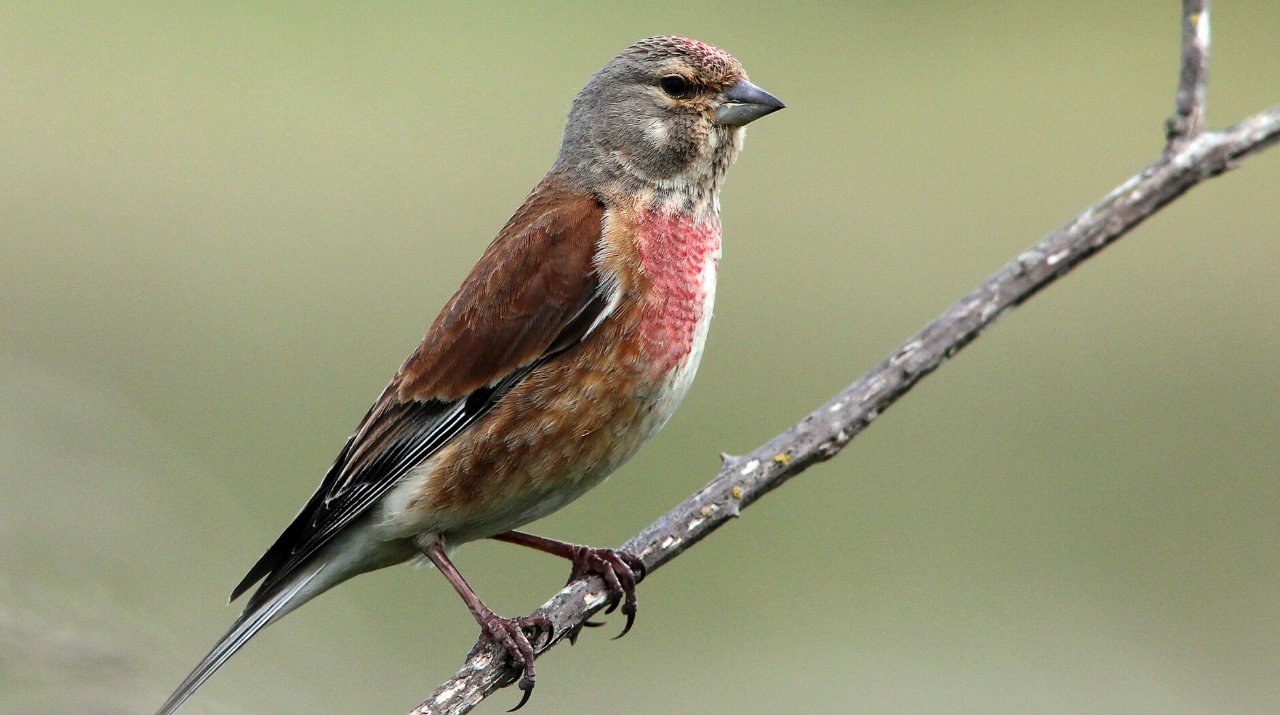
The Common Linnet is a slim, long-tailed finch of open country across Europe, the western Palearctic and North Africa. Summer males have a crimson forehead and breast on a grey head, while females and young are brown and streaked. It eats small seeds – its names come from its fondness for flax and hemp seeds – and sings a lively song of fast trills and twitters. It has declined in parts of Europe with intensive agriculture.
Did you know?
- Its English and scientific names come from its fondness for flax and hemp seeds.
- It was once a popular cage bird for its lively song.
Voice
About the species
Identification
A small finch. The breeding male has a bright red breast and a red forehead patch on a grey head, a chestnut back, a pale belly and a white wing stripe; all plumages show white edges to the tail. The female is grey-brown with a pale belly and also has a white wing stripe; young birds resemble the female but are more streaked. Told from redpolls by the lack of a black chin, and from Twite by the male's red and the grey bill. The song is a cheerful warble from a high perch; the call a sharp “tet-tet”.
Family
Fringillidae
Size
Small (sparrow)
Colours
brown, grey, red, white
About the habitat
Open landscapes with scattered shrubs and hedges – farmland, field margins, heathland, coastal dunes, clear-cuts and gardens.
Diet
Mainly small seeds taken on the ground and in low vegetation, especially from weeds such as knotgrass, docks, crucifers, chickweed, dandelion and thistles; chicks are also fed seeds, with some insects.
Behaviour
Feeds on the ground and in low weedy vegetation, often in flocks outside the breeding season, sometimes with other finches. Males sing a fast, musical song from bushes, wires and fences. It nests low in dense shrubs such as juniper or gorse, laying four to seven eggs. Many populations are partly migratory, often gathering on coasts in winter.
Sources
Photo: Joe Pell, CC BY 2.0 https://commons.wikimedia.org/wiki/File:Carduelis cannabina -England -male-8.jpg
Sound: Sonothèque ADVL, XC730819, CC0 1.0 https://xeno-canto.org/730819
Sound: Ryan Hodnett, CC BY-SA 4.0 https://commons.wikimedia.org/wiki/File:Bird_Call_-_Muro,_Spain_2022-04-18_(03).mp3
Sound: Sonothèque ADVL, XC918551, CC0 1.0 https://xeno-canto.org/918551
Text: Wikipedia (English) + FinBIF species descriptions, CC BY-SA 4.0; FinBIF: CC BY 4.0 https://en.wikipedia.org/wiki/Common_linnet