Suomi
 Svenska
 Polski
 Čeština
 Slovenčina
 Norsk
 Dansk
Black Stork
Ciconia nigra
Identify the Black Stork by sound or photo and log your sightings with Birdpass.


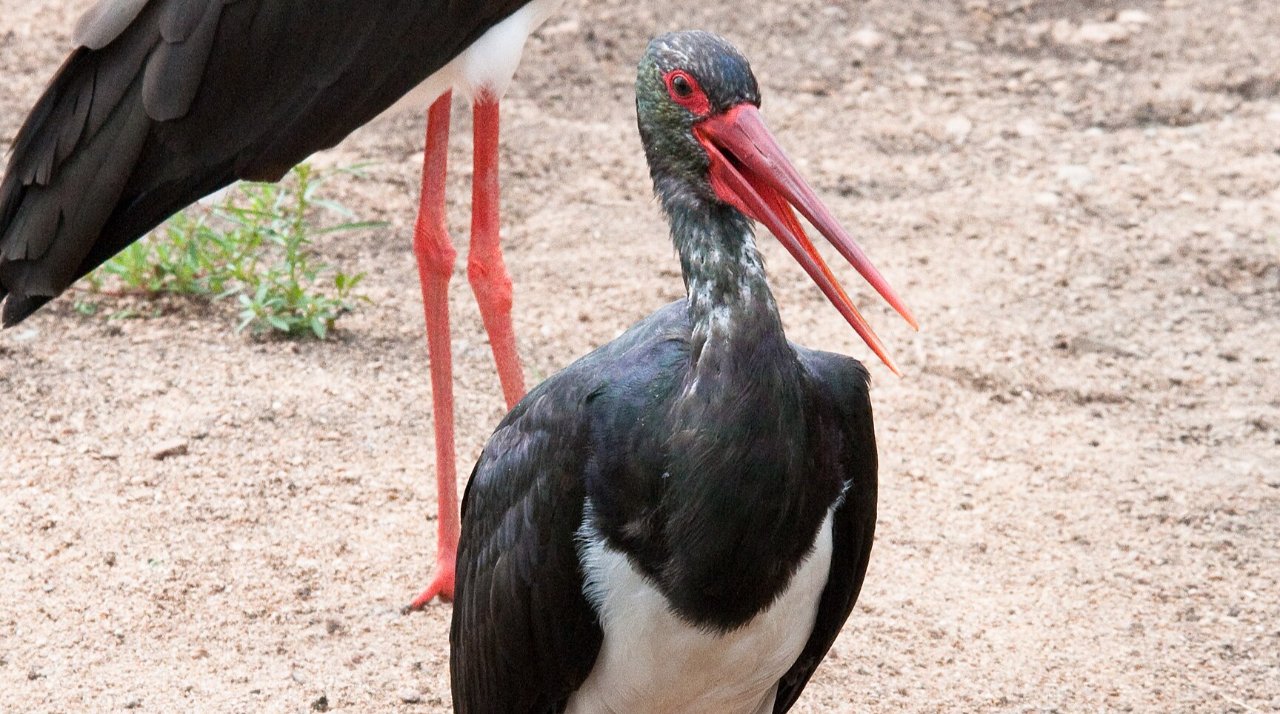
The Black Stork is a large, shy stork with glossy black plumage, a white belly and long red legs and bill. An uncommon breeder from Europe across the Palearctic to the Pacific, it lives in quiet forested wetlands and river valleys and winters in sub-Saharan Africa and the Indian subcontinent. Unlike the White Stork, it avoids people and nests deep in forests or on remote cliffs.
Did you know?
- On migration it avoids the open Mediterranean, crossing at Gibraltar, Sicily or via the Levant.
- Pairs often reuse the same large stick nest for many years.
About the species
Identification
A large, slim stork: adults are almost entirely glossy black with a metallic green-purple sheen and a white belly; the bill and legs are red. In flight it shows broad black wings, a white belly and outstretched neck. Juveniles are dull brown with greenish-brown bill and legs. Told from White Stork by its dark plumage contrasting with the white belly.
Family
Ciconiidae
Size
Very large (swan)
Colours
black, white, red, green
About the habitat
Quiet, extensive wetlands in or near large forests – river floodplains, marshes, forest streams and pools – away from human disturbance.
Diet
Mainly fish and amphibians, as well as aquatic insects, crustaceans, small reptiles and occasionally small mammals, caught by wading slowly in shallow water.
Behaviour
Usually solitary or in pairs; wades slowly in streams and pools, striking at prey. A strong soarer on thermals. Pairs build large stick nests high in old trees or on cliff ledges and often reuse them for years; both parents incubate and rear the chicks. On migration it avoids the open sea, crossing at narrow straits.
Sources
Photo: Chris Eason, CC BY 2.0 https://commons.wikimedia.org/wiki/File:Ciconia nigra -Kruger National Park-8.jpg
Text: Wikipedia (English) + FinBIF species descriptions, CC BY-SA 4.0; FinBIF: CC BY 4.0 https://en.wikipedia.org/wiki/Black_stork