Suomi
 Svenska
 Polski
 Čeština
 Slovenčina
 Norsk
 Dansk
Glossy Ibis
Plegadis falcinellus
Identify the Glossy Ibis by sound or photo and log your sightings with Birdpass.


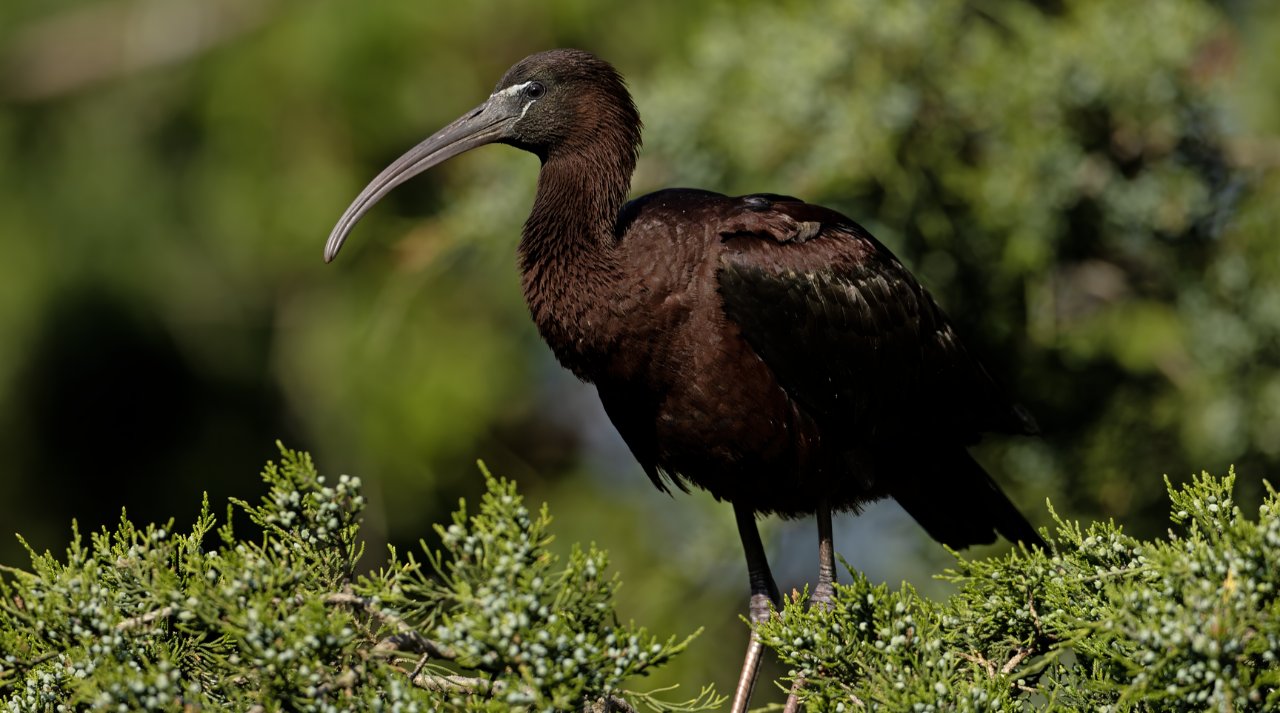
The Glossy Ibis is a slim, dark ibis with a long, down-curved bill and chestnut plumage with a bronze-green and purple gloss. It is the most widespread ibis, breeding in warm regions of Europe, Asia, Africa, Australia and the Americas, and many populations migrate or disperse widely. It nests in colonies in vegetated wetlands and has recovered in parts of Europe.
Did you know?
- Its scientific name means “little sickle”.
- Its gloss varies with the light, so it can look black at a distance.
Voice
About the species
Identification
A medium-sized, dark ibis whose plumage glistens bronze and green; it has a long, down-curved bill and long legs. In the breeding season thin pale lines border the bare face. In flight the neck and legs are outstretched and the wings lack pale markings; it differs from curlews, which are mottled brown and lack a metallic sheen, and from herons, which fly with a folded neck.
Family
Threskiornithidae
Size
Large (crow)
Colours
brown, black, green
About the habitat
Shallow fresh or brackish wetlands with dense emergent vegetation – marshes, reedbeds, flooded meadows, lagoons, rice fields and lake and river margins.
Diet
Mainly aquatic invertebrates – insects and larvae, leeches, snails, mussels, worms and crustaceans – as well as small fish, frogs and reptiles, found by probing soft mud in shallow water.
Behaviour
Feeds by wading in shallow water and probing or sweeping its bill. Highly nomadic, it disperses widely after breeding. Gregarious, it travels and roosts in flocks, often in trees, and nests in mixed colonies with herons. It flies with neck and legs outstretched, often in lines or V-formations.
Sources
Photo: Chuck Homler, Focus On Wildlife, CC BY-SA 4.0 https://commons.wikimedia.org/wiki/File:Glossy ibis.png
Sound: Sudipto Roy, XC129140, CC BY-SA 3.0 https://xeno-canto.org/129140
Text: Wikipedia (English) + FinBIF species descriptions, CC BY-SA 4.0; FinBIF: CC BY 4.0 https://en.wikipedia.org/wiki/Glossy_ibis