Suomi
 Svenska
 Polski
 Čeština
 Slovenčina
 Norsk
 Dansk
Eurasian Spoonbill
Platalea leucorodia
Identify the Eurasian Spoonbill by sound or photo and log your sightings with Birdpass.


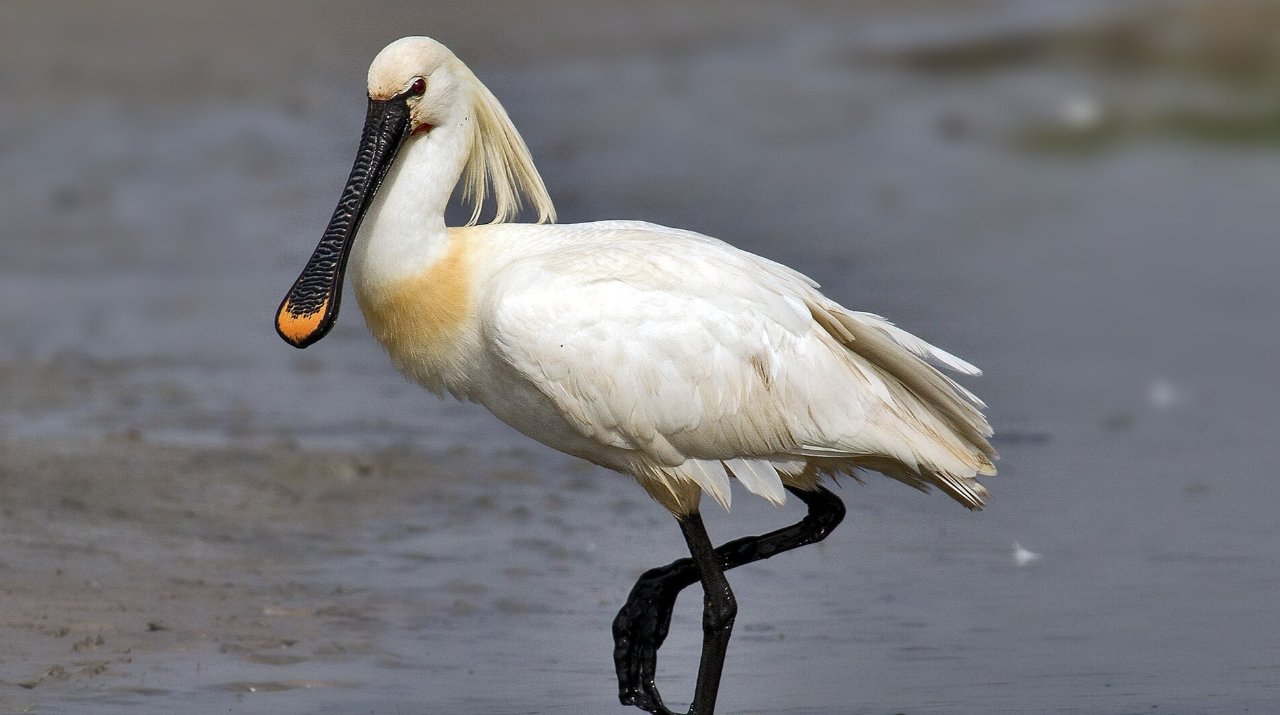
The Eurasian Spoonbill is a large, elegant white wader of Europe, Asia and Africa, instantly recognised by its flat, spoon-shaped bill. Northern breeders migrate to Africa and southern Europe, while many birds in milder regions stay put. In the breeding season adults have a shaggy crest and a yellowish breast patch. It feeds by sweeping its bill from side to side through shallow water.
Did you know?
- Unlike herons, spoonbills fly with their necks stretched out.
- It was once known as the “shovelard”, a name later given to the Northern Shoveler.
Voice
About the species
Identification
A large, all-white wader with a long, flat bill widening into a spoon at the tip, black in adults with a yellow tip and pinkish in young birds. In the breeding season adults have a bushy crest and a yellowish patch on the breast. In flight the neck is outstretched; young birds have black wingtips.
Family
Threskiornithidae
Size
Very large (swan)
Colours
white, yellow, black
About the habitat
Extensive shallow wetlands with muddy or sandy bottoms – marshes, lakes, rivers, floodplains, lagoons, estuaries and tidal creeks; it nests on undisturbed islands and in dense reedbeds or trees.
Diet
Aquatic invertebrates and small vertebrates – insects and larvae, crustaceans, molluscs, worms, leeches, tadpoles, frogs and small fish – caught by sweeping the partly open bill through the water and snapping it shut on prey.
Behaviour
A mostly silent, social wader that breeds in colonies, often with herons, egrets and cormorants, and roosts communally. It feeds mainly in the morning and evening, or by the tides on coasts. It flies with neck and legs outstretched, often in lines or V-formations. Northern populations migrate in flocks.
Sources
Photo: Andreas Trepte, CC BY-SA 2.5 https://commons.wikimedia.org/wiki/File:Eurasian Spoonbill-2.jpg
Sound: Joost van Bruggen, XC432229, CC BY-SA 4.0 https://xeno-canto.org/432229
Text: Wikipedia (English), CC BY-SA 4.0 https://en.wikipedia.org/wiki/Eurasian_spoonbill