Suomi
 Svenska
 Polski
 Čeština
 Slovenčina
 Norsk
 Dansk
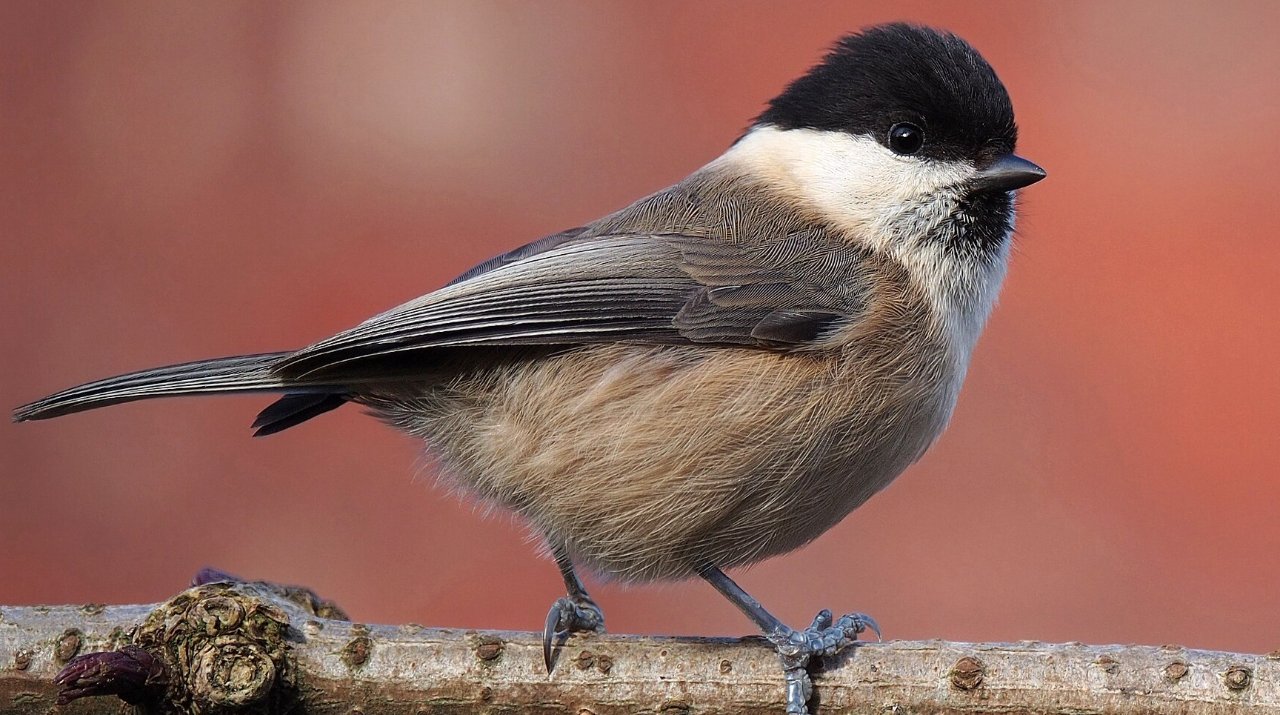
Willow Tit
Poecile montanus
Identify the Willow Tit by sound or photo and log your sightings with Birdpass.


The Willow Tit is a small, resident tit common across temperate and subarctic Europe and Asia. It has a matt black cap and bib, grey-brown upperparts and buffish underparts. Tied to damp, mixed and conifer woodland, it ranges further north than the very similar Marsh Tit. It excavates its own nest hole in rotten wood and has declined sharply in many regions.
Did you know?
- It is one of the few small songbirds that excavates its own nest hole.
- It was recognised as separate from the Marsh Tit only in the late 19th century.
Voice
About the species
Identification
A small tit with a matt black cap and bib, white cheeks, a grey-brown back and pale underparts; a pale panel shows on the wing. It resembles Marsh Tit, but the pale wing panel is usually clearer, the cap duller and the bib larger; the calls differ – Willow Tit has nasal “tchay” calls, whereas Marsh Tit's call is a sharp “pitchoo”.
Family
Paridae
Size
Tiny (goldcrest)
Colours
grey, black, white, brown
About the habitat
Damp deciduous, mixed and coniferous forest, especially young birch and willow stands, forest edges, clearings and scrub near bogs, with plenty of dead wood.
Diet
Insects, especially caterpillars, spiders and other invertebrates in summer; seeds of birch, alder and conifers, buds and berries in winter, and stored food. It visits feeders.
Behaviour
Resident and territorial, often in pairs, joining mixed flocks outside the breeding season. It forages acrobatically among branches and twigs and caches food in bark and lichen. It excavates its own nest hole in soft, rotten wood; the female incubates while both parents feed the chicks. Its typical call is a nasal, drawn-out “tchay-tchay”.
Sources
Photo: Francis C. Franklin, CC BY-SA 3.0 https://commons.wikimedia.org/wiki/File:Poecile montanus kleinschmidti.jpg
Sound: Anthony Wetherhill, XC462898, CC BY-SA 4.0 https://xeno-canto.org/462898
Text: Wikipedia (English) + FinBIF species descriptions, CC BY-SA 4.0; FinBIF: CC BY 4.0 https://en.wikipedia.org/wiki/Willow_tit