Suomi
 Svenska
 Polski
 Čeština
 Slovenčina
 Norsk
 Dansk
Marsh Tit
Poecile palustris
Identify the Marsh Tit by sound or photo and log your sightings with Birdpass.


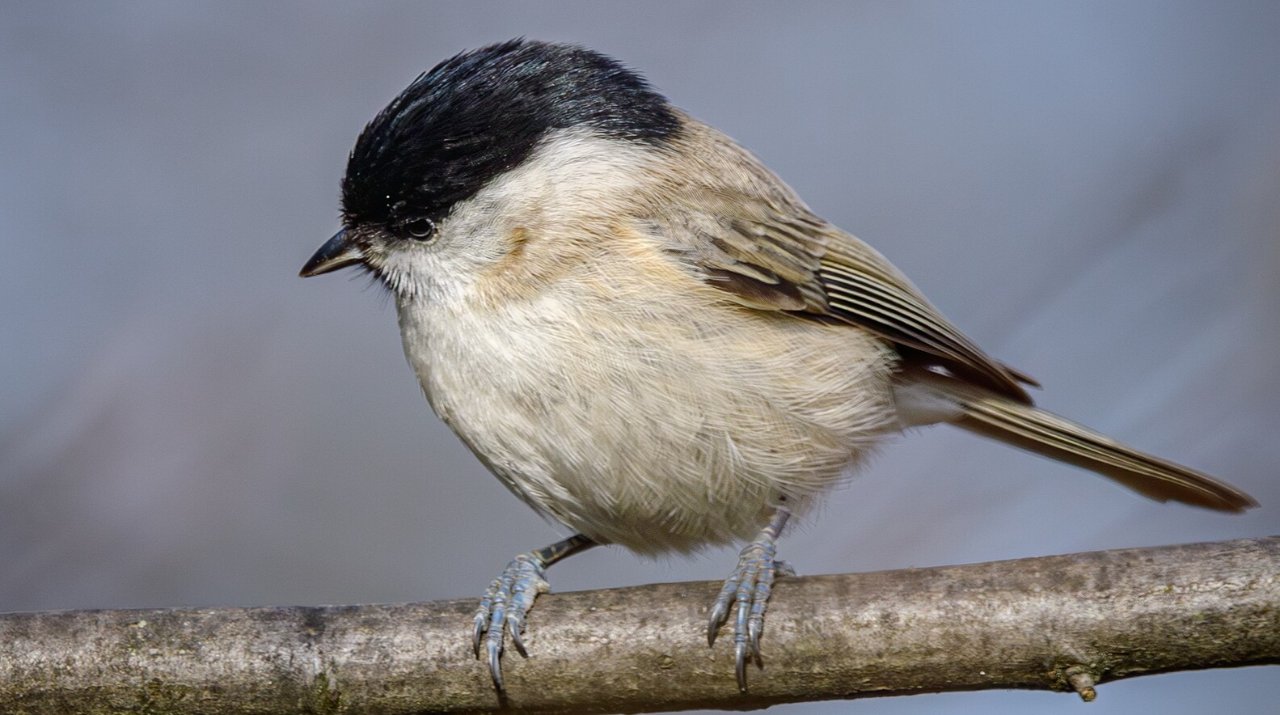
The Marsh Tit is a small tit of temperate Europe and eastern Asia with a glossy black cap, a small black bib, clean white cheeks and brown upperparts. Despite its name it lives in mature deciduous woodland rather than marshes. It closely resembles the Willow Tit and is most reliably told apart by voice. It has declined in parts of its range.
Did you know?
- Despite its name, it is a bird of woods rather than marshes.
- It was only formally separated from the Willow Tit in 1897.
Voice
About the species
Identification
It resembles Willow Tit, but the wing lacks a pale panel and the crown is glossy black (duller in Willow Tit); the bib is smaller and neater. The bill may show a small pale spot at the base. The voice and song differ, and are the best way to separate them. The sexes look alike.
Family
Paridae
Size
Tiny (goldcrest)
Colours
grey, black, white, brown
About the habitat
Mature broadleaf and mixed woodland with dense undergrowth and old trees with holes, as well as old parks, orchards and wooded edges.
Diet
Insects, spiders and larvae in spring and summer; seeds of trees such as beech and hazel, berries and mast in autumn and winter. It caches many seeds and visits feeders.
Behaviour
Usually seen singly or in pairs, moving methodically through lower branches and shrubs. It keeps a territory year-round and hides surplus food in bark and moss, relocating it months later. It nests in existing tree holes or nest boxes, laying 5–9 eggs. Its call is an explosive “pitchoo”, and the song a clear, ringing rattle.
Sources
Photo: Stephan Sprinz, CC BY 4.0 https://commons.wikimedia.org/wiki/File:Sumpfmeise im NSG Hirschacker und Dossenwald 2.jpg
Sound: Pálos Lőrinc, XC639965, CC BY-SA 4.0 https://xeno-canto.org/639965
Sound: Sonothèque ADVL, XC954051, CC0 1.0 https://xeno-canto.org/954051
Sound: Sonothèque ADVL, XC730597, CC0 1.0 https://xeno-canto.org/730597
Text: Wikipedia (English) + FinBIF species descriptions, CC BY-SA 4.0; FinBIF: CC BY 4.0 https://en.wikipedia.org/wiki/Marsh_tit