Suomi
 Svenska
 Polski
 Čeština
 Slovenčina
 Norsk
 Dansk
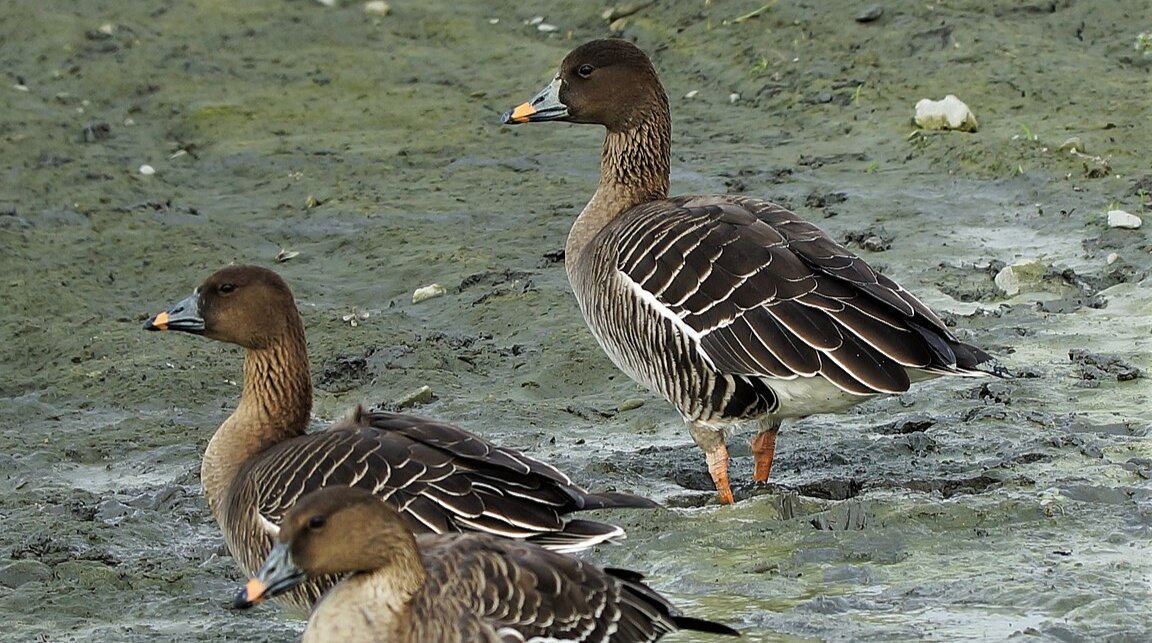
Tundra Bean Goose
Anser serrirostris
Identify the Tundra Bean Goose by sound or photo and log your sightings with Birdpass.


The Tundra Bean Goose is a medium-large grey goose that breeds on the Arctic tundra of northern Siberia and migrates to winter in Europe and Asia. It often occurs in small numbers among other grey geese and can be tricky to distinguish from the closely related Taiga Bean Goose; some authorities split the two, while others treat them as a single species.
Did you know?
- Genetic studies suggest the tundra and taiga lineages diverged about 2.5 million years ago and later exchanged genes again.
- Some bird lists split the Tundra and Taiga Bean Geese, while others still lump them as a single “bean goose”.
Voice
About the species
Identification
A medium-sized grey-brown goose with bright orange legs and a black bill with a narrow orange band near the tip. The upper wing-coverts are dark brown with narrow white fringes. Told from Pink-footed Goose by its orange (not pink) bill band and legs and browner (not bluish-grey) coverts. Very similar to Taiga Bean Goose, but usually smaller, shorter-necked and with a shorter, stubbier bill.
Family
Anatidae
Size
Very large (swan)
Colours
brown, grey, orange, white
About the habitat
Breeds on open Arctic tundra. On migration and in winter it uses open wetlands, lake shores, coastal areas and farmland.
Diet
Grasses and sedges, plus roots, seeds and spilled grain on farmland during migration and in winter.
Behaviour
A long-distance migrant that travels and feeds in flocks, often mixed with other grey geese. It grazes and probes with its bill; the call is a loud honk, higher-pitched in smaller birds.
Sources
Photo: 邱文強, CC BY-SA 4.0 https://commons.wikimedia.org/wiki/File:101777 豆雁來臨.jpg
Sound: Jochem verweij, CC BY-SA 4.0 https://commons.wikimedia.org/wiki/File:Anser_serrirostris_-_Tundra_Bean_Goose_XC512591.mp3
Text: Wikipedia (English) + GBIF regional observations + Wikipedia (English), CC BY-SA 4.0; GBIF occurrence data; Wikipedia: CC BY-SA 4.0 https://en.wikipedia.org/wiki/Tundra_bean_goose