
 Suomi
 Svenska
 Polski
 Čeština
 Slovenčina
 Norsk
 Dansk
Ross's Goose
Anser rossii
Identify the Ross's Goose by sound or photo and log your sightings with Birdpass.


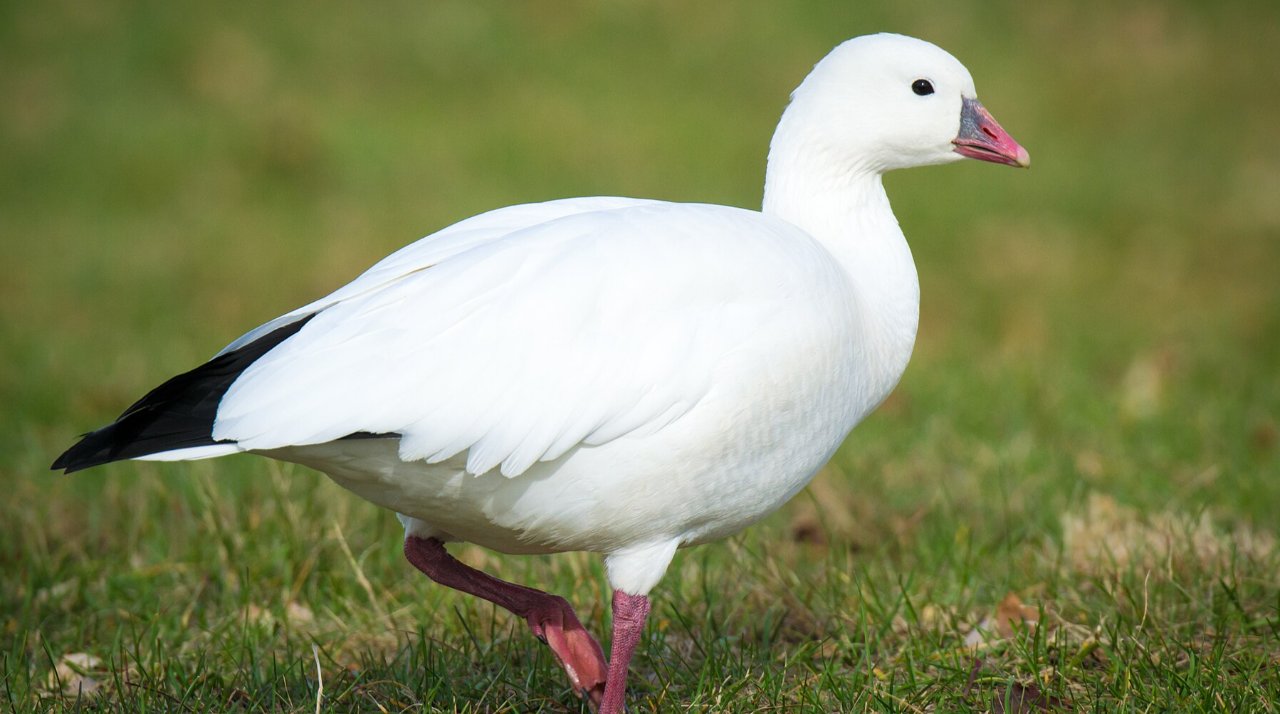
Ross's Goose is a small, white Arctic goose with black wingtips, a short neck and a stubby bill – the smallest of North America's white geese. It breeds in Arctic Canada and winters in the southern United States and northern Mexico. It closely resembles a small Snow Goose. Once rare because of hunting, it has rebounded under protection and is now of Least Concern.
Did you know?
- A rare blue morph occurs, but fewer than one in ten thousand adults show it.
- It is named after Bernard R. Ross of the Hudson's Bay Company.
About the species
Identification
A fairly small white goose (about 53–66 cm) with a short neck and rounded head. The bill is small and short, often bluish at the base, and lacks the Snow Goose's black “grinning patch”. Told from Snow Goose by its smaller size, shorter neck and rounder head; a dark morph is very rare.
Family
Anatidae
Size
Very large (swan)
Colours
white, black, red
About the habitat
Breeds on low Arctic tundra with wet meadows, marshes and dwarf birch and willow. On migration and in winter it uses wetlands and open fields.
Diet
Mainly plant material: grasses and sedges, and on migration and in winter also seeds of wild grasses and spilled grain.
Behaviour
A migratory, social goose that travels and feeds in flocks, often mixed with Snow Geese. It nests in large ground colonies on islands in shallow Arctic lakes and nearby mainland; large colonies can overgraze the vegetation.
Sources
Photo: Andrew C, CC BY 2.0 https://commons.wikimedia.org/wiki/File:Ross's Goose (Chen rossii) (23321411711).jpg
Text: Wikipedia (English) + GBIF regional observations + Wikipedia (Finnish), CC BY-SA 4.0; GBIF occurrence data; Wikipedia: CC BY-SA 4.0 https://en.wikipedia.org/wiki/Ross%27s_goose
 (23321411711).jpg)