Suomi
 Svenska
 Polski
 Čeština
 Slovenčina
 Norsk
 Dansk
Ring-necked Duck
Aythya collaris
Identify the Ring-necked Duck by sound or photo and log your sightings with Birdpass.


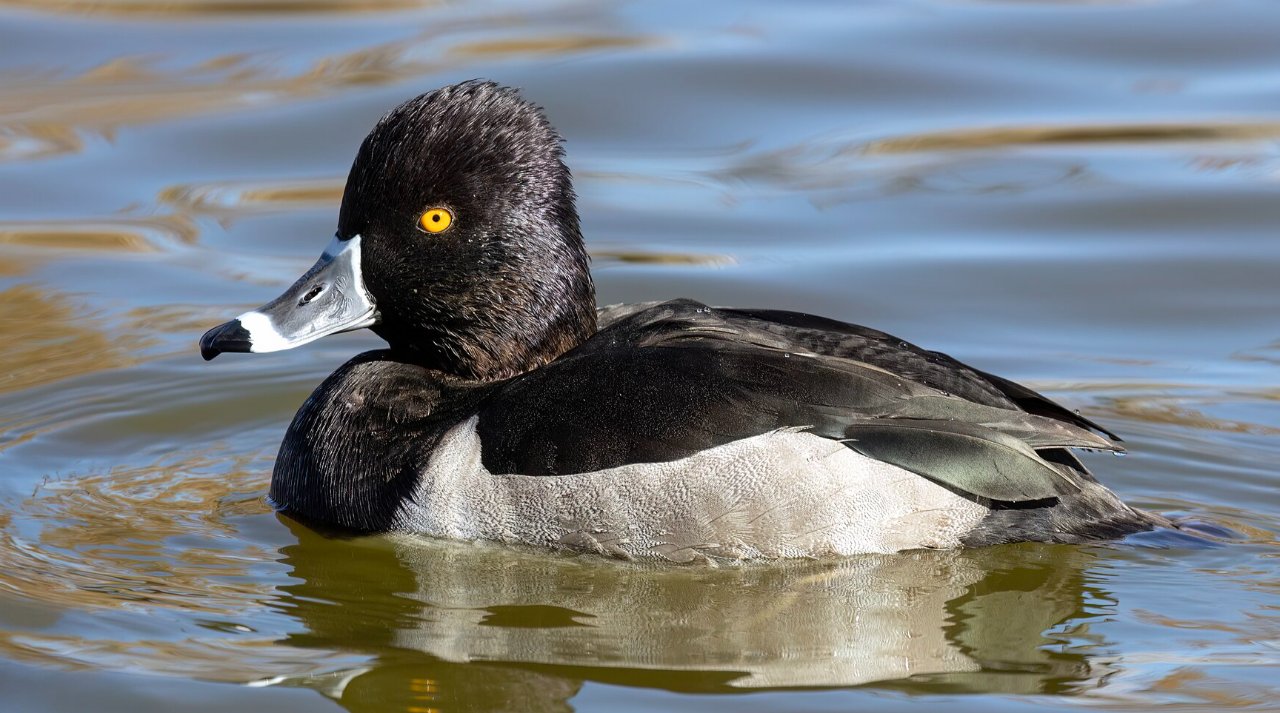
The Ring-necked Duck is a compact North American diving duck best known for the male's peaked head and white-ringed grey bill; the chestnut neck ring that gives it its name is hardly ever visible. It breeds on wooded, vegetated lakes, ponds and bogs in the northern United States and Canada and winters widely further south. It is a rare but regular vagrant to western and northern Europe.
Did you know?
- Its name refers to a faint chestnut neck ring that is rarely visible in the field.
- Unusually for a diving duck, it often uses small forest ponds and beaver wetlands.
About the species
Identification
A smallish diving duck. The male has a black head, breast and back, pale grey flanks with a clear vertical white bar at the front of the flank, and a grey bill with a pale band near the tip and a dark tip. The female is greyish brown and also shows the pale bill band; the wing has grey stripes. The vertical white flank bar and bill pattern help separate it from other Aythya ducks.
Family
Anatidae
Size
Large (crow)
Colours
black, white, grey, yellow
About the habitat
Freshwater lakes, small forest ponds, bogs and beaver wetlands with emergent vegetation; in winter shallow lakes, marshes and sheltered bays.
Diet
Seeds and tubers of aquatic plants such as pondweeds, smartweeds and water-lilies, together with aquatic insects, snails and other invertebrates, especially in spring and in the diet of ducklings.
Behaviour
Feeds by diving and also by tipping up; often in small flocks. It takes off from the water quickly for a diving duck. Pairs form during spring migration. The female builds a bowl nest anchored in dense vegetation over water and incubates alone. Females give a dry “trrr” call.
Sources
Photo: Polinova, CC BY-SA 4.0 https://commons.wikimedia.org/wiki/File:Ring-Necked Duck.jpg
Text: Wikipedia (English) + FinBIF species descriptions, CC BY-SA 4.0; FinBIF: CC BY 4.0 https://en.wikipedia.org/wiki/Ring-necked_duck