
 Suomi
 Svenska
 Polski
 Čeština
 Slovenčina
 Norsk
 Dansk
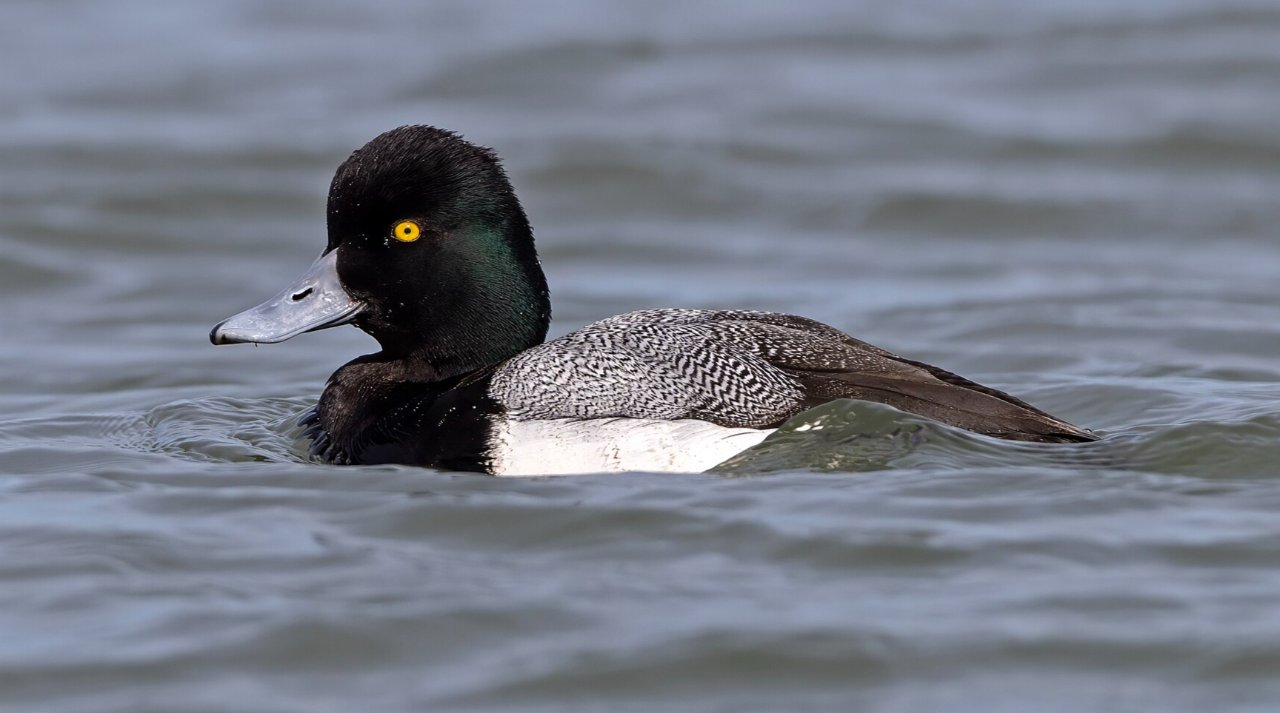
Lesser Scaup
Aythya affinis
Identify the Lesser Scaup by sound or photo and log your sightings with Birdpass.


The Lesser Scaup is a small North American diving duck that breeds in the boreal and parkland wetlands of Alaska and Canada and winters south to Central America. Nicknamed “little bluebill” for its blue-grey bill, it is very closely related to the Greater Scaup, and the two can be hard to tell apart. It is a rare vagrant to Europe.
Did you know?
- The origin of “scaup” is debated – possibly from “scalp”, an old word for shellfish beds, or from the female's harsh call.
- Its white wing stripe is limited to the secondaries, unlike Greater Scaup's, which extends into the primaries.
About the species
Identification
A small, neat scaup told from Greater Scaup mainly by head and bill shape: the highest point of the head is slightly behind the eye (above the eye in Greater Scaup), and the head gloss is purplish rather than greenish. The male has a very dark, purple-glossed head and neck, white belly, grey back, bluish bill and yellow eyes. The female resembles a female Tufted Duck but shows a white patch at the bill base and a frosty grey back. In flight the white wing stripe is confined mostly to the secondaries.
Family
Anatidae
Size
Large (crow)
Colours
black, white, grey, blue
About the habitat
Lakes, large ponds and rivers when breeding; in migration and winter also wider wetlands and sheltered coastal waters.
Diet
Aquatic invertebrates, often molluscs, crustaceans and insect larvae, taken by diving, as well as some plant material.
Behaviour
A true diving duck that feeds by diving and swimming underwater, often in flocks. Females give a harsh, rattling “scaup”, while males give soft whistles. It is migratory, moving south in winter.
Sources
Photo: Chuck Homler d/b/a Focus On Wildlife, CC BY-SA 4.0 https://commons.wikimedia.org/wiki/File:Drake Lesser Scaup (Aythya affinis) Barengat Inlet, New Jersey, USA.jpg
Text: Wikipedia (English), CC BY-SA 4.0 https://en.wikipedia.org/wiki/Lesser_scaup
 Barengat Inlet, New Jersey, USA.jpg)