Suomi
 Svenska
 Polski
 Čeština
 Slovenčina
 Norsk
 Dansk
Lesser White-fronted Goose
Anser erythropus
Identify the Lesser White-fronted Goose by sound or photo and log your sightings with Birdpass.


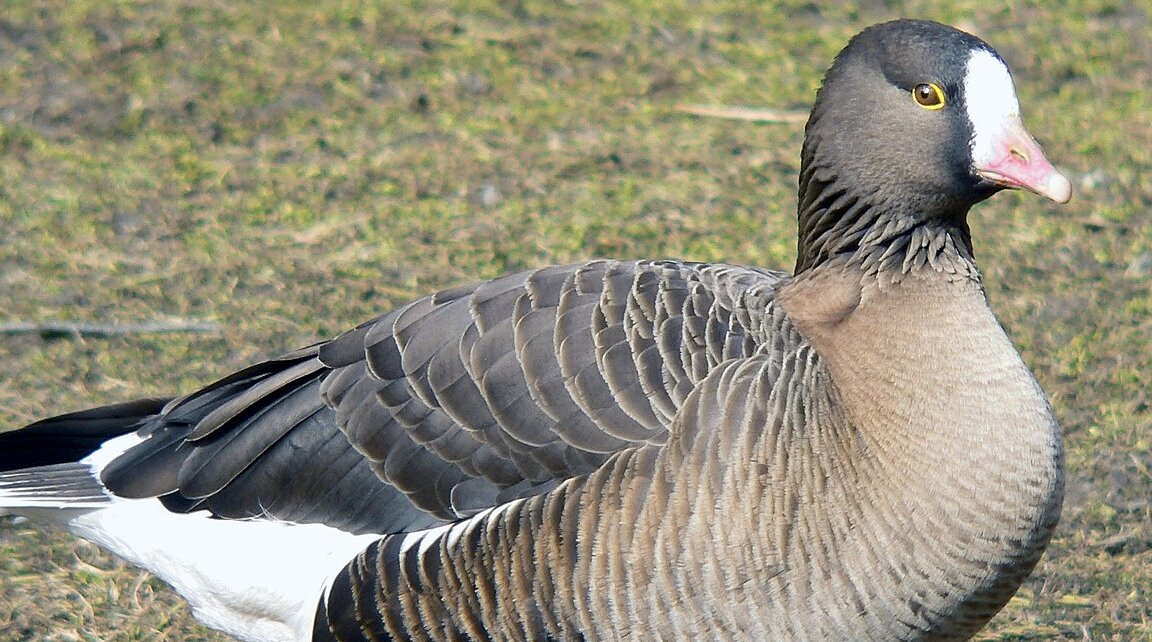
The Lesser White-fronted Goose is the smaller cousin of the Greater White-fronted Goose, sharing its white facial blaze and barred belly but adding a distinctive yellow eye-ring. It breeds on wet tundra and at the northern edge of the taiga across the Palearctic and winters in south-eastern Europe and Asia. It is globally threatened and the focus of international conservation, including reintroduction efforts in northern Europe.
Did you know?
- Birds seen at Slimbridge inspired Sir Peter Scott to found the Wildfowl & Wetlands Trust.
- Its bright yellow eye-ring is a distinctive field mark that birders rely on when scanning mixed flocks.
About the species
Identification
Resembles Greater White-fronted Goose but is smaller, with a yellow eye-ring and a larger white blaze that reaches the forehead. The bill is smaller and pinkish, the plumage darkish and the belly patches smaller than in Greater White-fronted Goose.
Family
Anatidae
Size
Very large (swan)
Colours
brown, grey, white
About the habitat
Breeds on wet tundra and at the edge of the northern taiga near lakes, river valleys and marshy lowlands with willow scrub. Outside the breeding season it uses wetlands, lake shores, coastal marshes, river floodplains and nearby farmland.
Diet
Grasses and sedges, as well as leaves, shoots, roots and berries; on migration and in winter also cereals and spilled grain on fields.
Behaviour
A gregarious long-distance migrant that feeds mainly by grazing and occasionally dabbling in shallow water. It forms small to medium flocks, often mixing with other geese; wary and alert, with a high-pitched yelping call and fast flight.
Sources
Photo: Unknown, CC BY-SA 3.0 https://commons.wikimedia.org/wiki/File:Anser erythropus.jpg
Text: Wikipedia (English) + FinBIF species descriptions, CC BY-SA 4.0; FinBIF: CC BY 4.0 https://en.wikipedia.org/wiki/Lesser_white-fronted_goose