
 Suomi
 Svenska
 Polski
 Čeština
 Slovenčina
 Norsk
 Dansk
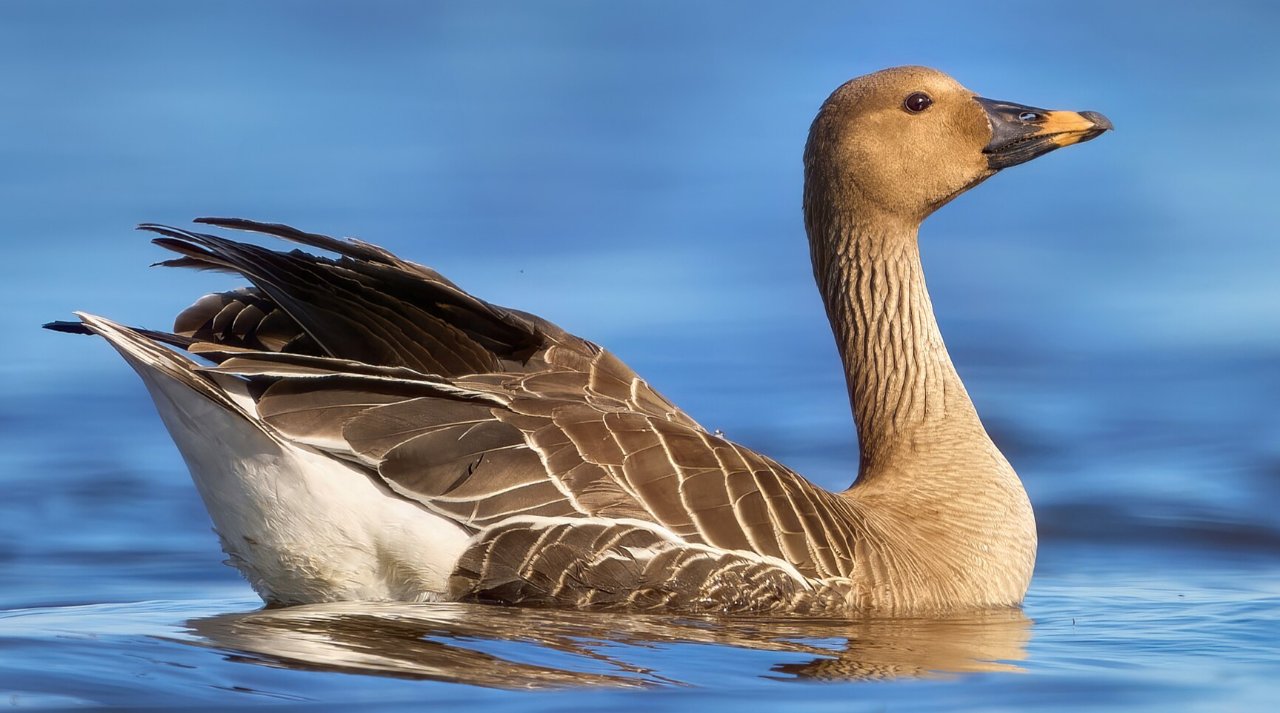
Taiga Bean Goose
Anser fabalis
Identify the Taiga Bean Goose by sound or photo and log your sightings with Birdpass.


The Taiga Bean Goose is a large, grey-brown goose that breeds in the boreal forest zone of northern Europe and Asia, favouring wet mires and boggy lakeshores, and winters farther south in Europe and Asia. It has a darker head, orange legs and a long, mostly black bill with an orange band. It is treated as a separate species from the Tundra Bean Goose by some authorities and lumped with it by others.
Did you know?
- Its English and scientific names refer to its old habit of grazing on bean-field stubble in winter.
- Genetic studies suggest the taiga and tundra lineages split about 2.5 million years ago and came back into contact about 60,000 years ago.
About the species
Identification
A grey-brown goose with a darker head, white tail with a clear dark terminal band and orange legs. The bill is long, black at the base and with an orange-yellow band near the tip. Compared with Tundra Bean Goose it is larger and longer-necked, with a longer bill that usually shows less black.
Family
Anatidae
Size
Very large (swan)
Colours
brown, grey, orange, white
About the habitat
Breeds in northern taiga with extensive wet mires, fens and boggy lakes; outside the breeding season it uses open farmland and nearby wetlands.
Diet
In the breeding season it grazes sedges and other wetland plants; on migration and in winter it feeds on fields on grain, sprouting cereals, clover and other green shoots.
Behaviour
Migratory and social, moving in family groups and flocks that rest and graze on open farmland during stopovers. It nests on raised bog hummocks; the female incubates while the male stands guard, and the goslings stay with their parents through autumn migration. Calls are deep, nasal honks.
Sources
Photo: Andrey Gulivanov, CC BY 2.0 https://commons.wikimedia.org/wiki/File:Taiga bean goose (54312538416).jpg
Text: Wikipedia (English) + GBIF regional observations + Wikipedia (Finnish), CC BY-SA 4.0; GBIF occurrence data; Wikipedia: CC BY-SA 4.0 https://en.wikipedia.org/wiki/Taiga_bean_goose
.jpg)