
 Suomi
 Svenska
 Polski
 Čeština
 Slovenčina
 Norsk
 Dansk
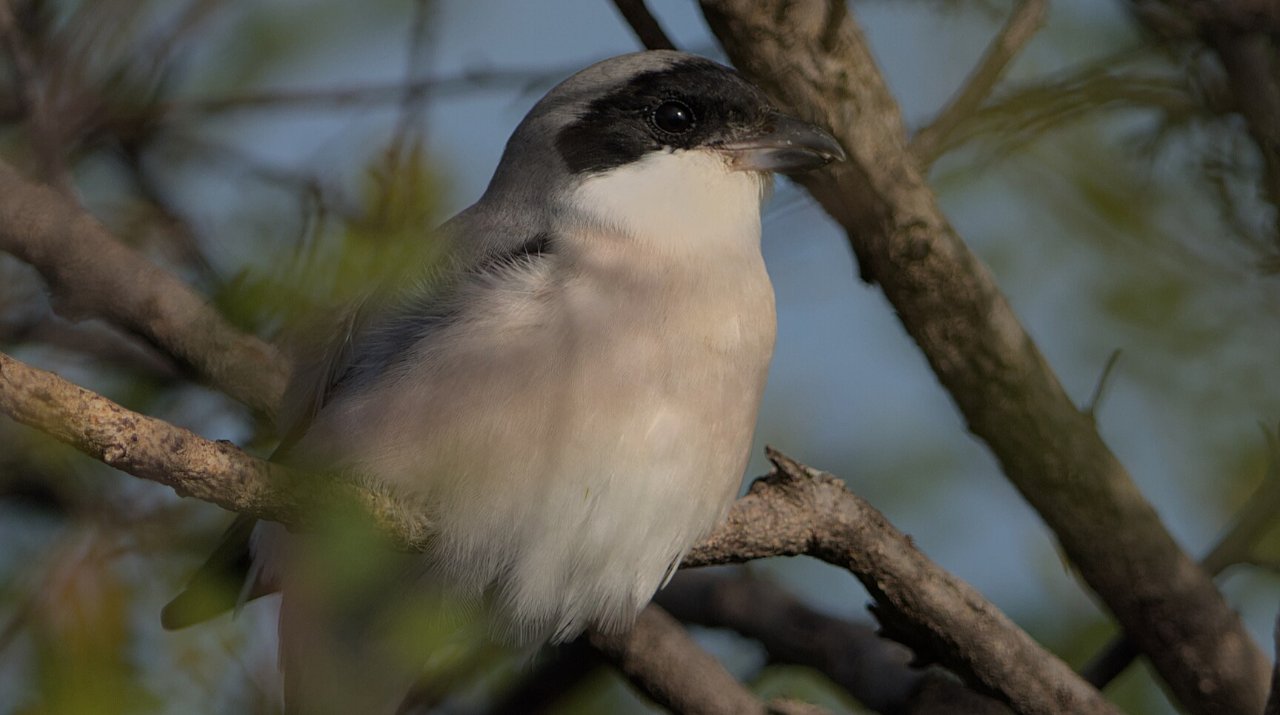
Lesser Grey Shrike
Lanius minor
Identify the Lesser Grey Shrike by sound or photo and log your sightings with Birdpass.


The Lesser Grey Shrike is a migratory shrike of dry, open lowlands, breeding across southern and central Europe and western Asia and wintering in southern Africa. Slightly smaller than the Great Grey Shrike, it has bold black, white and grey plumage with a black forehead, and males are often flushed pink below. It hunts large insects from wires and other lookouts.
Did you know?
- It often hovers while hunting on its breeding grounds.
- It migrates in a loop, travelling south via the eastern Mediterranean and returning further east.
About the species
Identification
A grey shrike, about 20 cm, resembling Great Grey Shrike. It is characterised by a black mask that extends over the forehead, black wings with a clear white patch and a pinkish wash on the breast. Compared with Great Grey Shrike it is smaller, shorter-tailed and longer-winged, and lacks a white supercilium.
Family
Laniidae
Size
Small (sparrow)
Colours
grey, white, black
About the habitat
Dry, sunny, open lowland landscapes with scattered trees and bushes – farmland, steppe, orchards, shelterbelts and roadside trees; in winter scrub and thorn savanna.
Diet
Mainly large insects such as beetles, grasshoppers, crickets and moths; occasionally small vertebrates and small fruit.
Behaviour
Hunts from prominent perches – wires, posts and treetops – sallying to catch prey in the air or on the ground, and often hovers while hunting. It impales prey less often than other shrikes. It flies low and slightly undulating, fans its tail when excited and defends its nest aggressively.
Sources
Photo: Derek Keats, CC BY 2.0 https://commons.wikimedia.org/wiki/File:Lesser grey shrike (Lanius minor), Kruger National Park, South Africa. - 52804244906.jpg
Text: Wikipedia (English) + FinBIF species descriptions, CC BY-SA 4.0; FinBIF: CC BY 4.0 https://en.wikipedia.org/wiki/Lesser_grey_shrike
, Kruger National Park, South Africa. - 52804244906.jpg)