
 Suomi
 Svenska
 Polski
 Čeština
 Slovenčina
 Norsk
 Dansk
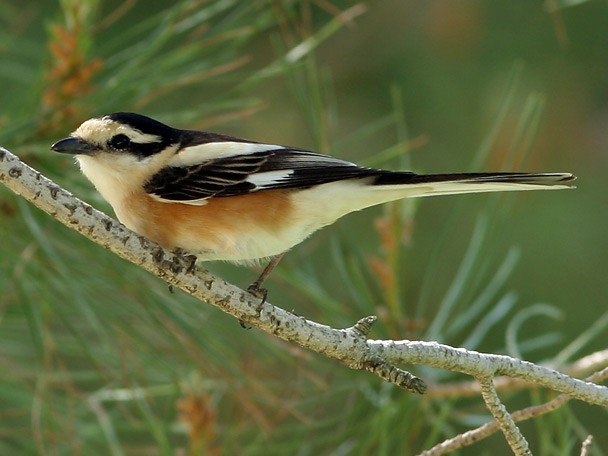
Masked Shrike
Lanius nubicus
Identify the Masked Shrike by sound or photo and log your sightings with Birdpass.


The Masked Shrike is the smallest shrike, a slim, long-tailed predator with striking black, white and orange plumage. It breeds from south-eastern Europe through the eastern Mediterranean to western Iran and winters mainly in north-east Africa. Less conspicuous than its relatives, it often hunts from semi-concealed perches in open woodland and sings a soft, warbler-like song.
Did you know?
- It is the smallest species in the genus Lanius.
- Adults show a neat orange flank patch that contrasts with the black-and-white body.
About the species
Identification
A contrasting black-and-white, long-tailed shrike; adults have a clear orange wash on the flanks. The male is black above with a clearly white forehead and supercilium and large white wing patches; the female is duller, and young birds are grey-brown and barred. It lacks the chestnut tones of Red-backed and Woodchat Shrikes.
Family
Laniidae
Size
Small (sparrow)
Colours
black, white, orange, grey
About the habitat
Open woodland with bushes and scattered large trees, olive groves, orchards and gardens with old trees or tall hedges; in winter thorny bushland and acacias.
Diet
Mainly large insects such as grasshoppers, beetles and wasps; occasionally small birds and lizards. Like other shrikes it sometimes impales prey on thorns.
Behaviour
Hunts from a branch or post, dashing out to seize prey on the ground or catching it in mid-air. Its calls are short and grating, but the song is soft and warbler-like. Both adults build a neat cup nest in a tree or bush; the female incubates 4–7 eggs for about two weeks, and both feed the young.
Sources
Photo: Claudia Becher, CC BY-SA 3.0 https://commons.wikimedia.org/wiki/File:Lanius nubicus (unmirrored).jpg
Text: Wikipedia (English) + Wikipedia (Finnish), CC BY-SA 4.0 https://en.wikipedia.org/wiki/Masked_shrike
.jpg)