Suomi
 Svenska
 Polski
 Čeština
 Slovenčina
 Norsk
 Dansk
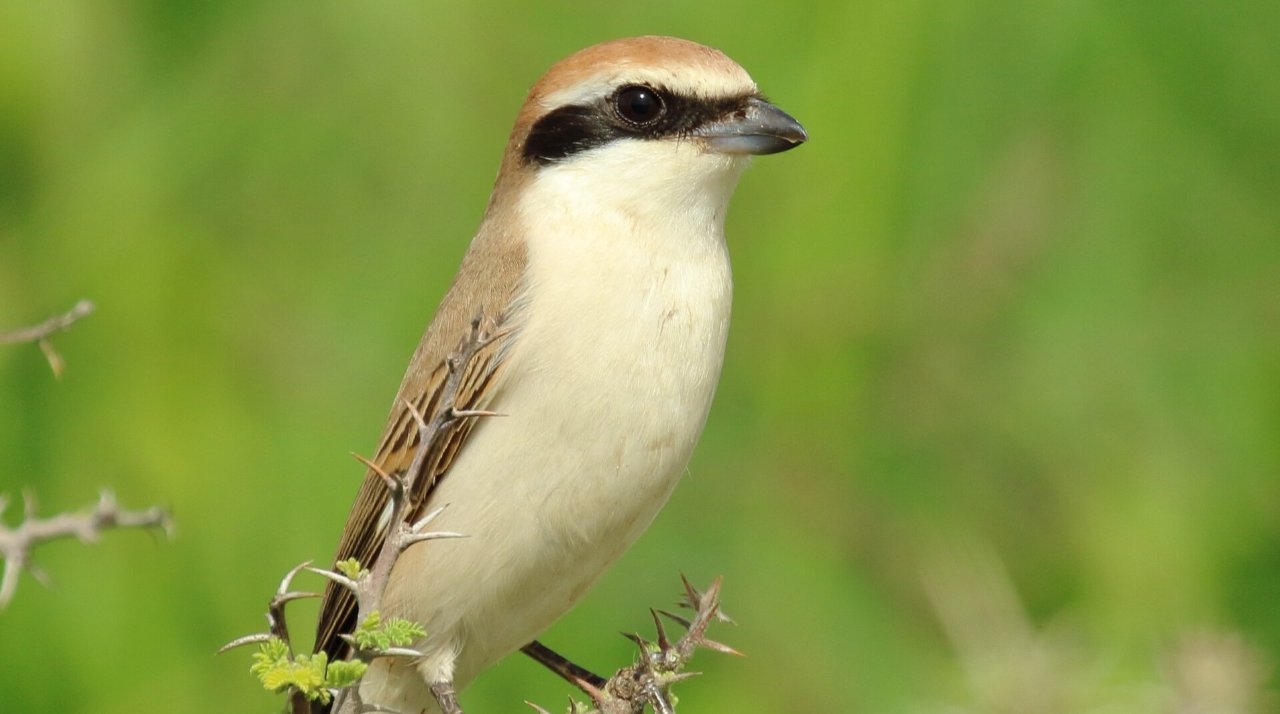
Red-tailed Shrike
Lanius phoenicuroides
Identify the Red-tailed Shrike by sound or photo and log your sightings with Birdpass.


The Red-tailed Shrike, or Turkestan Shrike, is a sandy-toned shrike with a rufous tail that breeds across southern Siberia and Central Asia and winters in eastern Africa, Arabia and north-western India. Once lumped with the Isabelline and Red-backed Shrikes, it is now treated as a separate species. Like other shrikes it hunts from exposed perches and impales prey on thorns.
Did you know?
- Like many shrikes, it impales prey on thorns or barbed wire as a larder.
- It was formerly treated as the same species as the Isabelline and Red-backed Shrikes.
About the species
Identification
The adult male is darker above and paler below than Isabelline Shrike, with a broad, pure white supercilium, a black mask, a rusty-brown crown and back and a rufous tail. Some birds have a greyer crown and nape. Females and young closely resemble Isabelline Shrike. Length about 16–18 cm.
Family
Laniidae
Size
Small (sparrow)
Colours
brown, orange, black, white
About the habitat
Open, dry country with scattered bushes and small trees – steppe, semi-desert, farmland, field edges and oases.
Diet
Mainly large insects such as beetles, grasshoppers and wasps; occasionally small lizards, rodents and small birds.
Behaviour
Hunts from exposed perches such as bushes, posts and wires, dropping to the ground or sallying out to seize prey, which it may impale for later. It gives a harsh, scolding call. A long-distance migrant.
Sources
Photo: Jrrobinantony, CC BY-SA 4.0 https://commons.wikimedia.org/wiki/File:0T4A6719.jpg
Text: Wikipedia (English) + GBIF regional observations + Wikipedia (Finnish), CC BY-SA 4.0; GBIF occurrence data; Wikipedia: CC BY-SA 4.0 https://en.wikipedia.org/wiki/Red-tailed_shrike