Suomi
 Svenska
 Polski
 Čeština
 Slovenčina
 Norsk
 Dansk
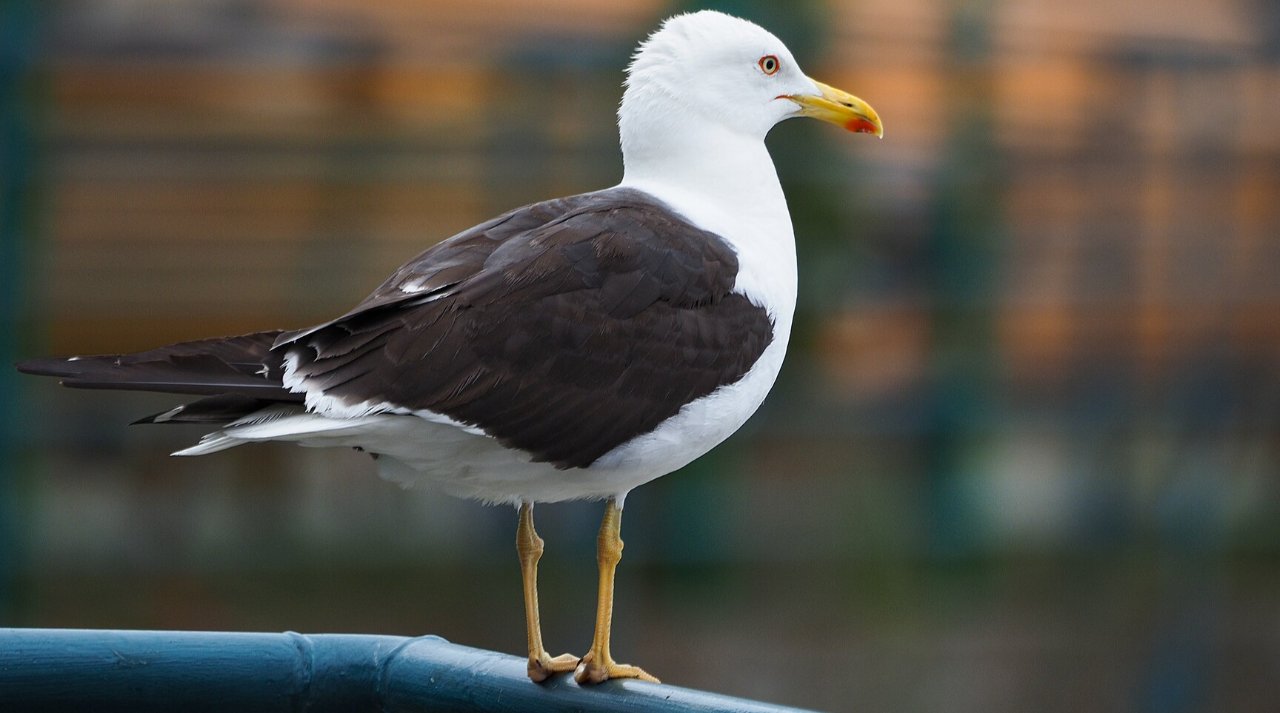
Lesser Black-backed Gull
Larus fuscus
Identify the Lesser Black-backed Gull by sound or photo and log your sightings with Birdpass.


The Lesser Black-backed Gull is a slim, dark-backed gull that breeds on coasts, islands and large lakes of northern and western Europe. It is a long-distance migrant, wintering from western Europe to West Africa, and it has increasingly appeared in North America. Smaller and slimmer than the Great Black-backed Gull, it has yellow legs and a slate-grey to black back. Some populations, such as the Baltic subspecies, have declined sharply.
Did you know?
- It and the Herring Gull form the endpoints of a gull “ring species” around the Northern Hemisphere.
- Chicks peck at the red spot on the parent's bill to trigger feeding – a classic instinctive behaviour.
Voice
About the species
Identification
The adult has a black to slate-grey back and wings, a white head and underparts, bright yellow legs and a yellow bill with a red spot. It is smaller and slimmer than Great Black-backed Gull; the white wingtip spot is smaller and the white trailing edge narrower. In young birds the best flight marks are the white rump and all-dark outer wing, whereas young Herring Gulls have a more mottled rump and a pale window in the outer wing.
Family
Laridae
Size
Large (crow)
Colours
white, black, grey, yellow
About the habitat
Coasts, rocky islets, harbours and estuaries, as well as large lakes, reservoirs and rivers; it also feeds on farmland, in parks and at landfills and nests on flat roofs.
Diet
Opportunistic: fish and marine invertebrates, insects, earthworms, molluscs, seeds and berries, small mammals, eggs and chicks, as well as offal, carrion and scraps; it follows fishing boats and steals food from other seabirds.
Behaviour
Breeds colonially on coastal islands, lake islets and rooftops, pairs defending small territories around their nests. It forages by picking from the surface, pattering along shores, plunging shallowly, scavenging and pirating from other birds. Its call is a deeper laughing cry than a Herring Gull's. Juveniles take several years to reach adult plumage.
Sources
Photo: Henry Söderlund, CC BY 2.0 https://commons.wikimedia.org/wiki/File:Larus fuscus, a gull in Helsinki, Finland, 2020 August.jpg
Sound: Sonothèque ADVL, XC776691, CC0 1.0 https://xeno-canto.org/776691
Sound: Sonothèque ADVL, XC707079, CC0 1.0 https://xeno-canto.org/707079
Sound: Sonothèque ADVL, XC776692, CC0 1.0 https://xeno-canto.org/776692
Text: Wikipedia (English) + FinBIF species descriptions, CC BY-SA 4.0; FinBIF: CC BY 4.0 https://en.wikipedia.org/wiki/Lesser_black-backed_gull