
 Suomi
 Svenska
 Polski
 Čeština
 Slovenčina
 Norsk
 Dansk
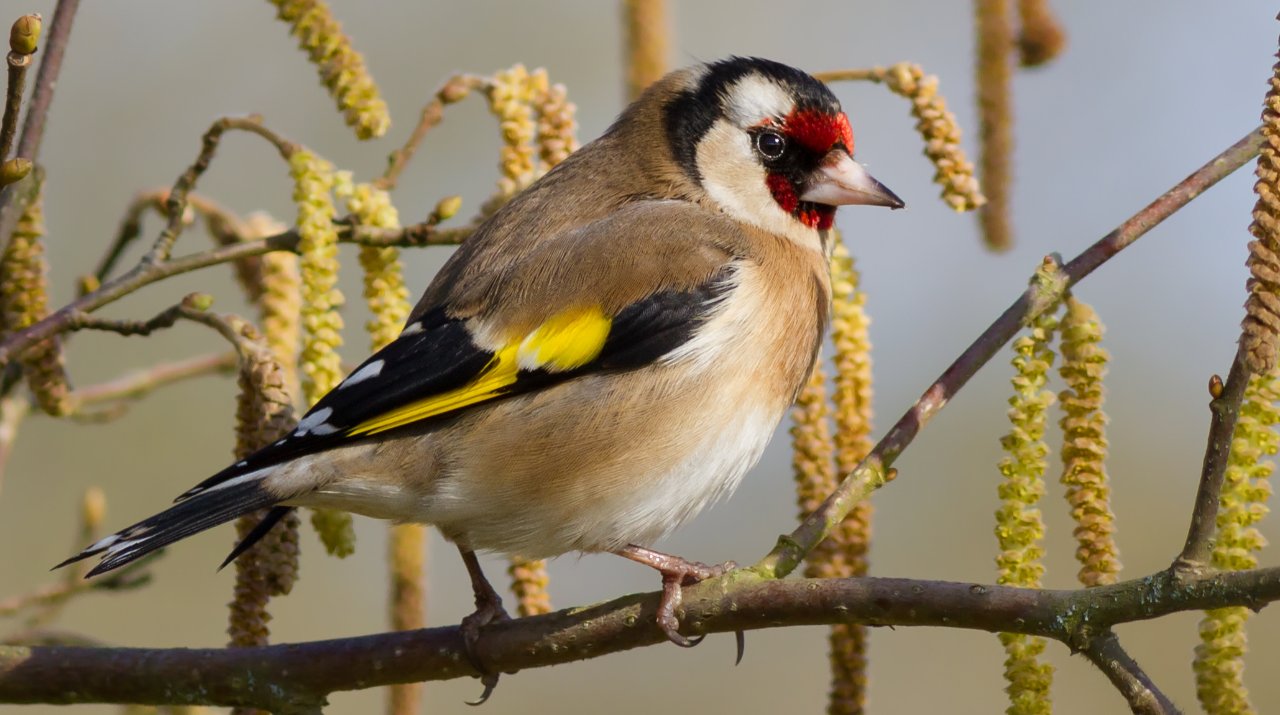
European Goldfinch
Carduelis carduelis
Identify the European Goldfinch by sound or photo and log your sightings with Birdpass.


The European Goldfinch is a small, brightly marked finch native to Europe, North Africa and western and central Asia, and introduced to Australia, New Zealand and elsewhere. It is instantly recognised by its red face, black-and-white head and bold yellow wing bar. Its tinkling song and lively, sociable flocks make it a familiar bird of open country, parks and gardens.
Did you know?
- Goldfinches often appear in Italian Renaissance paintings of the Madonna and Child.
- Its genus name Carduelis comes from the Latin for thistle.
Voice
About the species
Identification
Recognised by its red face and black-and-white head; the body is brown and white, and the black wings show a bold yellow bar and white spots. The sexes are nearly alike, though the male often has slightly more red on the face. Juveniles lack the red and black head pattern and are more streaked, but still show the yellow wing bar.
Family
Fringillidae
Size
Small (sparrow)
Colours
brown, red, black, white, yellow
About the habitat
Open and semi-open landscapes with scattered trees and bushes: farmland edges, meadows, hedgerows, orchards, parks and gardens, especially where thistles and other seed-rich weeds abound.
Diet
Mainly small seeds, especially of thistles and teasels, as well as dandelions and other composites; in the breeding season also small insects. It readily visits feeders for nyjer and other fine seeds.
Behaviour
Active and social, forming flocks outside the breeding season. It perches acrobatically on seed heads, extracting seeds with its slender bill, and flies with a bouncing, undulating flight. The song is a bright, silvery twittering. The female builds a neat, compact nest near the tips of branches, of moss and lichen bound with spider silk and lined with plant down; both parents feed the young. Birds from colder regions migrate.
Sources
Photo: Pierre Dalous, CC BY-SA 3.0 https://commons.wikimedia.org/wiki/File:Carduelis carduelis (2012).jpg
Sound: Sander Pieterse, XC101463, CC BY-SA 4.0 https://xeno-canto.org/101463
Sound: محبي الطيور المغردة, XC481945, CC BY-SA 4.0 https://xeno-canto.org/481945
Text: Wikipedia (English) + FinBIF species descriptions, CC BY-SA 4.0; FinBIF: CC BY 4.0 https://en.wikipedia.org/wiki/European_goldfinch
.jpg)