Suomi
 Svenska
 Polski
 Čeština
 Slovenčina
 Norsk
 Dansk
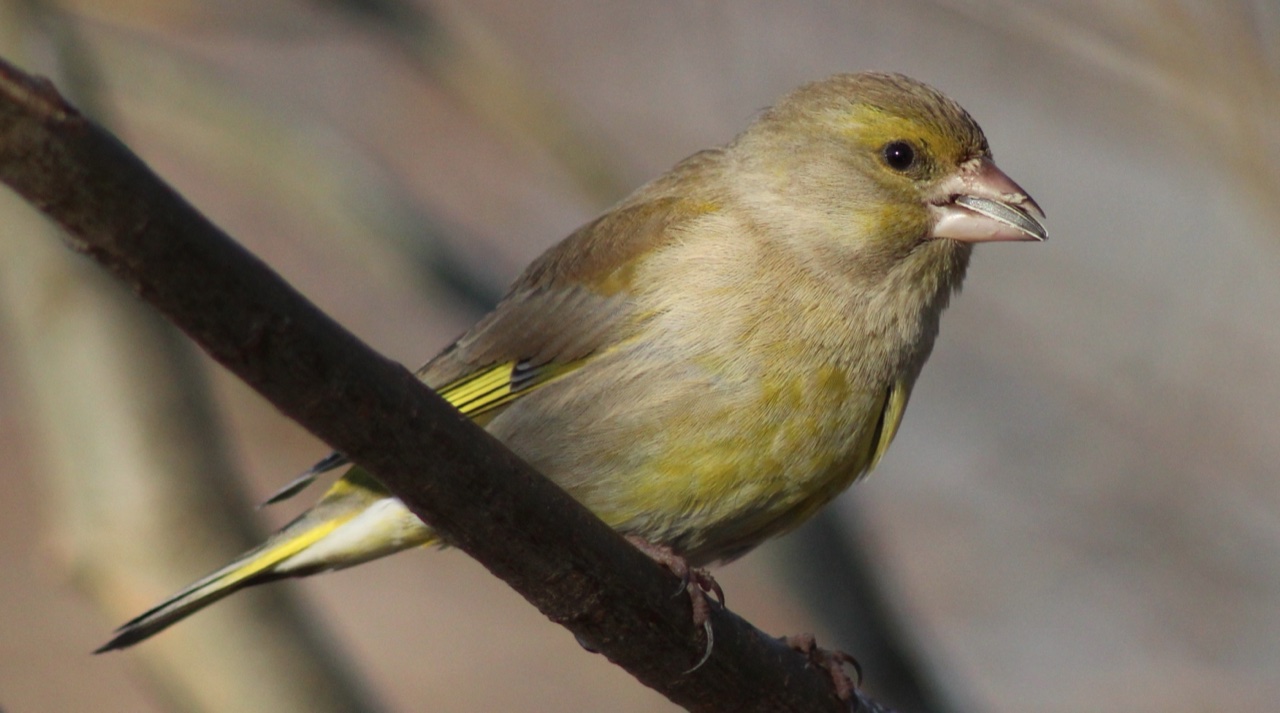
European Greenfinch
Chloris chloris
Identify the European Greenfinch by sound or photo and log your sightings with Birdpass.


The European Greenfinch is a sturdy, sparrow-sized, olive-green finch with bright yellow flashes in the wings and tail. It is widespread across Europe, North Africa and south-west Asia, where it is largely resident, though some northern birds move south in winter; it has been introduced to Australia, New Zealand and South America. With its thick, conical bill and wheezy, trilling song, it is a familiar bird of gardens and woodland edges. Many populations crashed in the 2000s due to the parasite Trichomonas.
Did you know?
- William Wordsworth wrote a poem about it, The Green Linnet, in 1803.
- Its scientific name comes from the Ancient Greek khloros, meaning green.
Voice
About the species
Identification
A yellowish-green finch with a clear yellow pattern on the wings and at the base of the tail that shows well in flight. The male is brighter than the female. It has a strong, deep, seed-eater's bill and pinkish legs; the flight is fast and fairly direct. Compared with Siskin it is larger, less streaked and lacks the male Siskin's black cap.
Family
Fringillidae
Size
Small (sparrow)
Colours
green, yellow, grey, brown
About the habitat
Gardens, parks, farmland with hedges, scrub, plantations and woodland edges, often near human settlements.
Diet
Mainly seeds of wild plants, trees and weeds, also buds, shoots, berries and flowers; in the breeding season some insects, especially for the nestlings. It readily takes sunflower seeds at feeders.
Behaviour
Gregarious outside the breeding season, often in flocks with other finches. Forages in trees, shrubs and on the ground and frequently visits feeders. The male sings a mix of trills, twitters and a wheezy “dzweee” and performs a slow, fluttering “butterfly” display flight. The nest is placed in dense trees or bushes; the female incubates while the male feeds her, and pairs may raise two or three broods.
Sources
Photo: Estormiz, CC0 https://commons.wikimedia.org/wiki/File:Carduelis chloris Oulu 20120507.JPG
Sound: Sonothèque ADVL, XC731705, CC0 1.0 https://xeno-canto.org/731705
Sound: Camille Vacher, XC930527, CC BY 4.0 https://xeno-canto.org/930527
Text: Wikipedia (English) + FinBIF species descriptions + GBIF regional observations + Wikipedia (English), CC BY-SA 4.0; FinBIF: CC BY 4.0; GBIF occurrence data; Wikipedia: CC BY-SA 4.0 https://en.wikipedia.org/wiki/European_greenfinch