Suomi
 Svenska
 Polski
 Čeština
 Slovenčina
 Norsk
 Dansk
Common Eider
Somateria mollissima
Identify the Common Eider by sound or photo and log your sightings with Birdpass.


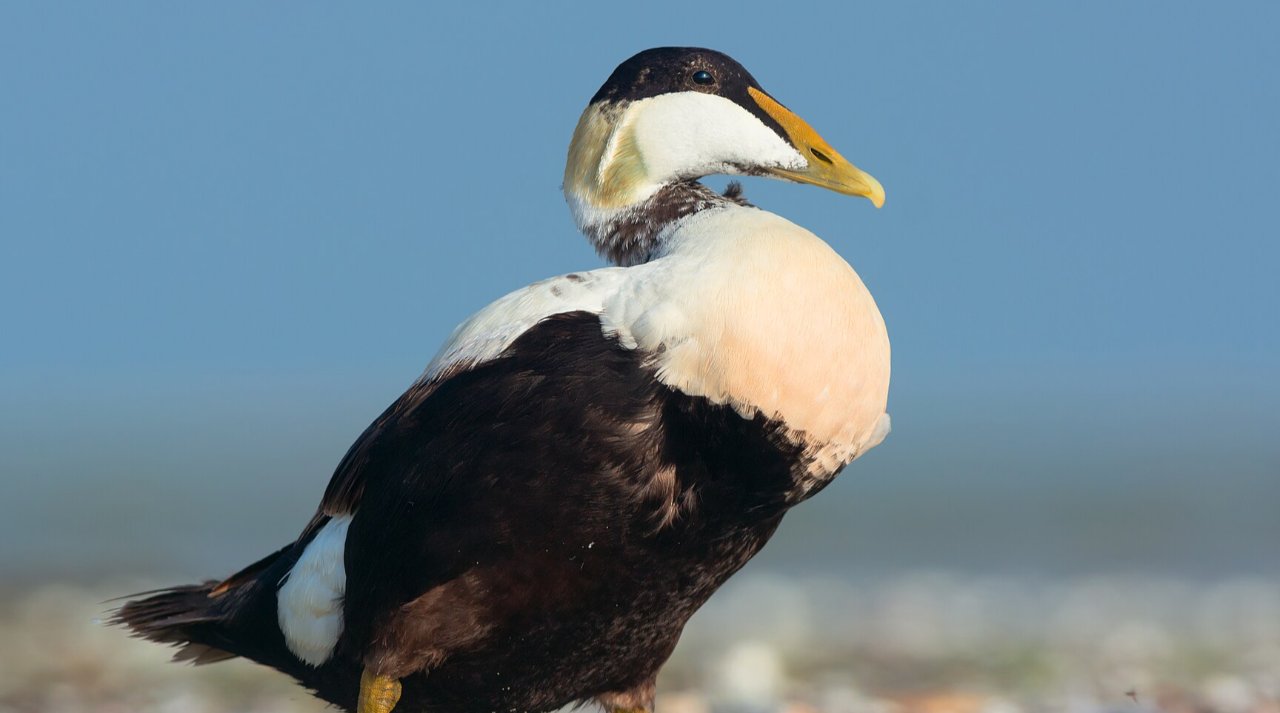
The Common Eider is the largest eider, a heavy sea duck of northern coasts across Europe, North America and eastern Siberia. It breeds on islands and low coasts close to the sea, lining its nest with exceptionally soft eiderdown, and winters in large flocks on cold coastal waters. Males are black and white with a green nape; females are mottled brown with a long, wedge-shaped head and bill. It has declined in the Baltic in recent decades.
Did you know?
- Eiderdown is still collected from nests after the ducklings have left, a sustainable tradition.
- A small population in Switzerland breeds on large lakes, feeding on invasive zebra mussels.
Voice
About the species
Identification
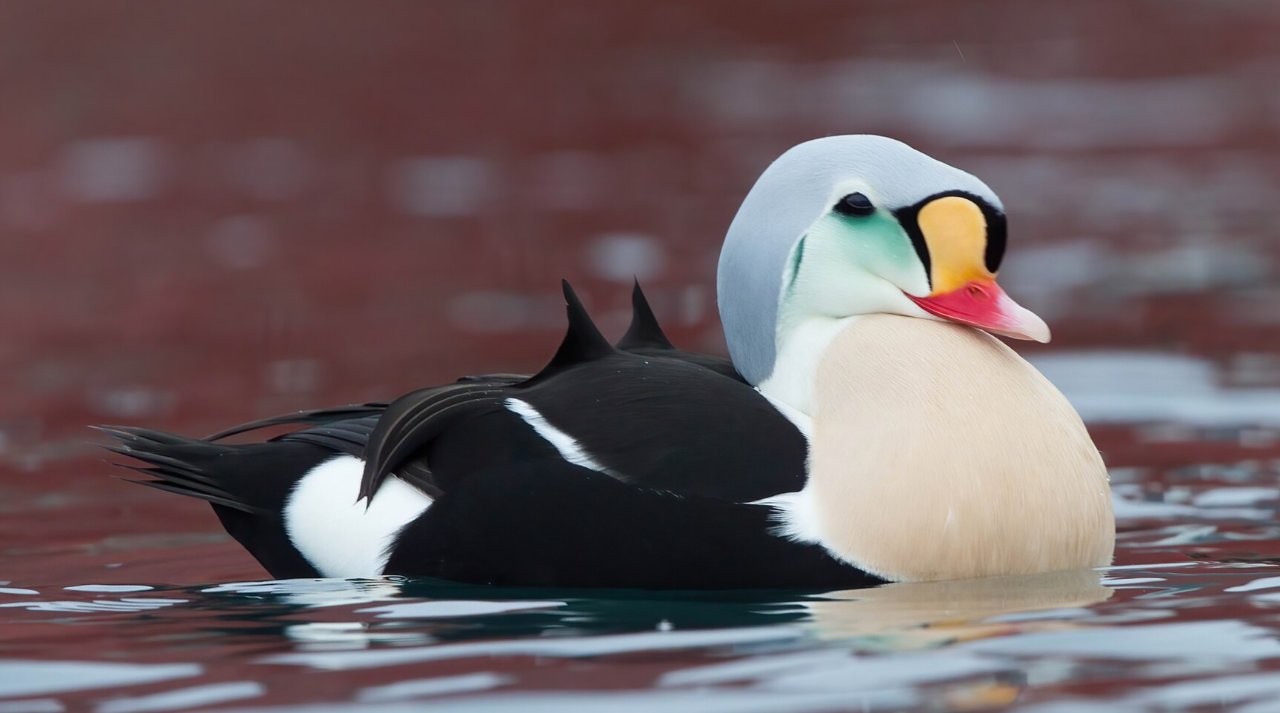
A large, bulky sea duck with a wedge-shaped head and bill. The male is strongly contrasting: white back and breast, black crown and black belly, with a pale green nape; the female is brown, mottled and barred. On land it looks clumsy, but on water it is an agile swimmer and diver. Males lack the orange bill knob and blue head of King Eider.
Family
Anatidae
Size
Very large (swan)
Colours
white, black, green
About the habitat
Cold marine coasts, outer and middle archipelagos, skerries and small islets, avoiding large forested islands with mammalian predators; in winter ice-free coastal waters and the open sea edge.
Diet
Mainly blue mussels, which it swallows whole and crushes in its gizzard, as well as snails, crabs (after removing legs and claws), sea urchins and occasionally small fish. It feeds in shallow water but can dive to about 20 m.
Behaviour
A strong diver that feeds in flocks on coastal waters. It breeds colonially on islets, often near gulls and terns; females return to where they hatched and form kin groups, sometimes laying eggs in relatives' nests. Males give low, cooing “ah-ooo” calls in display, then leave to moult while females incubate 4–6 eggs for 25–28 days. Broods merge into crèches guarded by several females. It flies low and fast over the sea in lines.
Sources
Photo: Ryzhkov Sergey, CC BY-SA 4.0 https://commons.wikimedia.org/wiki/File:Пухівка на Кінбурнській косі.jpg
Sound: Unknown, CC BY-SA 4.0 https://commons.wikimedia.org/wiki/File:Common_Eider_(Somateria_mollissima)_(W1CDR0001491_BD11).ogg
Text: Wikipedia (English) + GBIF regional observations + Wikipedia (Danish) + FinBIF species descriptions + Wikipedia (Finnish), CC BY-SA 4.0; GBIF occurrence data; Wikipedia: CC BY-SA 4.0; FinBIF: CC BY 4.0; Wikipedia: CC BY-SA 4.0 https://en.wikipedia.org/wiki/Common_eider