
 Suomi
 Svenska
 Polski
 Čeština
 Slovenčina
 Norsk
 Dansk
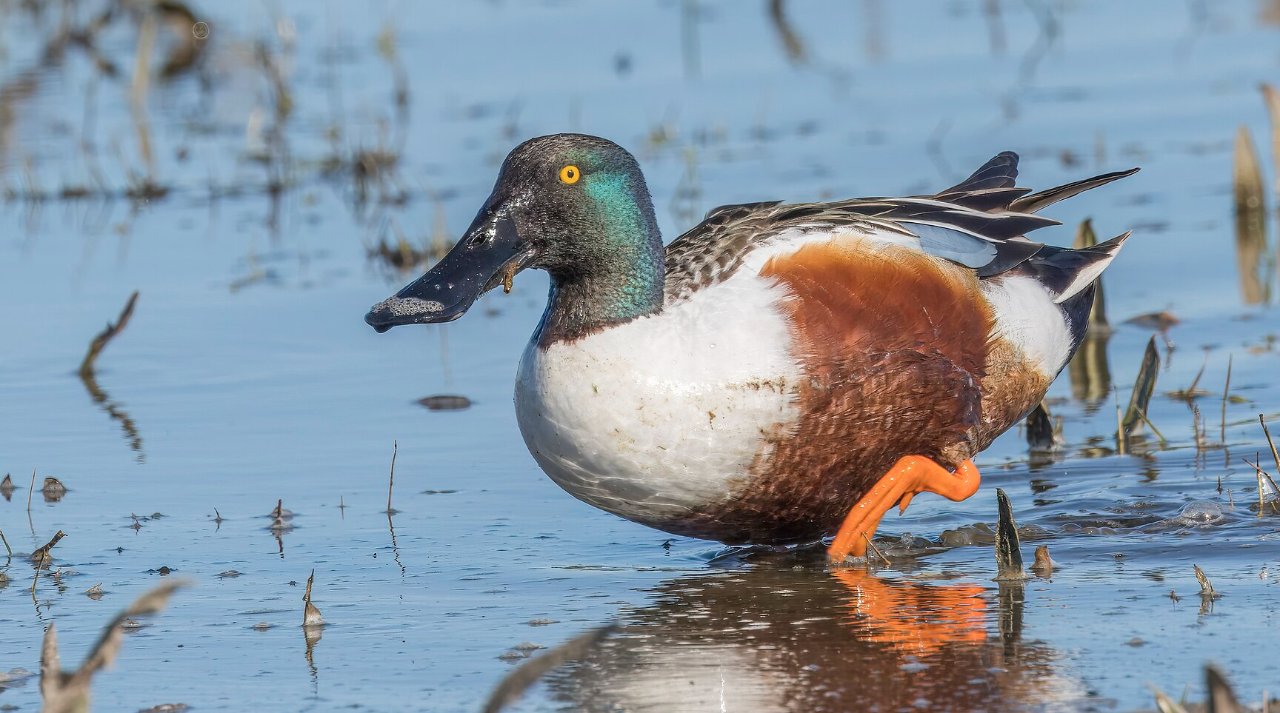
Northern Shoveler
Spatula clypeata
Identify the Northern Shoveler by sound or photo and log your sightings with Birdpass.


The Northern Shoveler is a common dabbling duck of the Northern Hemisphere, instantly recognised by its oversized, spoon-shaped bill. It breeds widely across northern Europe, Asia and North America and winters in southern Europe, Africa, South Asia and Central America. Its bill strains tiny prey from shallow water, letting it exploit food other ducks ignore.
Did you know?
- Its bill has fine, comb-like edges that sieve tiny invertebrates from the water.
- Some birds wintering in India cross the Himalayas.
Voice
About the species
Identification
A medium-sized, short-necked duck whose very broad, spatulate bill is its clearest feature, giving it a front-heavy look. The breeding male has a green head, yellow eye, white breast and chestnut flanks and belly, with pale blue upperwing coverts and a green speculum in flight. The female is mottled brown and resembles a Mallard but has bluish-grey upperwing coverts and the huge bill; the eclipse male resembles the female.
Family
Anatidae
Size
Large (crow)
Colours
green, white, brown, blue, orange
About the habitat
Shallow, nutrient-rich lakes, ponds and marshes with dense emergent vegetation, wet meadows and mud-bottomed marshes rich in invertebrates; also grassy islets near gull colonies.
Diet
Mainly small aquatic animals – crustaceans, snails, insect larvae and plankton – strained from the water with the comb-like edges of the bill; also seeds and duckweed.
Behaviour
Feeds by sweeping its broad bill from side to side along the surface, often in groups swimming in circles to stir up food. It nests on the ground in dense vegetation near water; the female lays about 9–11 eggs in May and incubates for 22–28 days, and the young fledge at 40–45 days. Males are territorial and perform elaborate courtship. It is generally quiet; males give a clunking “took-took”.
Sources
Photo: Charles J. Sharp, CC BY-SA 4.0 https://commons.wikimedia.org/wiki/File:Northern shoveler (Spatula clypeata) male Marken.jpg
Sound: Sonothèque ADVL, XC730779, CC0 1.0 https://xeno-canto.org/730779
Sound: Sonothèque ADVL, XC919310, CC0 1.0 https://xeno-canto.org/919310
Sound: Sonothèque ADVL, XC1041165, CC0 1.0 https://xeno-canto.org/1041165
Text: Wikipedia (English) + GBIF regional observations + Wikipedia (Danish) + FinBIF species descriptions + Wikipedia (Finnish), CC BY-SA 4.0; GBIF occurrence data; Wikipedia: CC BY-SA 4.0; FinBIF: CC BY 4.0; Wikipedia: CC BY-SA 4.0 https://en.wikipedia.org/wiki/Northern_shoveler
 male Marken.jpg)