Suomi
 Svenska
 Polski
 Čeština
 Slovenčina
 Norsk
 Dansk
White-cheeked Pintail
Anas bahamensis
Identify the White-cheeked Pintail by sound or photo and log your sightings with Birdpass.


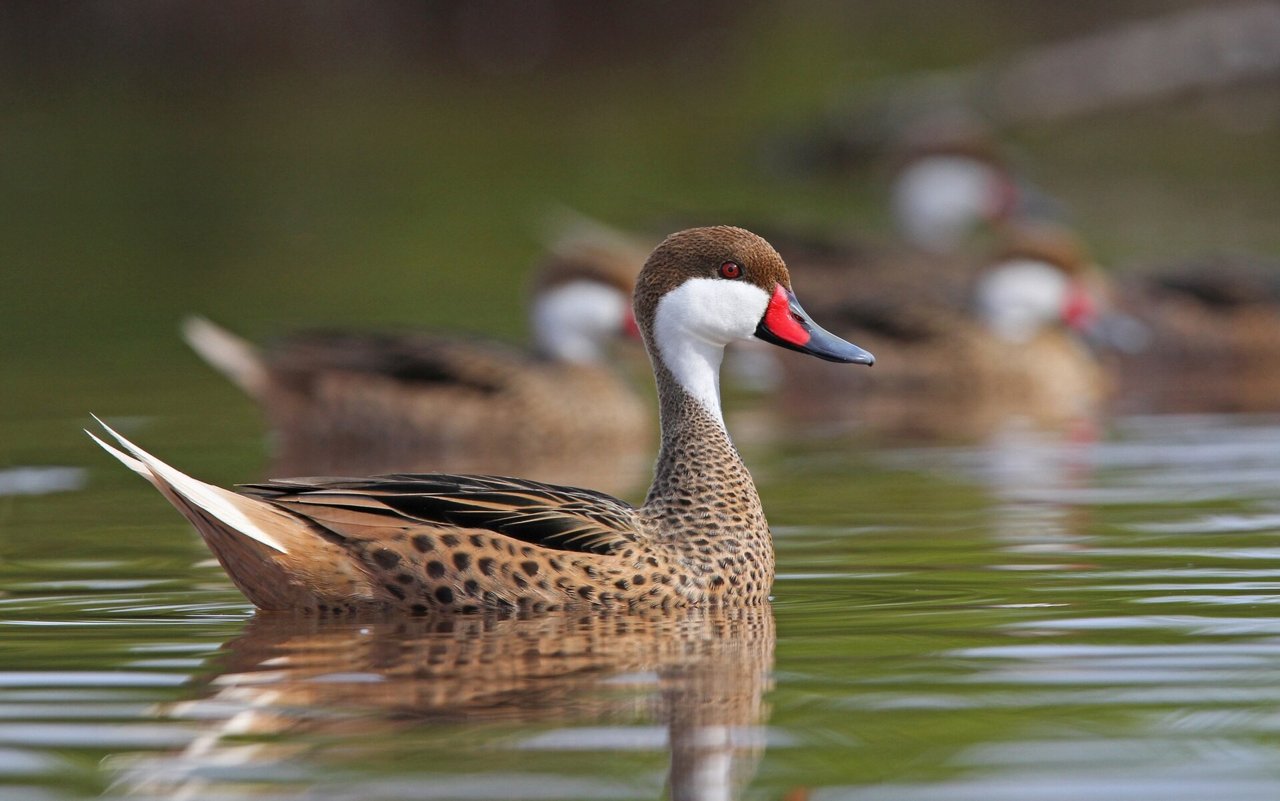
The White-cheeked Pintail is a handsome dabbling duck of the Caribbean, South America and the Galápagos, easily recognised by its crisp white cheeks, red-based grey bill and green wing patch. It favours brackish lagoons, estuaries and mangroves but also uses freshwater pools. Three subspecies are recognised, and the sexes look very similar. In Europe it occurs only as an escape from collections.
Did you know?
- The small, dull Galápagos subspecies is one of three recognised forms.
- Aviculture has produced a pale leucistic form known as the “silver Bahama pintail”.
About the species
Identification
A medium-sized brown duck with a sharply defined white cheek and throat, a grey-blue bill with a red base, a pointed buff tail and a green speculum bordered with buff. The female is slightly smaller and duller.
Family
Anatidae
Size
Large (crow)
Colours
brown, white, red, black, grey
About the habitat
Brackish lakes, estuaries and mangrove swamps as well as freshwater pools and lakes, mostly in coastal lowlands.
Diet
Aquatic plants such as wigeongrass, grass seeds, algae and small aquatic invertebrates, taken by dabbling.
Behaviour
A classic dabbling duck that forages at or just below the surface by tipping up in shallow water. It nests on the ground, concealed under vegetation close to water.
Sources
Photo: christoph_moning, CC BY 4.0 https://commons.wikimedia.org/wiki/File:Anas bahamensis bahamensis, Crossing Rocks, South Abaco, Bahamas 94136093.jpg
Text: Wikipedia (English), CC BY-SA 4.0 https://en.wikipedia.org/wiki/White-cheeked_pintail