Suomi
 Svenska
 Polski
 Čeština
 Slovenčina
 Norsk
 Dansk
Green-Winged Teal
Anas carolinensis
Identify the Green-Winged Teal by sound or photo and log your sightings with Birdpass.


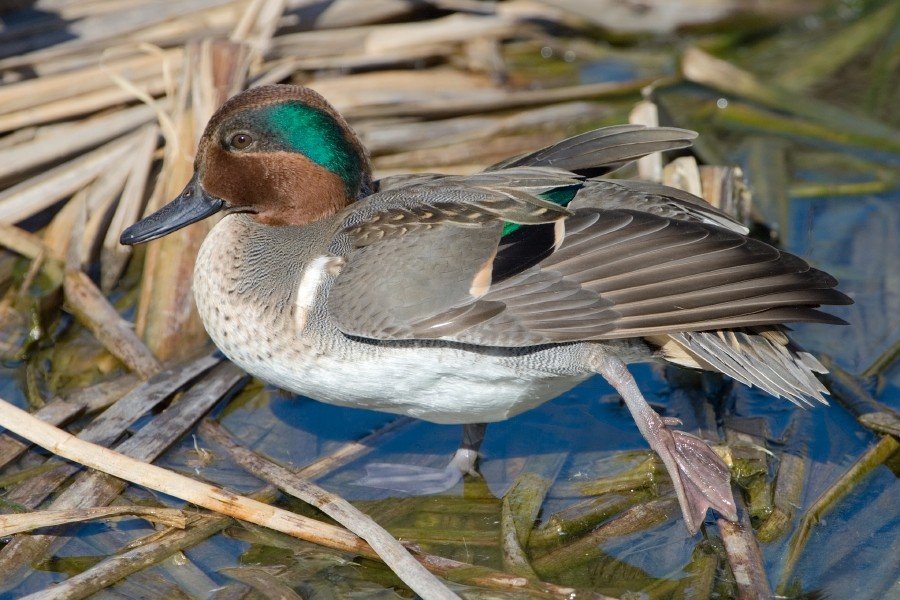
The Green-winged Teal is North America's smallest dabbling duck, breeding widely across the continent's northern wetlands and migrating far south for winter. Males are recognised by a chestnut head with a green eye patch and a vertical white bar on the side of the breast; females are mottled brown. Once lumped with the Eurasian Teal, it is now generally treated as a separate species. It is a rare vagrant to Europe.
Did you know?
- Its swift, twisting flocks can look more like shorebirds than ducks.
- Young Green-winged Teal have the fastest growth rate of any duck.
Voice
About the species
Identification
A very small duck. The male resembles a male Eurasian Teal but has a vertical white bar at the side of the breast and lacks the horizontal white stripe along the flanks; the cream border to the green face patch is fainter. Females are almost identical to female Eurasian Teal.
Family
Anatidae
Size
Large (crow)
Colours
grey, brown, green, white, black
About the habitat
Shallow, sheltered wetlands – marshes, ponds, bogs and slow streams – with dense emergent vegetation; in winter also estuaries and flooded fields.
Diet
Mainly seeds and other aquatic plant material, plus aquatic insects and other small invertebrates, taken by dabbling in shallow water and along muddy margins.
Behaviour
Gregarious outside the breeding season, forming tight, fast-flying flocks that wheel rapidly over wetlands. Males give a clear whistle, females a soft quack. Among the earliest spring arrivals on the breeding grounds; it nests on the ground under cover, and the males leave when incubation begins.
Sources
Photo: Alan D. Wilson, CC BY-SA 2.5 https://commons.wikimedia.org/wiki/File:Green-winged Teal, Port Aransas, Texas.jpg
Sound: Mikko Heikkinen, CC BY-SA 4.0 https://commons.wikimedia.org/wiki/File:Anas_crecca_-_Eurasian_Teal_XC467849.mp3
Text: Wikipedia (English), CC BY-SA 4.0 https://en.wikipedia.org/wiki/Green-winged_teal