
 Suomi
 Svenska
 Polski
 Čeština
 Slovenčina
 Norsk
 Dansk
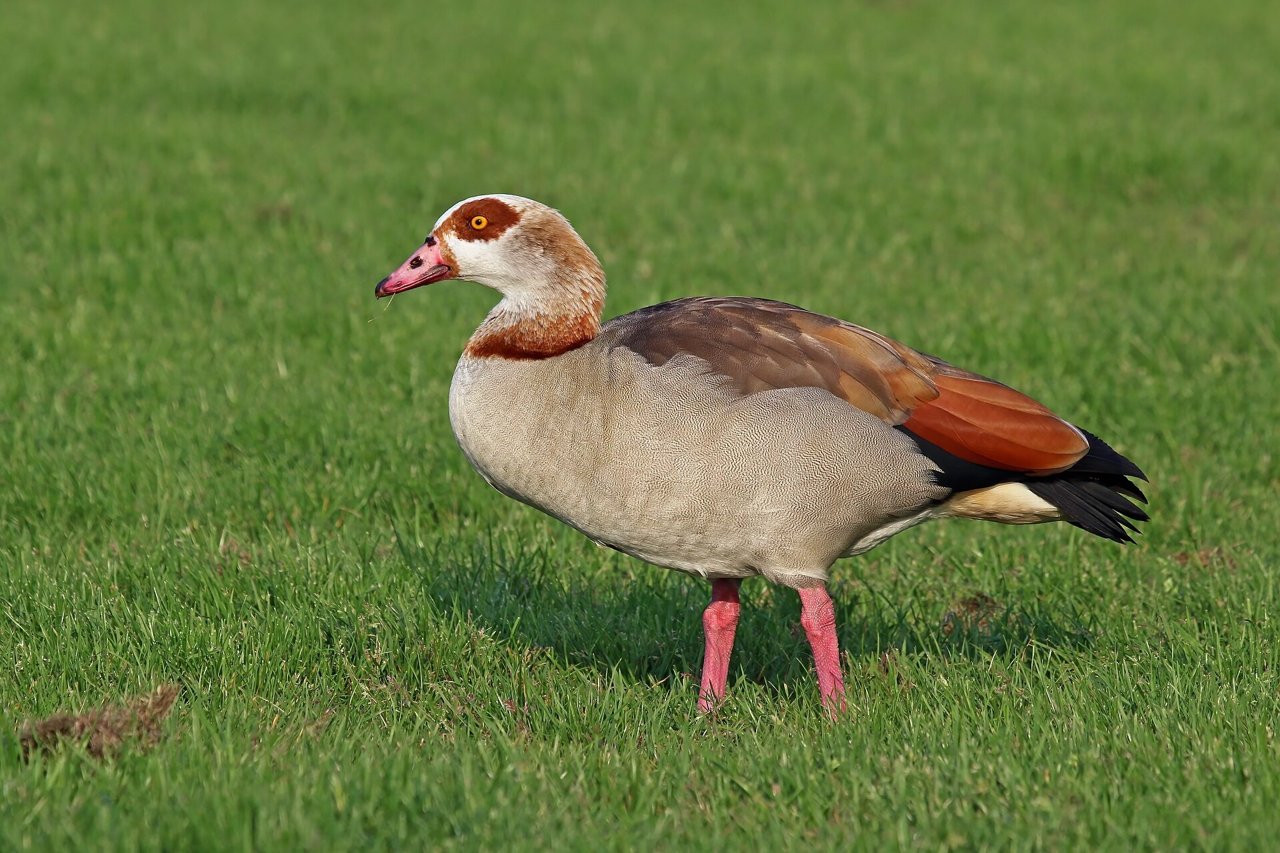
Egyptian Goose
Alopochen aegyptiaca
Identify the Egyptian Goose by sound or photo and log your sightings with Birdpass.


The Egyptian Goose is an African sheldgoose native to sub-Saharan Africa and the Nile Valley. Popular as an ornamental bird, it now has self-sustaining feral populations in parts of western Europe, the Middle East and the United States. It swims strongly and flies with heavy, goose-like wingbeats, flashing bold white wing patches. Males and females look alike, though males are a little larger.
Did you know?
- Egyptian Geese were regularly depicted in ancient Egyptian art.
- The genus name Alopochen means “fox-goose”, referring to its ruddy back.
Voice
About the species
Identification
A large, long-legged, goose-like duck with pale grey-brown body, a dark brown patch around the eye and another in the centre of the breast, pink legs and bill. In flight it shows large white wing patches and a green speculum. Unlike any native waterfowl in northern Europe.
Family
Anatidae
Size
Very large (swan)
Colours
brown, grey, white, orange
About the habitat
Open or semi-open country near fresh water – rivers, lakes and wetlands – and, in introduced ranges, parks and farmland.
Diet
Mainly plant material – grasses, leaves, seeds and shoots – often grazing on lawns and fields; young birds also take small invertebrates.
Behaviour
Usually seen in pairs or family groups; strongly territorial and often aggressive towards other birds. Males give hoarse, breathy calls while females have a loud, raucous quack. Courtship includes honking, neck-stretching and wing displays. It nests in a variety of sites, from the ground to tree holes and old nests of other birds.
Sources
Photo: Charles J. Sharp, CC BY-SA 4.0 https://commons.wikimedia.org/wiki/File:Egyptian goose (Alopochen aegyptiaca) London.jpg
Sound: Sonothèque ADVL, XC918822, CC0 1.0 https://xeno-canto.org/918822
Text: Wikipedia (English), CC BY-SA 4.0 https://en.wikipedia.org/wiki/Egyptian_goose
 London.jpg)