Suomi
 Svenska
 Polski
 Čeština
 Slovenčina
 Norsk
 Dansk
Western Capercaillie
Tetrao urogallus
Identify the Western Capercaillie by sound or photo and log your sightings with Birdpass.


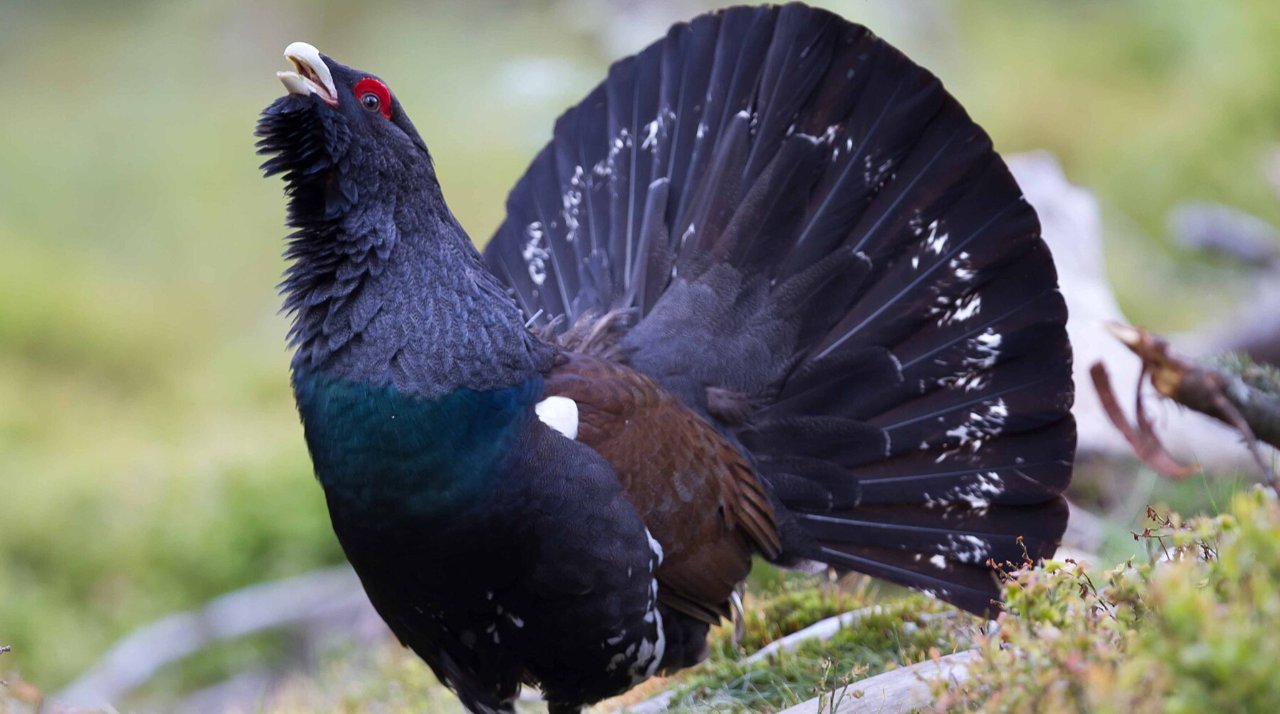
The Western Capercaillie is the largest grouse, a hefty, mostly ground-dwelling bird of mature conifer forests across northern Europe and western Siberia and in the mountains of central and southern Europe. It is famous for the males' dramatic dawn lek displays. Males are much larger and darker than the mottled, rufous-breasted females. Many central European populations are fragmented or declining.
Did you know?
- Its name comes from Gaelic capall coille, “horse of the woods”.
- It is the world's largest grouse; males may weigh twice as much as females.
Voice
About the species
Identification
The largest forest grouse. The male is dark grey-black mottled with brown and grey, with a greenish-glossed breast, a red wattle above the eye and a white spot at the wing bend; its large tail is fanned during display. The female is mottled brown with a rufous-orange breast; she resembles a female Black Grouse but is larger, heavier and has a rufous breast patch and a rounded tail.
Family
Phasianidae
Size
Very large (swan)
Colours
grey, black, brown, green, red
About the habitat
Extensive mature coniferous forest, often pine or spruce, with an open structure and a rich field layer of bilberry; also bog edges and clearings.
Diet
Pine and spruce needles and buds in winter; leaves, shoots and berries such as bilberry in the snow-free season. Chicks rely heavily on insects such as ants and caterpillars.
Behaviour
Mostly terrestrial but roosts in trees, often feeding in pines in winter; it flies powerfully in short bursts. In spring males gather at leks at dawn, fanning their tails and producing clicks, pops and a whetting sound. Hens nest on the ground and raise the precocial chicks alone. It sometimes hybridises with Black Grouse. In cold spells it roosts in snow.
Sources
Photo: David Palmer, CC BY 2.0 https://commons.wikimedia.org/wiki/File:David Palmer Capercaillie.jpg
Sound: Unknown, CC BY-SA 4.0 https://commons.wikimedia.org/wiki/File:Western_Capercaillie_(Tetrao_urogallus)_(W1CDR0001418_BD47).ogg
Text: Wikipedia (English) + FinBIF species descriptions, CC BY-SA 4.0; FinBIF: CC BY 4.0 https://en.wikipedia.org/wiki/Western_capercaillie