Suomi
 Svenska
 Polski
 Čeština
 Slovenčina
 Norsk
 Dansk
Sandhill Crane
Antigone canadensis
Identify the Sandhill Crane by sound or photo and log your sightings with Birdpass.


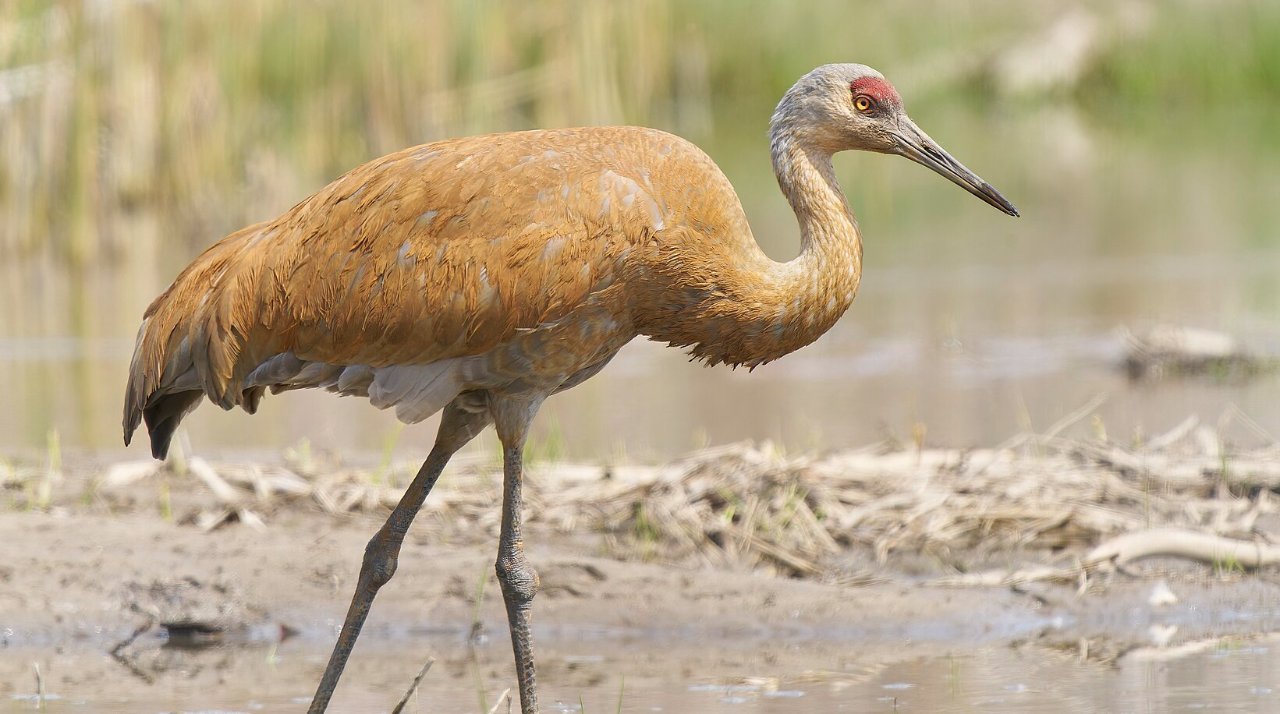
The Sandhill Crane is a tall, grey crane of North America that also reaches north-eastern Siberia, recognised by its red forehead, long legs and straight-necked flight. It favours open wetlands and river edges and is renowned for spectacular migrations, especially through the Platte River valley in Nebraska. It is a very rare vagrant to Europe.
Did you know?
- Up to 450,000 Sandhill Cranes pass through Nebraska's central Platte River valley each spring.
- Mated pairs perform a synchronised “unison call”, the female giving two notes for each of the male's.
Voice
About the species
Identification
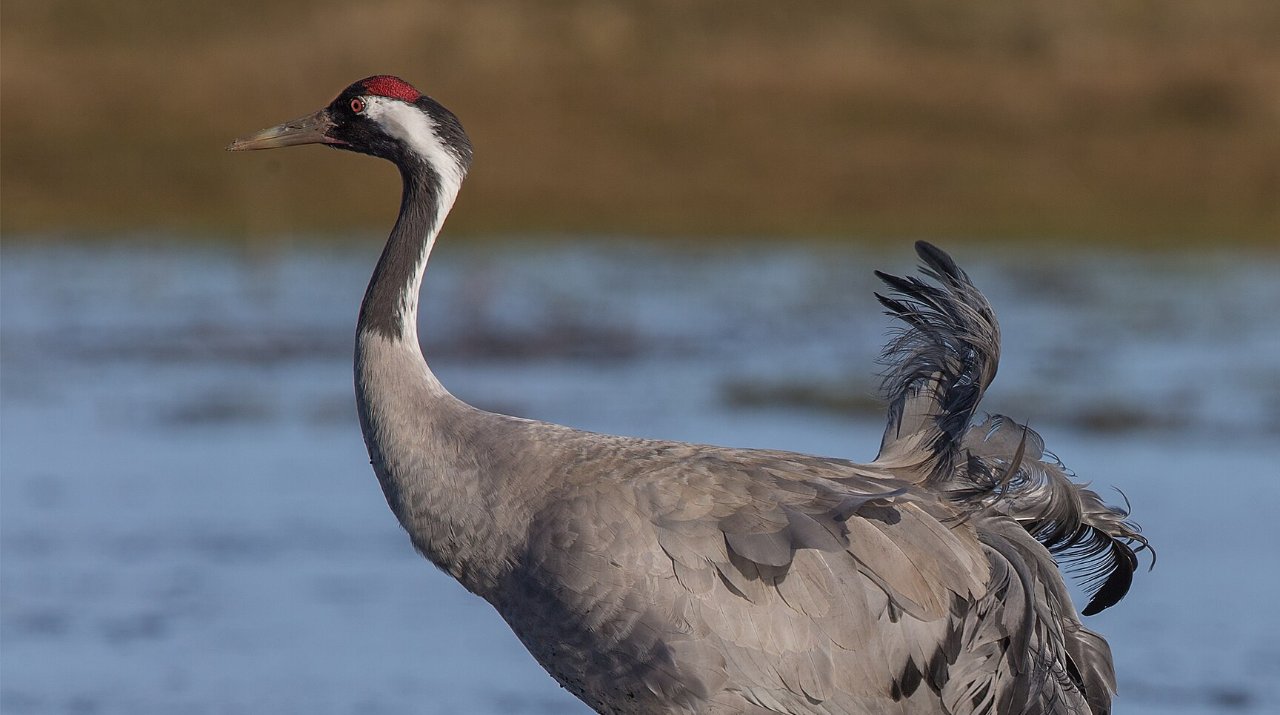
A tall grey crane with a red forehead, white cheeks and a straight dark bill; plumage often stained rusty brown from preening with iron-rich mud. Smaller and shorter-billed than Common Crane and lacks its black-and-white head and neck pattern.
Family
Gruidae
Size
Very large (swan)
Colours
grey, brown, red, white
About the habitat
Open wetlands and shallow waters at the edges of lakes, marshes and rivers, with adjacent wet meadows, prairies and farmland.
Diet
An omnivore: seeds, grain and tubers, together with insects and other invertebrates and occasionally small vertebrates, found by probing and gleaning in wetlands, meadows and fields.
Behaviour
Highly social and migratory, travelling in large flocks and soaring on thermals with little flapping. Its loud, rolling, trumpeting calls carry far. Pairs perform a synchronised “unison call” and dance displays with leaps and bows.
Sources
Photo: Paul Danese, CC BY-SA 4.0 https://commons.wikimedia.org/wiki/File:20260423 sandhill crane matthaei botanical gardens PD07096.jpg
Sound: Jonathon Jongsma, XC111490, CC BY-SA 3.0 https://xeno-canto.org/111490
Sound: Jonathon Jongsma, XC111491, CC BY-SA 3.0 https://xeno-canto.org/111491
Text: Wikipedia (English), CC BY-SA 4.0 https://en.wikipedia.org/wiki/Sandhill_crane