Suomi
 Svenska
 Polski
 Čeština
 Slovenčina
 Norsk
 Dansk
Velvet Scoter
Melanitta fusca
Identify the Velvet Scoter by sound or photo and log your sightings with Birdpass.


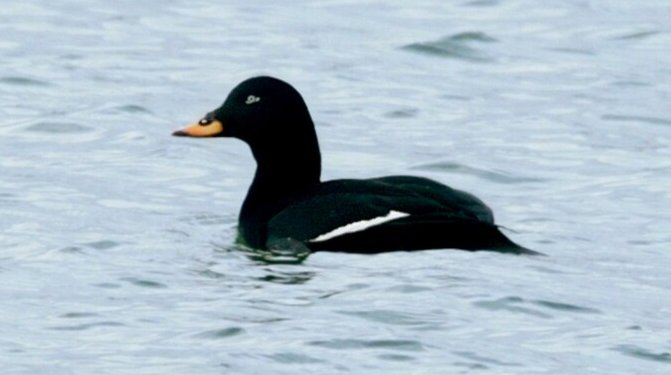
The Velvet Scoter is a large, dark sea duck that breeds across northern Europe into western Siberia and winters on temperate coasts, including the Black and Caspian Seas. Males are velvety black with a small white mark below the eye and a swollen orange-yellow bill; females are brown with pale face patches. Both sexes show a bold white wing patch. It is listed as Vulnerable globally.
Did you know?
- Its scientific name means “dusky black duck”.
- It belongs to a species complex that also includes the White-winged and Stejneger's Scoters.
About the species
Identification
The male is almost entirely black, with white wing patches and a white spot below the eye; the bill is thick and yellow. Females and young are dark brown with pale spots on the cheek and a broad white patch on the upperwing; the bill is greyish. The white wing patch, visible in flight, separates it from Common Scoter.
Family
Anatidae
Size
Very large (swan)
Colours
black, white, orange
About the habitat
Breeds near large lakes, slow rivers, archipelagos and tundra pools in boreal and subarctic regions; winters on shallow coastal seas, bays and estuaries.
Diet
Mainly bottom-living molluscs such as mussels and clams, as well as crustaceans, aquatic insects and small fish, taken by diving.
Behaviour
Often in tight flocks offshore, diving in quick succession and resurfacing together, and taking off en masse. It flies low over the water in strong, direct lines. It nests on the ground near fresh or brackish water, well hidden in vegetation; the female incubates and tends the young, while the male leaves early to moult.
Sources
Photo: Vince, CC BY 2.0 https://commons.wikimedia.org/wiki/File:Velvet Scoter, Eyebrook Reservoir, Leics.jpg
Text: Wikipedia (English) + FinBIF species descriptions, CC BY-SA 4.0; FinBIF: CC BY 4.0 https://en.wikipedia.org/wiki/Velvet_scoter