Suomi
 Svenska
 Polski
 Čeština
 Slovenčina
 Norsk
 Dansk
Franklin's Gull
Leucophaeus pipixcan
Identify the Franklin's Gull by sound or photo and log your sightings with Birdpass.


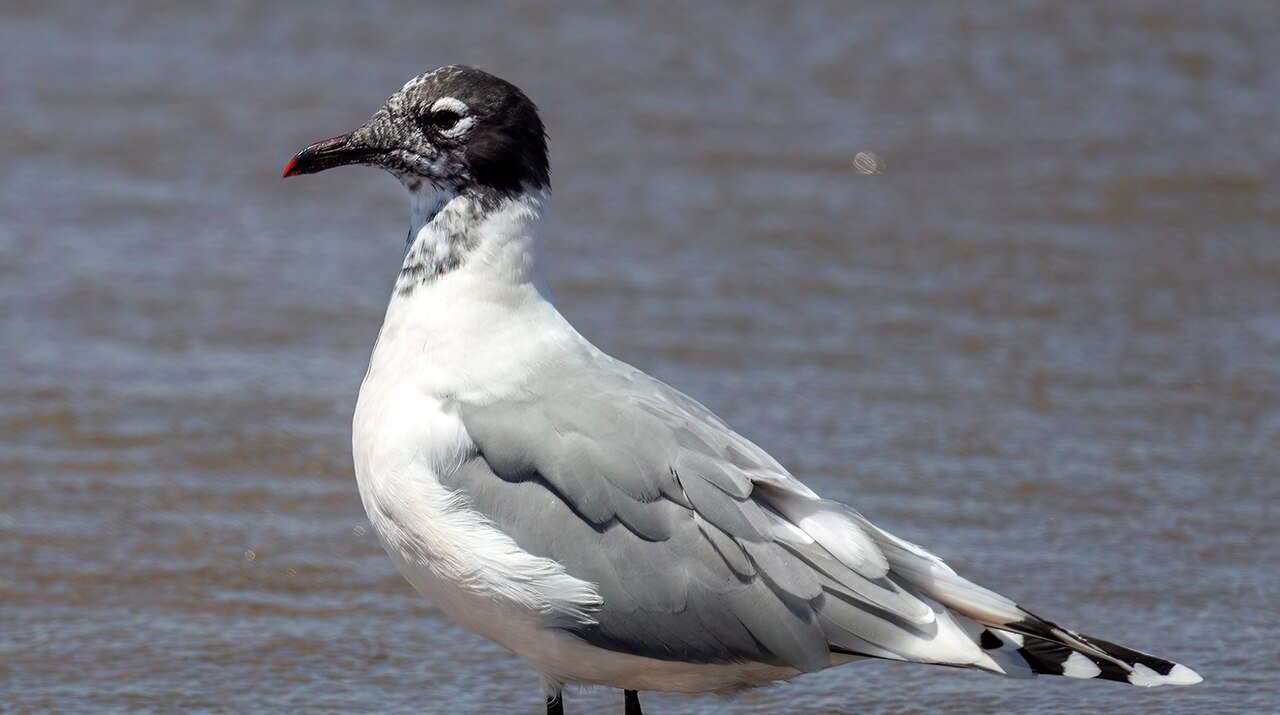
Franklin's Gull is a small, migratory hooded gull that breeds in colonies on prairie marshes of central Canada and the northern United States. In summer it has a black hood, a red bill and legs and dark grey upperwings with black tips bordered by a white band. It makes long flights to winter along the Pacific coast of South America, from Peru to Chile, and is a rare vagrant elsewhere, including Europe.
Did you know?
- Its name honours the Arctic explorer Sir John Franklin.
- Unusually for a gull, it moults its flight feathers twice a year.
About the species
Identification
In breeding plumage the adult has a black hood with a clear, thick white eye-ring and a dark red bill and legs. The upperwings are dark grey, and the outer primaries have black-and-white tips separated from the grey by a white band; the underparts may show a pink flush. In winter the hood is only partly lost, leaving a dark half-hood. Young birds have dark upperwings, a dark tail band and dark patches on the head.
Family
Laridae
Size
Large (crow)
Colours
grey, white, black, red
About the habitat
Breeds in prairie marshes and lakes with emergent vegetation; on migration fields and wetlands; in winter Pacific coasts of South America.
Diet
Omnivorous, feeding heavily on insects, especially in the breeding season – hawking swarms in the air and picking them from the ground and water; also small fish, earthworms and scraps.
Behaviour
Highly social and colonial, it nests on floating platforms in marshes, laying two to three eggs that hatch after about three weeks. It forages in flight over insect swarms and follows ploughs, and in spring flocks may drift down rivers picking insects from the surface before flying back upstream.
Sources
Photo: Polinova, CC BY-SA 4.0 https://commons.wikimedia.org/wiki/File:FranklinsGull.jpg
Text: Wikipedia (English), CC BY-SA 4.0 https://en.wikipedia.org/wiki/Franklin%27s_gull