Suomi
 Svenska
 Polski
 Čeština
 Slovenčina
 Norsk
 Dansk
Ring-Billed Gull
Larus delawarensis
Identify the Ring-Billed Gull by sound or photo and log your sightings with Birdpass.


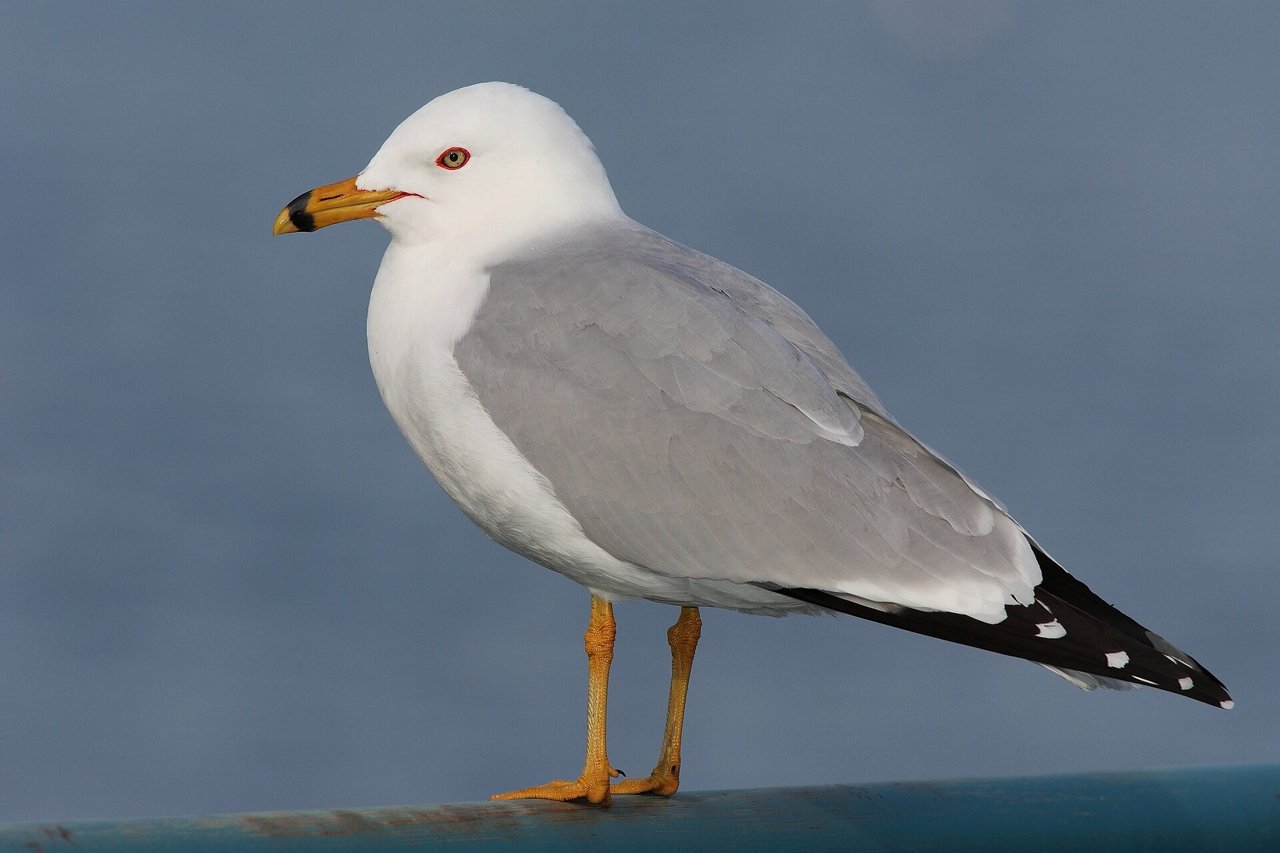
The Ring-billed Gull is a medium-sized North American gull, easily recognised by the neat black ring on its yellow bill and its yellow legs. It breeds in colonies by lakes, rivers and coasts across Canada and the northern United States and winters mainly across the United States into Mexico. Highly adaptable, it is a familiar sight on beaches, in parks and even car parks. It is a rare vagrant to Europe.
Did you know?
- The oldest known Ring-billed Gull was recorded alive at 28 years of age.
- Its scientific name, delawarensis, refers to the Delaware River.
Voice
About the species
Identification
A medium-sized gull, between Common and Herring Gull in size, with a pale grey back, a pale yellow eye and a yellow bill with a clear black ring near the tip; the legs are yellow. In flight the black wingtips show small white mirrors. Young birds are mottled grey-brown with a pink bill tipped black. Told from Common Gull by its pale eye, heavier ringed bill and paler grey back.
Family
Laridae
Size
Large (crow)
Colours
white, grey, black, yellow
About the habitat
Breeds by lakes, rivers and coasts on open, flat islands and rooftops; outside the breeding season beaches, harbours, parks, fields and urban areas.
Diet
Opportunistic: insects, fish, earthworms, eggs, small rodents and grain, taken in the air, on water and on land; it scavenges and readily steals food from other birds and people.
Behaviour
Nests in dense colonies on the ground on islands and increasingly on flat rooftops, often returning to the same site year after year. Migratory and gregarious, it gathers in large flocks around human activity and is bold enough to chase hawks.
Sources
Photo: User:Mdf, CC BY-SA 3.0 https://commons.wikimedia.org/wiki/File:Larus-delawarensis-021.jpg
Sound: Jonathon Jongsma, XC75111, CC BY-SA 3.0 https://xeno-canto.org/75111
Text: Wikipedia (English), CC BY-SA 4.0 https://en.wikipedia.org/wiki/Ring-billed_gull