Suomi
 Svenska
 Polski
 Čeština
 Slovenčina
 Norsk
 Dansk
Bonaparte's Gull
Chroicocephalus philadelphia
Identify the Bonaparte's Gull by sound or photo and log your sightings with Birdpass.


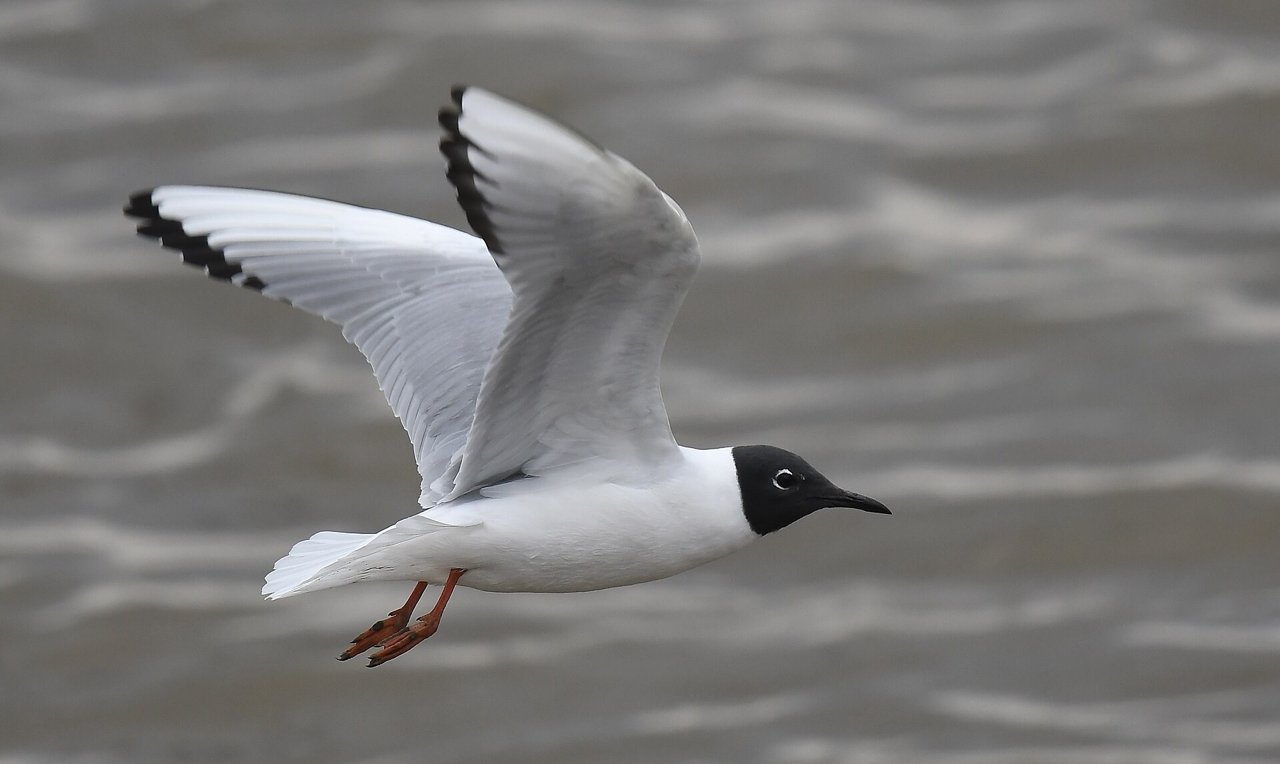
Bonaparte's Gull is a small, elegant gull of North America. In the breeding season it has a slate-black hood; in winter its head is mostly white with a dark ear spot, and it has a slim dark bill. It breeds in the boreal forest and winters on coasts and the Great Lakes. It is named after the ornithologist Charles Lucien Bonaparte, nephew of Napoleon, and is a rare vagrant to Europe.
Did you know?
- Unlike most gulls, it nests in trees.
- Flocks gather at salmon spawning runs to eat drifting eggs.
Voice
About the species
Identification
A small gull, smaller than a Black-headed Gull, with a thin black bill, pink legs, pale grey upperparts and a white wedge on the outer wing with black trailing edge. The underside of the primaries is pale, unlike the dark under-primaries of Black-headed Gull.
Family
Laridae
Size
Medium (thrush)
Colours
white, grey, black, red
About the habitat
Breeds in open boreal forest near bogs, fens, marshes and ponds; winters along coasts, estuaries and on large lakes.
Diet
Mainly insects on the breeding grounds; on migration and in winter small fish, crustaceans, molluscs, krill, marine worms and other invertebrates.
Behaviour
A strongly migratory gull with light, tern-like flight. It quickly congregates where food is abundant, for example over termite swarms or at salmon runs, and sometimes steals food from other birds. Unusually for a gull, it nests in trees, usually conifers near water.
Sources
Photo: Wildreturn, CC BY 2.0 https://commons.wikimedia.org/wiki/File:Bonaparte's Gull in breeding plumage - 52016973462.jpg
Sound: steve, XC926085, CC BY-SA 4.0 https://xeno-canto.org/926085
Text: Wikipedia (English), CC BY-SA 4.0 https://en.wikipedia.org/wiki/Bonaparte%27s_gull