Suomi
 Svenska
 Polski
 Čeština
 Slovenčina
 Norsk
 Dansk
American Herring Gull
Larus smithsonianus
Identify the American Herring Gull by sound or photo and log your sightings with Birdpass.


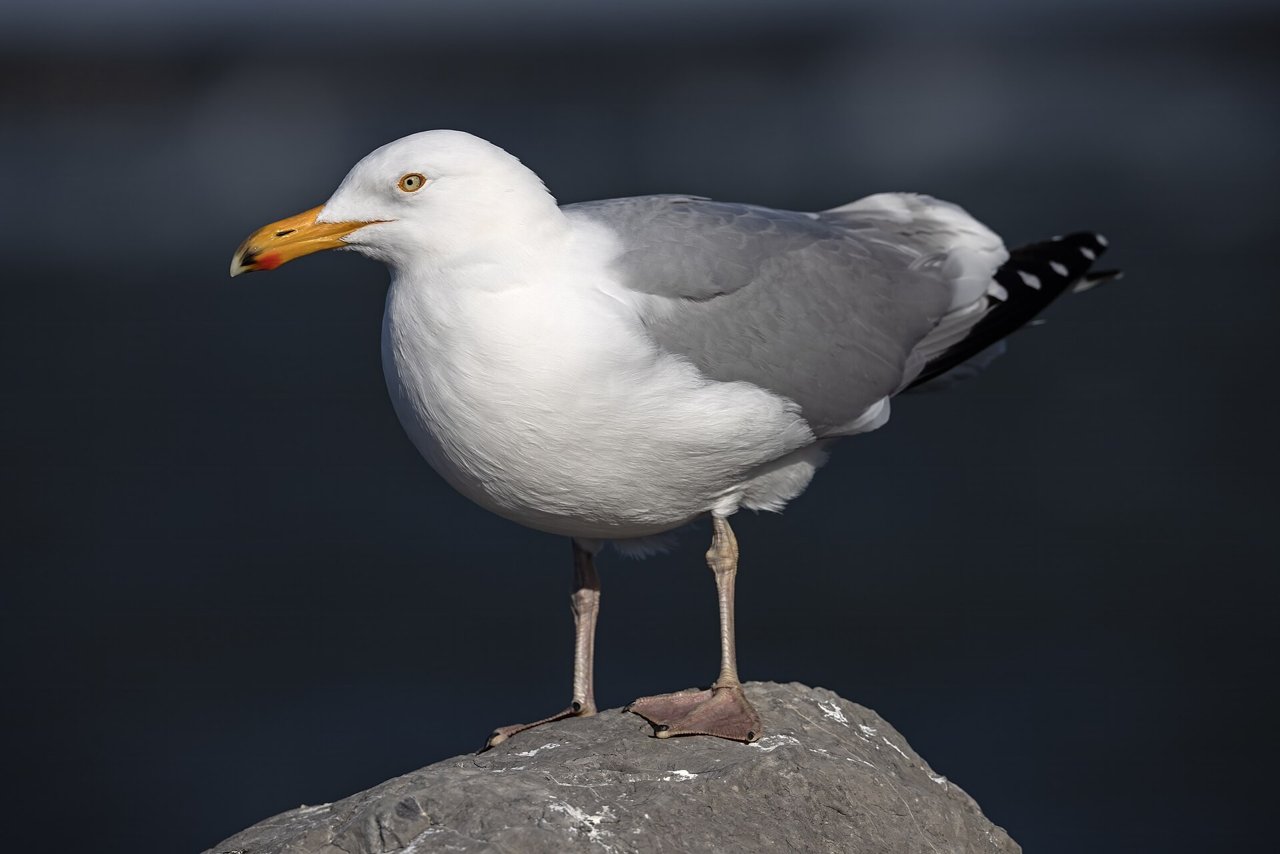
The American Herring Gull is a large, pink-legged gull of North America, now widely treated as separate from the European Herring Gull. Adults are white with a pale grey back and black-tipped wings with white mirrors, while young birds are darker and more evenly brown. Extremely adaptable, it lives on coasts, lakes and rivers and even in car parks and landfills. It is a rare vagrant to Europe.
Did you know?
- It drops clams and mussels onto roads or rocks from the air to crack them open.
- The name smithsonianus honours James Smithson, founder of the Smithsonian Institution.
About the species
Identification
Adults are very like European Herring Gulls: pale grey back, white head and underparts, black wingtips with white mirrors, a yellow bill with a red spot and pink legs. Young birds are darker and more uniform brown, with a dark tail, dark rump barring and evenly brown underparts, which distinguish them from young European Herring Gulls.
Family
Laridae
Size
Large (crow)
Colours
white, grey, black, yellow
About the habitat
Breeds on coasts, islands and cliffs and by lakes across northern North America, sometimes on roofs; feeds at sea, on beaches, mudflats, lakes, rivers, fields and landfills.
Diet
Highly opportunistic: mussels, crabs, sea urchins and squid, fish such as capelin and smelt, insects, eggs and chicks of other birds, carrion and refuse. It feeds from the surface, by shallow plunge-diving, scavenging and dropping shellfish to crack them.
Behaviour
Vocal and social, it breeds in colonies near water; both parents build the ground nest, incubate the usual three eggs and feed the young, which fledge in six to seven weeks. Young birds take about four years to reach adult plumage.
Sources
Photo: Chuck Homler d/b/a Focus On Wildlife, CC BY-SA 4.0 https://commons.wikimedia.org/wiki/File:Herring Gull Very Close.jpg
Text: Wikipedia (English), CC BY-SA 4.0 https://en.wikipedia.org/wiki/American_herring_gull