
 Suomi
 Svenska
 Polski
 Čeština
 Slovenčina
 Norsk
 Dansk
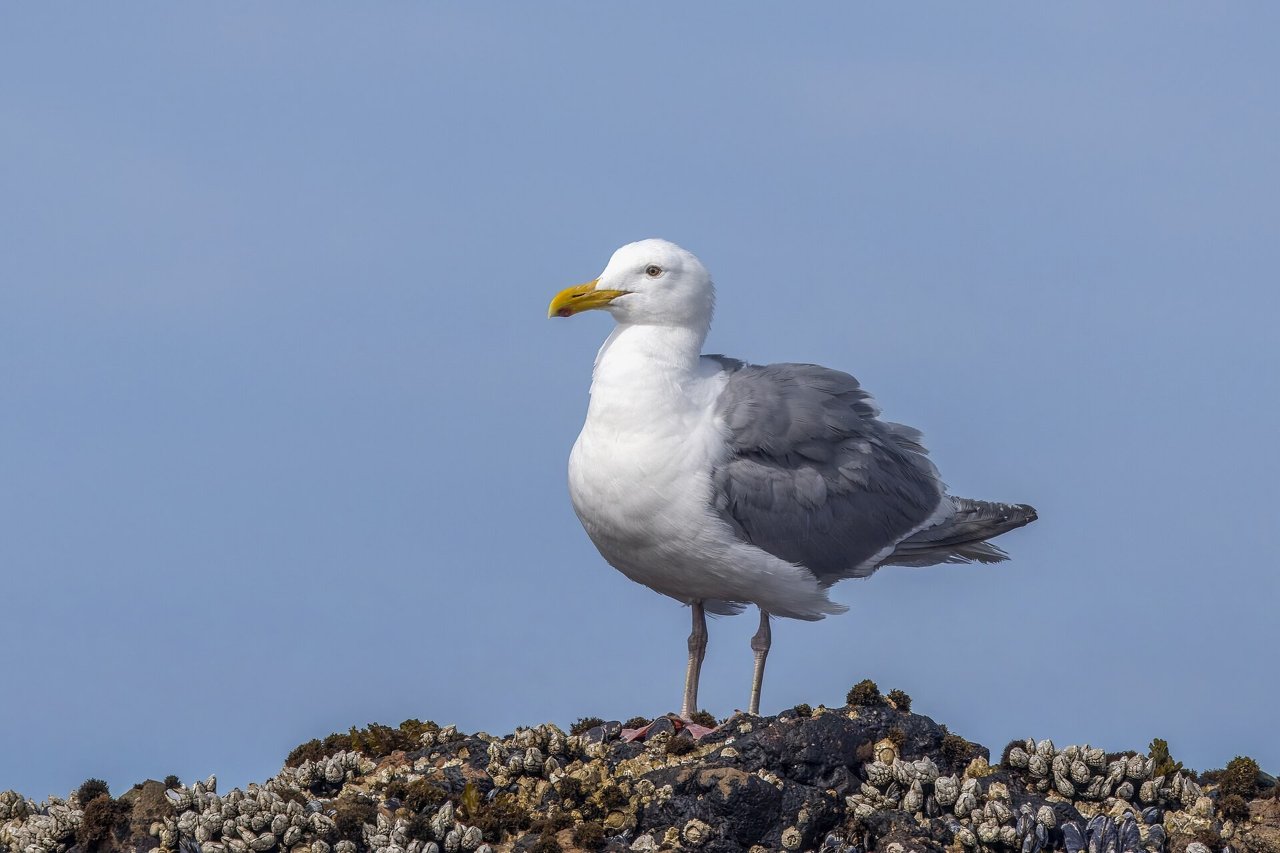
Glaucous-winged Gull
Larus glaucescens
Identify the Glaucous-winged Gull by sound or photo and log your sightings with Birdpass.


The Glaucous-winged Gull is a large, white-headed gull of the North Pacific, rarely found far from the sea. Adults have pale silvery-grey wings with wingtips of the same colour as the back, pink legs and a yellow bill with a red spot; in winter the head becomes smudged. It breeds from coastal Alaska to the Russian Far East and winters south along the Pacific coast to north-west Mexico.
Did you know?
- A ringed Glaucous-winged Gull lived for more than 37 years.
- Hybrids with Western Gull are known as “Olympic Gulls”.
About the species
Identification
A large, heavy gull with a pale grey back and grey wingtips that are only slightly darker than the rest of the wing, lacking black. The bill is heavy and yellow with a red spot, the legs pink and the eye dark. Young birds are evenly grey-brown with grey-brown flight feathers and a black bill.
Family
Laridae
Size
Large (crow)
Colours
white, grey, yellow, red
About the habitat
Almost always coastal – beaches, rocky shores, bays, harbours and offshore islands along the North Pacific.
Diet
Opportunistic coastal feeder: fish, mussels and other shore invertebrates, carrion and scraps; in towns it takes handouts and raids garbage.
Behaviour
Breeds in colonies in summer, usually raising two or three chicks that fledge at about six weeks. It forages along shores and in harbours, often in noisy groups. Where it meets the Western Gull the two hybridise widely.
Sources
Photo: Charles J. Sharp, CC BY-SA 4.0 https://commons.wikimedia.org/wiki/File:Glaucous-winged gull (Larus glaucescens) Tofino.jpg
Text: Wikipedia (English), CC BY-SA 4.0 https://en.wikipedia.org/wiki/Glaucous-winged_gull
 Tofino.jpg)