
 Suomi
 Svenska
 Polski
 Čeština
 Slovenčina
 Norsk
 Dansk
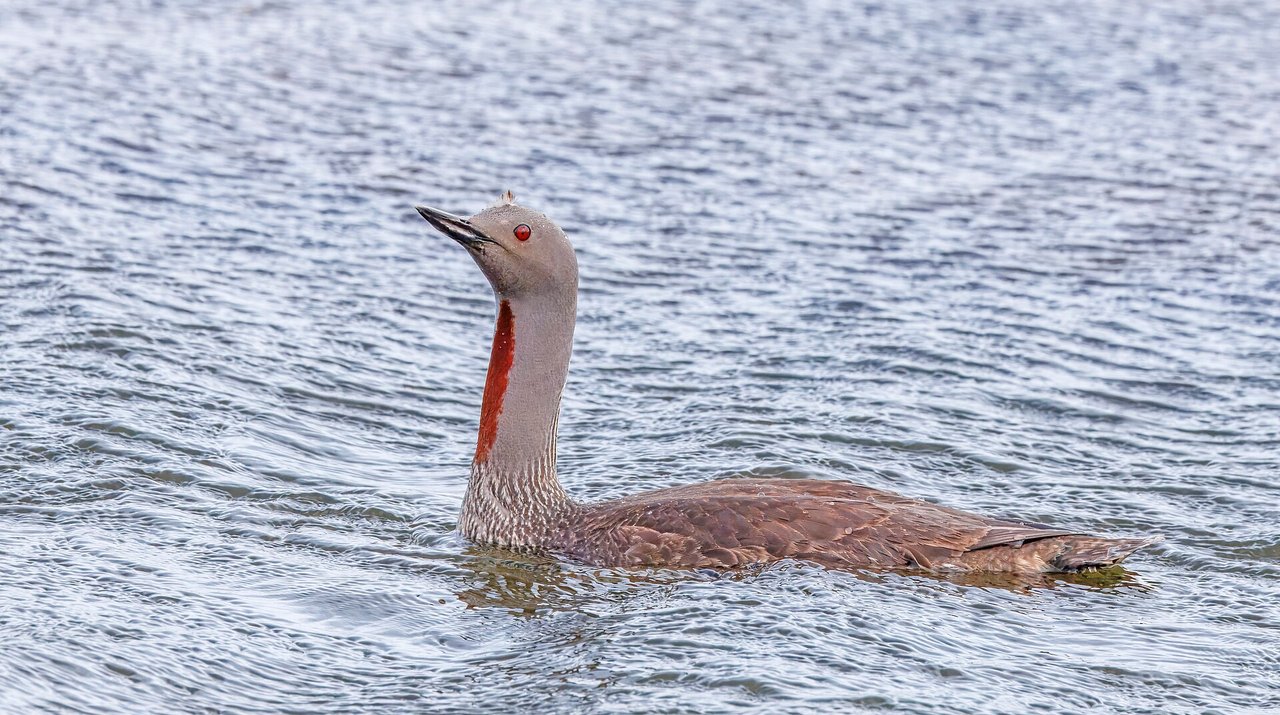
Red-throated Loon
Gavia stellata
Identify the Red-throated Loon by sound or photo and log your sightings with Birdpass.


The Red-throated Loon is the smallest and most widespread loon, breeding across the Arctic and subarctic of the Northern Hemisphere and wintering on northern coasts. In breeding plumage it has a smooth grey head with a dark red throat patch; in winter it is plain grey above and white below. It often nests on tiny ponds and flies to larger lakes or the sea to fish. Some populations are threatened by oil spills, pollution and fishing nets.
Did you know?
- It is the only loon that typically holds its slender bill slightly upturned.
- It can nest on tiny, secluded ponds yet fly out to bigger lakes or the sea to fish.
Voice
About the species
Identification
The smallest loon. In breeding plumage it has a grey head, a clear dark red throat patch, a plain dark back and a white belly. The pale, thin, slightly upturned bill is often held tilted upwards, which helps separate it from Black-throated Loon. In winter it is paler than other loons, with a white face and finely white-spotted back.
Family
Gaviidae
Size
Very large (swan)
Colours
grey, white, red, brown
About the habitat
Breeds on small, secluded forest lakes, bog pools and tundra ponds; feeds on larger lakes, rivers and the sea. Winters on bays, estuaries and near-shore seas.
Diet
Mainly small fish, supplemented by crustaceans, molluscs, aquatic insects and occasionally amphibians, caught in underwater pursuit.
Behaviour
A strong pursuit diver with legs set far back, agile underwater but clumsy on land; it can stay submerged for about two minutes. It often peers underwater with its head before diving. On breeding waters it gives far-carrying wails and goose-like cackling. Pairs are long-term, and both parents build the nest, incubate the usual two eggs and feed the young. In flight it looks hunchbacked, with faster, deeper wingbeats than other loons.
Sources
Photo: Charles J. Sharp, CC BY-SA 4.0 https://commons.wikimedia.org/wiki/File:Red-throated diver (Gavia stellata) breeding Rif.jpg
Sound: Sonothèque ADVL, XC946100, CC0 1.0 https://xeno-canto.org/946100
Text: Wikipedia (English) + GBIF regional observations + Wikipedia (Danish) + FinBIF species descriptions + Wikipedia (Finnish), CC BY-SA 4.0; GBIF occurrence data; Wikipedia: CC BY-SA 4.0; FinBIF: CC BY 4.0; Wikipedia: CC BY-SA 4.0 https://en.wikipedia.org/wiki/Red-throated_loon
 breeding Rif.jpg)