Suomi
 Svenska
 Polski
 Čeština
 Slovenčina
 Norsk
 Dansk
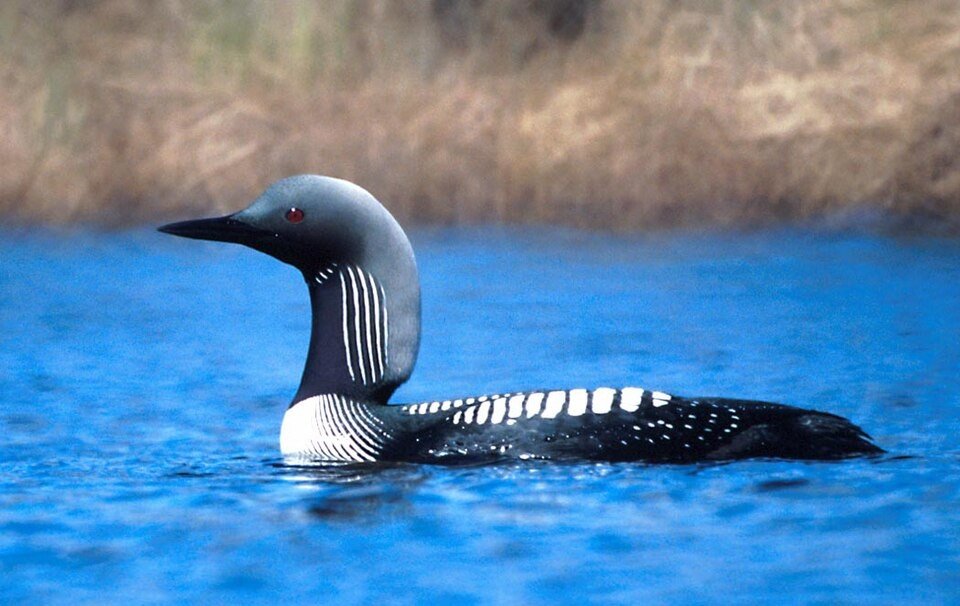
Pacific Loon
Gavia pacifica
Identify the Pacific Loon by sound or photo and log your sightings with Birdpass.


The Pacific Loon is a sleek, medium-sized diver that breeds on tundra lakes across Alaska, northern Canada and eastern Siberia and winters at sea, mainly along the Pacific coast of North America. In breeding plumage it has a smooth pale grey head, a black throat with a purplish sheen and a chequered back; unlike the similar Black-throated Loon, it lacks a white flank patch. It is a very rare vagrant to Europe.
Did you know?
- To get airborne it needs a long runway of open water, often 30–50 m.
- It was formerly considered the same species as the Black-throated Loon.
About the species
Identification
Length 60–68 cm, wingspan 95–115 cm; slightly larger than Red-throated Loon but smaller and daintier than Black-throated Loon. The head is smaller and more rounded, there is less white on the rear flanks (no white flank patch), and the throat sheen differs from Black-throated Loon's. In winter it often shows a thin dark “chinstrap”.
Family
Gaviidae
Size
Very large (swan)
Colours
black, white, grey
About the habitat
Breeds on tundra lakes and pools; winters on coastal seas, bays and sounds and occasionally large inland waters.
Diet
Mainly small fish caught by pursuit diving, also crustaceans and other aquatic invertebrates. Flocks sometimes forage cooperatively, driving fish shoals towards the surface.
Behaviour
Most vocal in spring and summer, giving harsh calls and haunting wails. Pairs are monogamous and fiercely territorial, attacking intruders with stabbing dives, and nest right at the water's edge; adults often carry small chicks on their backs. Unlike most loons it may migrate in flocks.
Sources
Photo: Tim Bowman, USFWS, Public domain https://commons.wikimedia.org/wiki/File:PacificLoon24.jpg
Text: Wikipedia (English) + GBIF regional observations + Wikipedia (Danish), CC BY-SA 4.0; GBIF occurrence data; Wikipedia: CC BY-SA 4.0 https://en.wikipedia.org/wiki/Pacific_loon