
 Suomi
 Svenska
 Polski
 Čeština
 Slovenčina
 Norsk
 Dansk
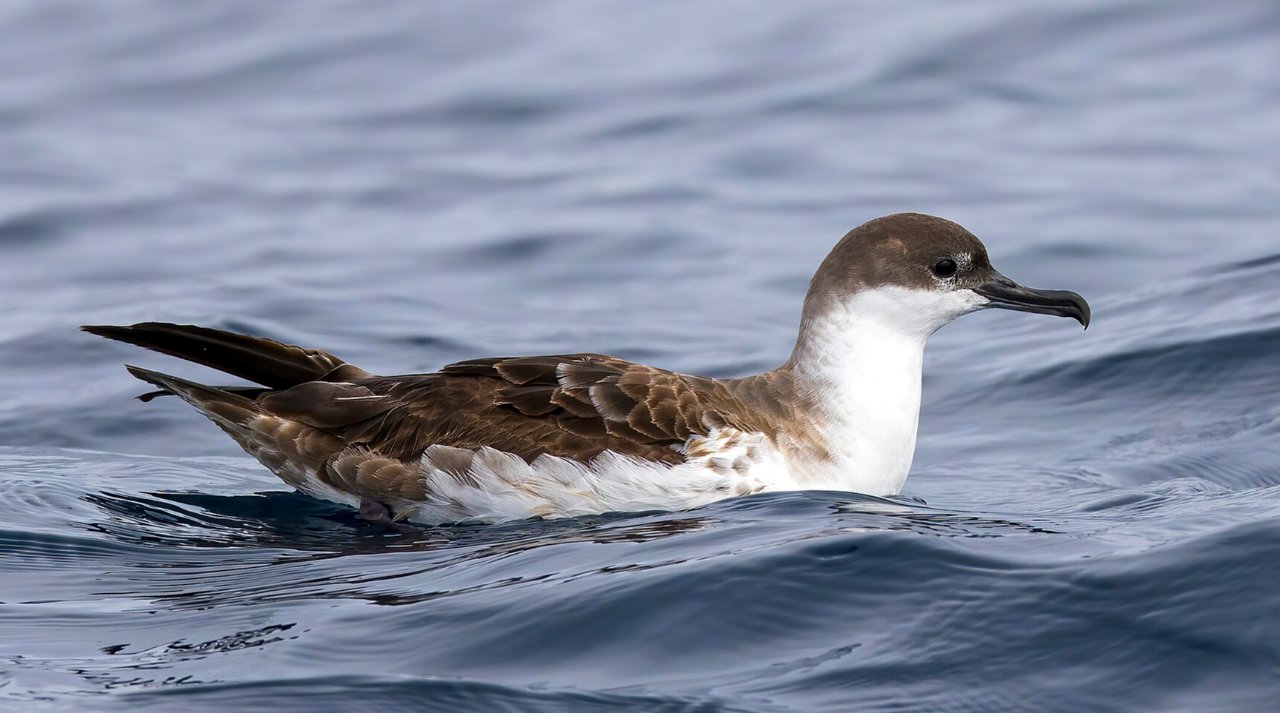
Great Shearwater
Ardenna gravis
Identify the Great Shearwater by sound or photo and log your sightings with Birdpass.


The Great Shearwater is a large, ocean-going seabird with dark upperparts, white underparts with a brownish belly patch, a dark cap and a white horseshoe at the base of the tail. It breeds in vast colonies on remote South Atlantic islands such as Tristan da Cunha and Gough and after breeding makes a huge loop through the Atlantic – north along the Americas, across to European waters in late summer and south along the eastern Atlantic. Its stiff, low, shearing flight over the waves is distinctive.
Did you know?
- It is one of few birds that migrate from Southern Hemisphere breeding grounds to spend the northern summer in the Northern Hemisphere.
- Great Shearwaters are among the seabirds with the highest rates of plastic ingestion.
About the species
Identification
A medium-large shearwater (43–51 cm, wingspan 105–122 cm) with a sharply defined dark cap contrasting with a white collar. It has a dark patch on the breast sides, dark bands on the underwing coverts and axillaries and a diffuse dark belly patch. From above the white uppertail coverts form a pale horseshoe; the undertail coverts are grey-brown. The bill is black, the wings pointed and the flight rather stiff-winged.
Family
Procellariidae
Size
Large (crow)
Colours
brown, white
About the habitat
The open Atlantic Ocean; breeds on rocky, grassy South Atlantic islands and ranges widely at sea, off the coasts of the Americas and western Europe during the northern summer and autumn.
Diet
Mainly fish and squid taken from the surface or by plunge-diving and pursuit underwater; also crustaceans and offal from fishing vessels, which it often follows.
Behaviour
Flies with classic shearing flight, tilting from side to side on stiff wings with few wingbeats. Highly gregarious at sea, gathering in large, noisy flocks and following boats. It nests in dense colonies, laying a single white egg in a burrow, and visits the colony at night to avoid predatory gulls.
Sources
Photo: Charles J. Sharp, CC BY-SA 4.0 https://commons.wikimedia.org/wiki/File:Greater shearwater (Ardenna gravis) Sagres.jpg
Text: Wikipedia (English), CC BY-SA 4.0 https://en.wikipedia.org/wiki/Great_shearwater
 Sagres.jpg)