
 Suomi
 Svenska
 Polski
 Čeština
 Slovenčina
 Norsk
 Dansk
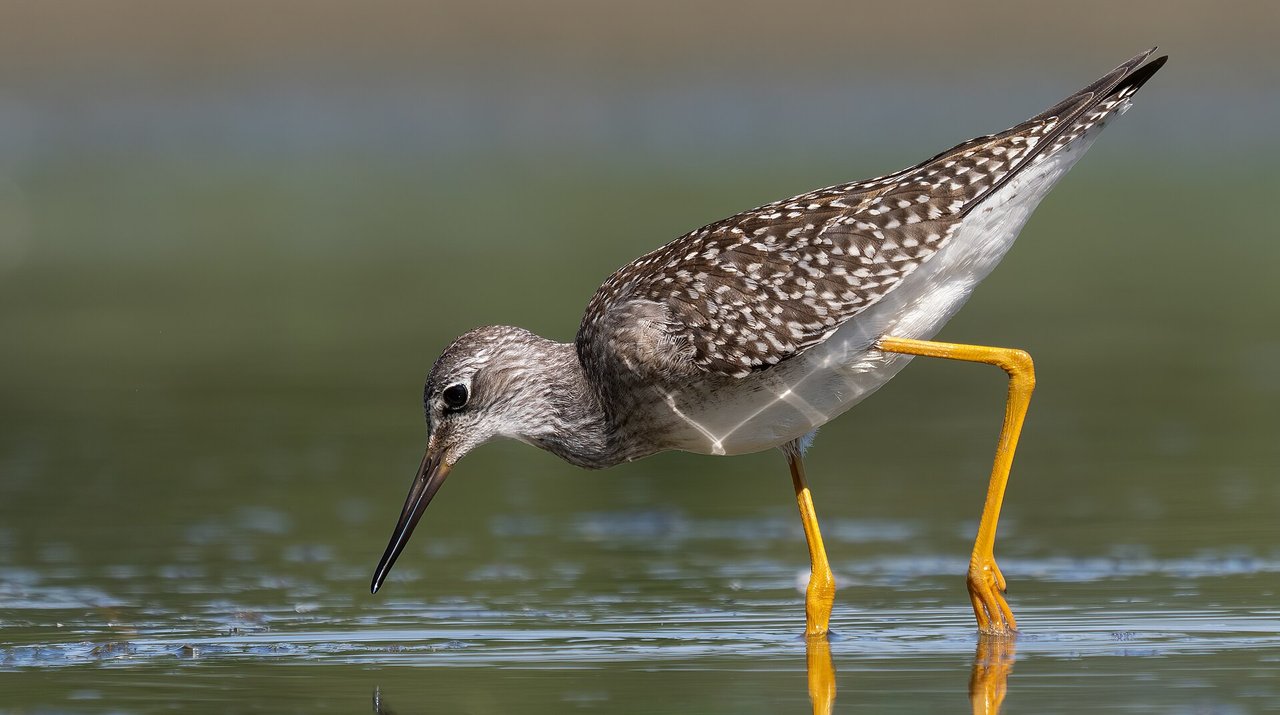
Lesser Yellowlegs
Tringa flavipes
Identify the Lesser Yellowlegs by sound or photo and log your sightings with Birdpass.


The Lesser Yellowlegs is a slender North American wader named for its bright yellow legs. It breeds in the boreal forest from Alaska to Quebec and winters from the southern United States to southern South America. It closely resembles the Greater Yellowlegs but is smaller, with a slim, straight, dark bill about the length of the head and a softer call. It is a regular but rare vagrant to Europe.
Did you know?
- Despite its looks, it is more closely related to the Willet than to the Greater Yellowlegs.
- It was described by Johann Friedrich Gmelin in 1789.
About the species
Identification
About 24 cm long and weighing 50–110 g. It has long yellow legs and a thin, straight, dark bill about as long as the head. The upperparts are grey-brown with pale spots, the underparts pale with fine streaking on the neck and breast; in flight a white square rump shows. It is clearly smaller than Greater Yellowlegs with a relatively shorter, straighter bill, and larger and longer-legged than Wood Sandpiper.
Family
Scolopacidae
Size
Medium (thrush)
Colours
grey, white, brown, yellow
About the habitat
Breeds in open clearings, bogs and wet meadows near ponds in the boreal forest; on migration and in winter mudflats, marshes, lagoons and flooded fields.
Diet
Mainly small invertebrates – flies, beetles, water boatmen, mayflies, worms, crustaceans and molluscs – as well as small fish and seeds, picked briskly from shallow water and mud.
Behaviour
Wades in shallow water with a brisk, high-stepping gait, picking and jabbing and making short dashes. It nests on the ground near water in the boreal forest; both parents incubate and tend the chicks, and they boldly mob predators together.
Sources
Photo: Rhododendrites, CC BY-SA 4.0 https://commons.wikimedia.org/wiki/File:Lesser yellowlegs (32690).jpg
Text: Wikipedia (English) + GBIF regional observations + Wikipedia (Finnish), CC BY-SA 4.0; GBIF occurrence data; Wikipedia: CC BY-SA 4.0 https://en.wikipedia.org/wiki/Lesser_yellowlegs
.jpg)