Suomi
 Svenska
 Polski
 Čeština
 Slovenčina
 Norsk
 Dansk
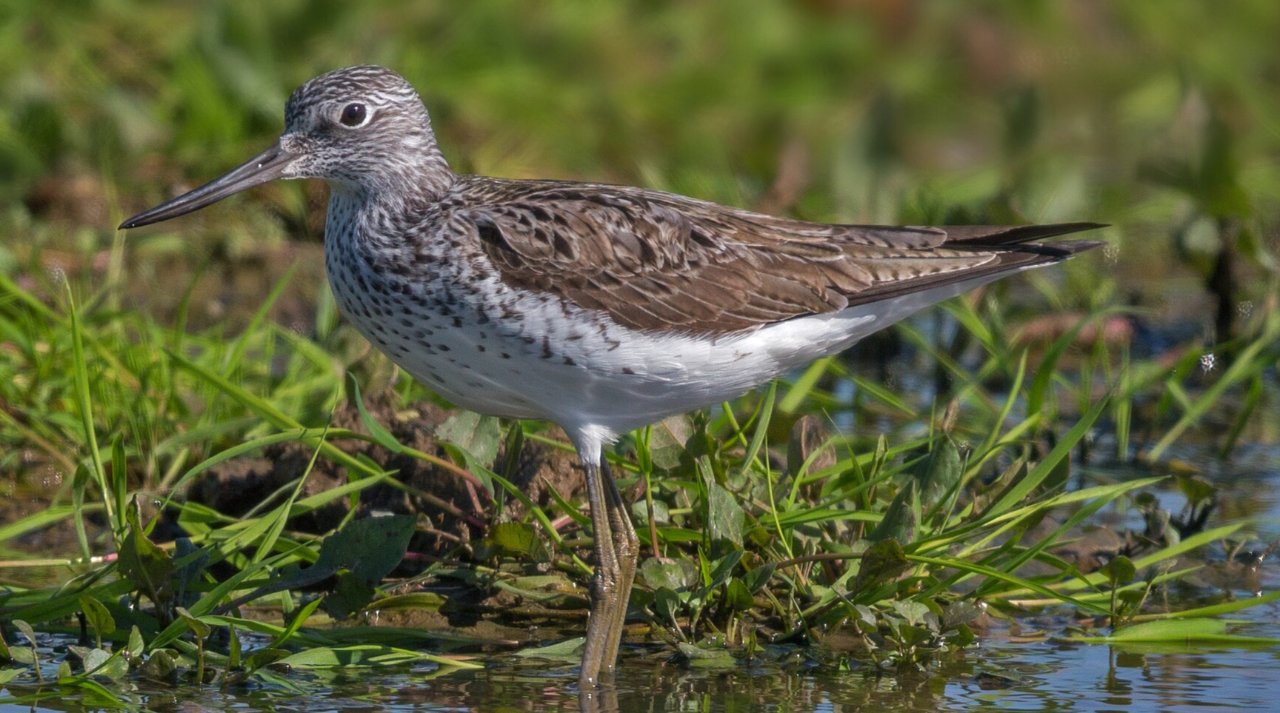
Common Greenshank
Tringa nebularia
Identify the Common Greenshank by sound or photo and log your sightings with Birdpass.


The Common Greenshank is a large shank of the subarctic, breeding on bogs and forest mires from north-west Europe across the Palearctic and wintering in Africa, South Asia and Australasia. It has long greenish legs, a long, slightly upturned bill and a white wedge up the back visible in flight. Its loud, ringing three-note call is familiar on wetlands. Breeding birds are brown and crisply marked, greyer in winter.
Did you know?
- Its name nebularia comes from the Latin for “mist”, after its damp haunts.
- Its three-note call is often written “teu-teu-teu”.
Voice
About the species
Identification
A large shank, grey-brown in summer and pale grey in winter. The long legs are greenish and the long bill slightly upturned. In flight a white wedge runs from the rump up the back. The call is a loud, ringing “tew-tew-tew”. It is larger than Wood Sandpiper and lacks the red legs of Common Redshank.
Family
Scolopacidae
Size
Medium (thrush)
Colours
grey, white, brown, green
About the habitat
Breeds on open bogs and forest mires, often near conifer forest; on migration and in winter estuaries, coasts and all kinds of inland wetlands.
Diet
Mainly small invertebrates such as insects, worms and crustaceans, as well as small fish and amphibians, which it may chase actively in shallow water.
Behaviour
Wades in shallow water, probing or sweeping its bill and sometimes running after small fish; often alone or in small groups. When disturbed it takes off with a loud, sharp three-note call and strong, direct flight. It nests in a ground scrape on dry ground near bogs, often beside a stone or log, laying about four eggs.
Sources
Photo: Andreas Trepte, CC BY-SA 2.5 https://commons.wikimedia.org/wiki/File:Common-Greenshank.jpg
Sound: Sonothèque ADVL, XC730780, CC0 1.0 https://xeno-canto.org/730780
Text: Wikipedia (English) + FinBIF species descriptions + Wikipedia (Finnish), CC BY-SA 4.0; FinBIF: CC BY 4.0; Wikipedia: CC BY-SA 4.0 https://en.wikipedia.org/wiki/Common_greenshank