
 Suomi
 Svenska
 Polski
 Čeština
 Slovenčina
 Norsk
 Dansk
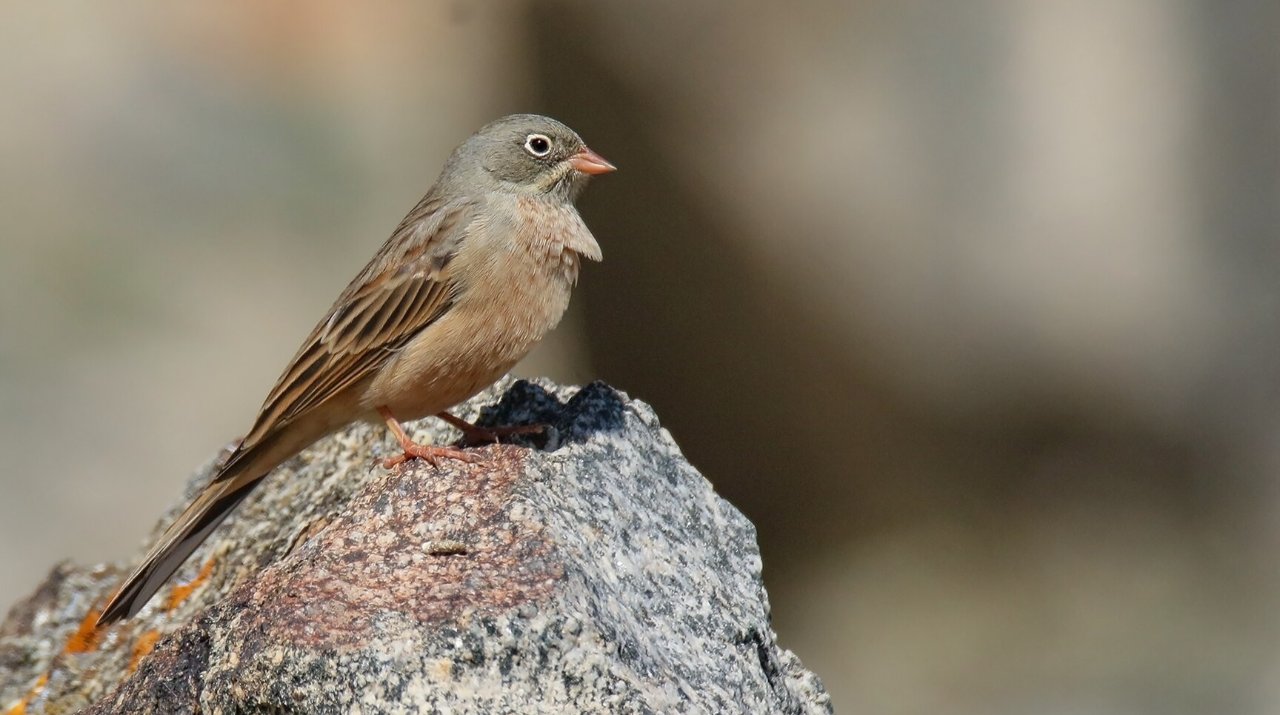
Grey-necked Bunting
Emberiza buchanani
Identify the Grey-necked Bunting by sound or photo and log your sightings with Birdpass.


The Grey-necked Bunting is a small, pale bunting of dry, open country across Central Asia, breeding from the Caspian region to the Altai and migrating south for the winter. Males show a grey head with a neat white eye-ring and a pinkish bill, while females are plainer. It often gathers in small flocks outside the breeding season and winters mainly in West and South Asia.
Did you know?
- Edward Blyth described the species from a drawing by Francis Buchanan-Hamilton, for whom it is named.
- It is a very rare vagrant north of its range and may be overlooked because it resembles the Ortolan Bunting.
About the species
Identification
A slim bunting; the male has a greyish head and nape, warm brown upperparts and a fairly fine, pinkish bill. Females and young are sandier and less contrasting. Told from Ortolan Bunting by its slimmer build, clearly grey head and lighter bill; Ortolan is larger and more coarsely streaked. Compared with Cretzschmar's Bunting its head pattern is more subdued and its overall tone greyer, whereas Cretzschmar's has a rusty throat and more contrasting head.
Family
Emberizidae
Size
Small (sparrow)
Colours
grey, brown, white
About the habitat
Dry, open, stony hillsides with scattered scrub and temperate grasslands; in winter weedy and stubble fields.
Diet
Mainly seeds, with small insects especially in the breeding season; it forages mostly on the ground in open, weedy places.
Behaviour
Usually in small flocks outside the breeding season. It nests on the ground and sings from exposed perches, giving a short, metallic jingle; in winter it gives a subdued clicking call.
Sources
Photo: Imran Shah from Islamabad, Pakistan, CC BY-SA 2.0 https://commons.wikimedia.org/wiki/File:Grey-necked Bunting (Emberiza buchanani) (31793472228).jpg
Text: Wikipedia (English), CC BY-SA 4.0 https://en.wikipedia.org/wiki/Grey-necked_bunting
 (31793472228).jpg)