
 Suomi
 Svenska
 Polski
 Čeština
 Slovenčina
 Norsk
 Dansk
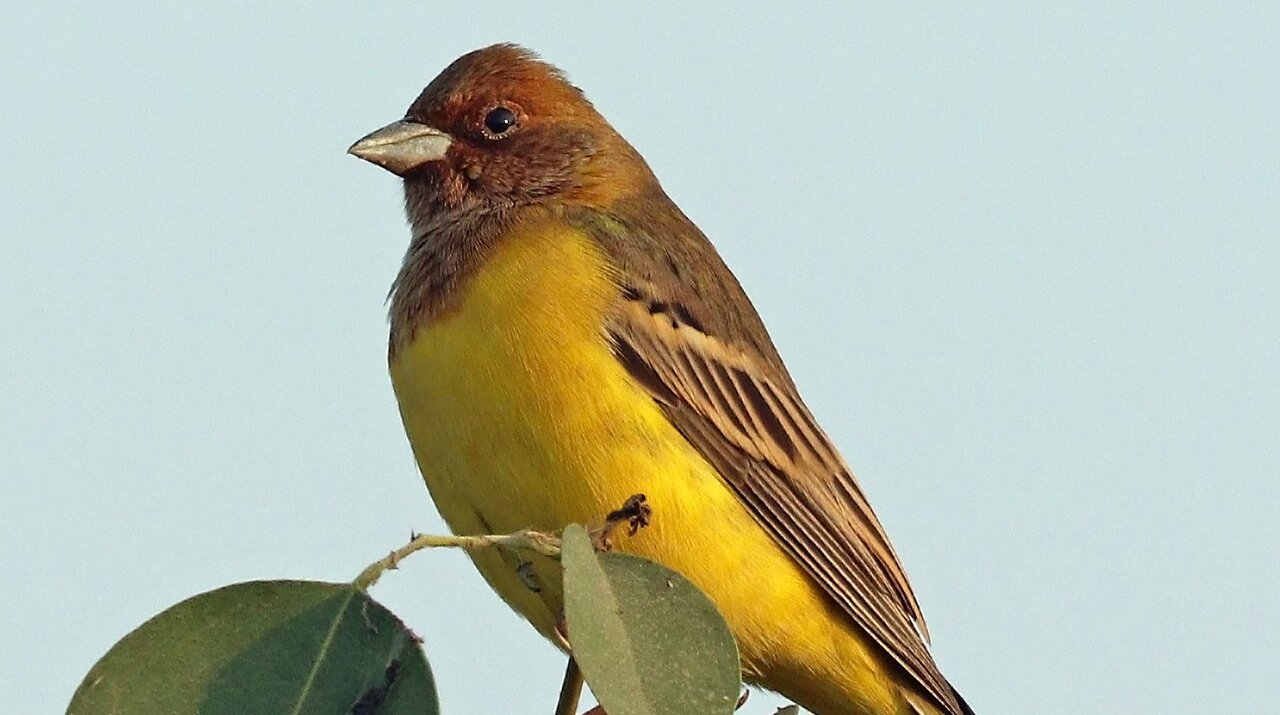
Red-headed Bunting
Emberiza bruniceps
Identify the Red-headed Bunting by sound or photo and log your sightings with Birdpass.


The Red-headed Bunting is a migratory bunting that breeds across Central Asia and winters mainly in India. Breeding males are striking, with bright yellow underparts, greenish upperparts and a reddish-brown head and breast, while females and juveniles are much duller and hard to tell from Black-headed Bunting. It breeds in open scrub and farmland and is a rare visitor to western Europe, where escapes from captivity have complicated its status.
Did you know?
- In western Europe its status is muddled by escapes from captivity, as it was once commonly kept as a cage bird.
- In winter huge flocks can cause damage to grain crops in India.
About the species
Identification
The breeding male has yellow underparts, a reddish-brown head and throat, a greenish, streaked back and a yellowish rump. Females and young are very similar to those of Black-headed Bunting and often cannot be identified in the field. Compared with male Black-headed Bunting, the male Red-headed has a brown rather than black head.
Family
Emberizidae
Size
Small (sparrow)
Colours
yellow, red, brown, green
About the habitat
Open, scrubby country and farmland in the breeding season; winters further south on the Indian subcontinent.
Diet
Mainly seeds, switching to insects when feeding young.
Behaviour
A long-tailed, migratory bunting that often sings a jerky song from a high perch. It breeds in scrub and farmland, placing its nest in a bush or tree and laying three to five eggs. In winter it gathers in large flocks in cereal fields.
Sources
Photo: Charles J. Sharp, CC BY-SA 4.0 https://commons.wikimedia.org/wiki/File:Red-headed bunting (Emberiza bruniceps) male non-breeding plumage.jpg
Text: Wikipedia (English), CC BY-SA 4.0 https://en.wikipedia.org/wiki/Red-headed_bunting
 male non-breeding plumage.jpg)